


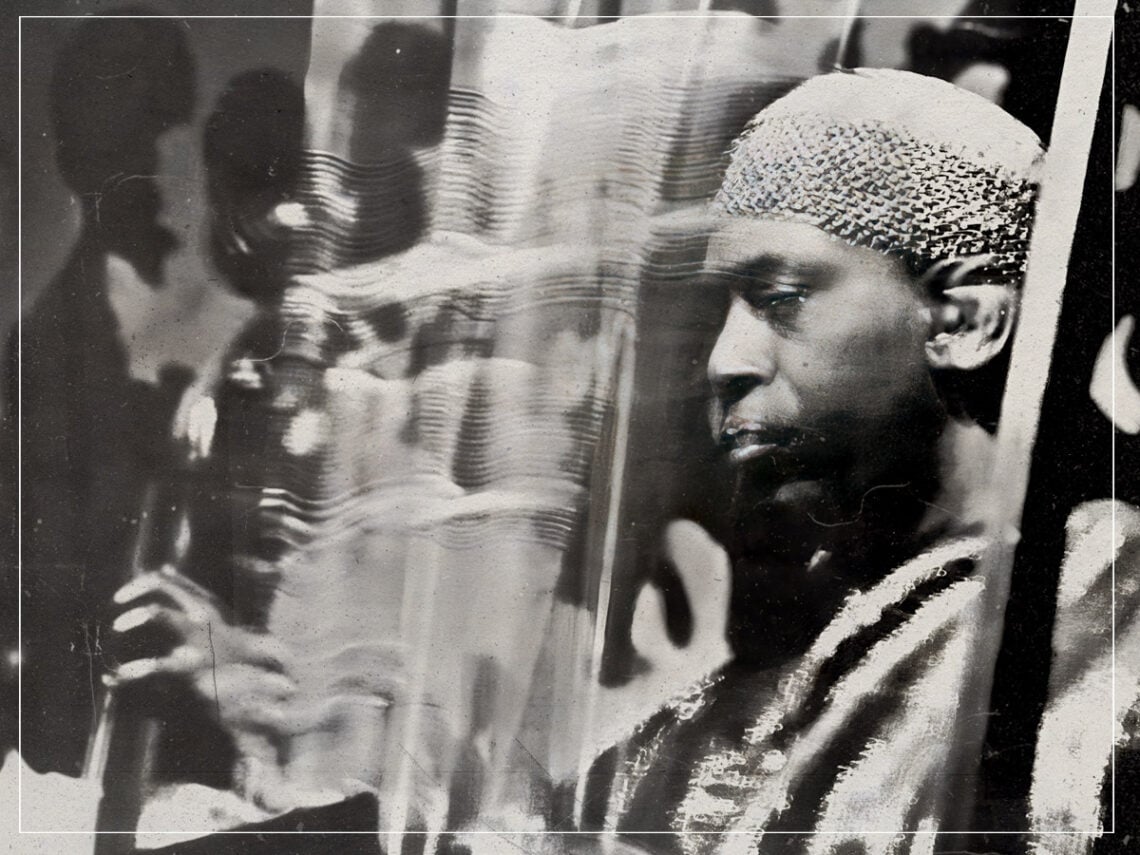
“It doesn’t get more avant-garde”: The night Sun Ra and John Cage jammed

We’ve all heard of some of the strangest collaborations in music, like the joint sessions of Nick Cave and Kylie Minogue or Pavarotti’s live performance with Spice Girls. However, do any of these hold a candle to the joining of forces between Sun Ra and John Cage? In other words, could the world have predicted the convergence of an off-kilter avant-garde jazz innovator and an unconventional classical composer?
While Cage took a somewhat unconventional approach to music, often utilising strange objects or even silence to create strange sounds, rhythms, and atmospheres, his creations centred around the boundaries between life and art. Often, he would toy with tradition in a way that felt entirely unsettling to challenge what it meant to create the most open-minded and open-ended structures.
For instance, perhaps one of his most famous creations, ‘4’33’, has become one of his most revered purely because of his innovative approach. For the entirety of the piece, which spans four minutes and 33 seconds, Cage instructed his performers not to play their instruments. This garnered so much controversy that many musicians and music historians went to the drawing board, questioning whether his music could even be described as such.
Still, his convergence with Sun Ra blindsided many, not just because the two names were rarely uttered in the same sentence but because they each came from thoroughly different worlds. Ra, for one, wasn’t often framed in the same world as Cage at all and often explored space-related themes for his broader visions of greater societal equality and justice. He and his band, the Arkestra, innovated jazz sounds and sensibilities and often appeared in futuristic attire to emphasise their otherworldly intrigue.
Moreover, despite his freewheelin’ ways, Cage actually, for the most part, despised experimental music, making his gravitation towards Ra an extremely unlikely occurrence. And yet, in 1986, the pair met in Coney Island for a performance that long brushed the sidelines of musical history like a mythological secret, for a once-in-a-lifetime amalgamation that nearly didn’t happen.
True to their strong-willed and independent natures, the two musicians arrived at the venue separately: Cage, venturing into Brooklyn for the first time in his life, and Ra, driving around somewhere nearby, lost and without directions, unsure if he would make it on time. They previously had no contact worthy of note other than vague remarks about the others’ artistry. Yet, they came together to showcase the magic of their blend to an audience of around two hundred, each eagerly anticipating the collision of their individualistic worlds.
Despite the concert later being available on a double LP, there still seems to be an element of mystery that follows this collaboration through space and time. Maybe this prevailing uncertainty doesn’t stem from the music, however; maybe it’s rooted in the distinctive worlds of two accomplished iconoclasts, somehow coming together in one unlikely convergence. At the same time, the pair almost approached such history-making with a casual finesse, which seems to seep from the core of the performance itself. As Rick Russo, who produced the concert, put it, “When both John Cage and Sun Ra entered the stage together, I had a tremendous sense of relief.”
That said, there is a lot to be said about the circumstances surrounding the entire event. Beyond bridging the gap between Cage’s compositional madness and the philosophical jazz maverick himself, nothing seems more otherworldly than the fact that any of it ever happened in the first place. As Russo later reflected to The Vinyl Factory, “It doesn’t get more avant-garde than having John Cage and Sun Ra ‘meet’ in a converted penny arcade, now a sideshow theatre, in the middle of a legendary amusement park.”
