


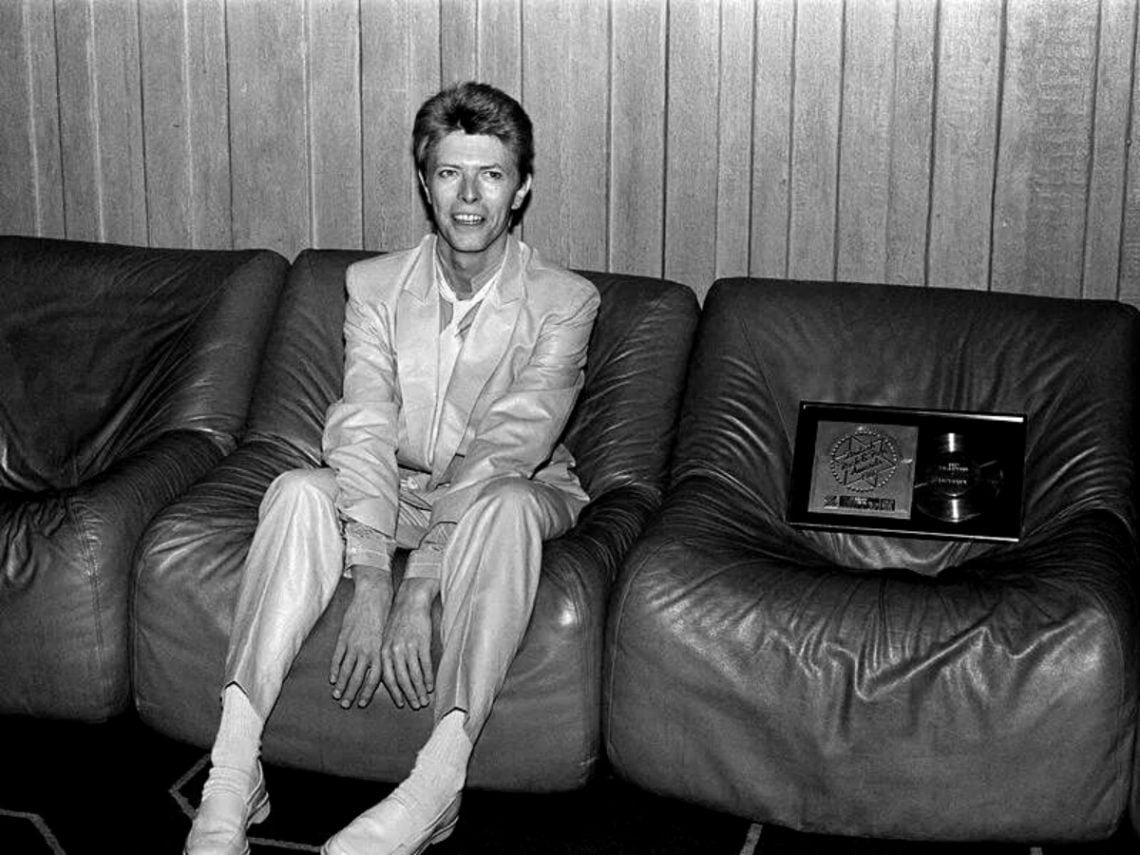
Death and despair on December 9th, 1980: The most harrowing night of David Bowie’s career

On December 9th, 1980, David Bowie stepped out onto the stage at New York’s Booth Theatre to perform The Elephant Man. There were three empty seats in the front row.
“I can’t tell you how difficult that was to go on,” Bowie later declared, still shaken by the memory of it all. “I almost didn’t make it through the performance.”
The night before that show, John Lennon and Yoko Ono were returning to their Dakota Building apartment after leaving the Record Factory studio at around 10:30pm. A limousine dropped them off outside. Yoko Ono quickly shuffled towards the lobby while Lennon collected cassettes of the day’s recordings and a few pieces of equipment.
As he walked towards the entrance Mark David Chapman called out “Mr Lennon”, with all the nonchalant formality of a doctor popping their head into the waiting room, and then fired four shots into the icon’s back, missing with a fifth shot as Lennon began to slump to the ground. Later that same evening, Lennon was declared dead.
An eerie evening at Booth Theatre
The empty seats on the front row of The Elephant Man, the following evening, belonged to Lennon, Yoko Ono and the murderer Mark David Chapman. “I was second on his list,” Bowie later said. “Chapman had a front-row ticket to The Elephant Man the next night. John and Yoko were supposed to sit front-row for that show too. So the night after John was killed there were three empty seats in the front row.”
The three vacant seats provided an unsubtle and garishly harrowing vignette of the tragedy that befell the world less than 24 hours before Bowie emerged onto the stage in an attempt to entertain the shell-shocked people of New York once more. For the grief-stricken ‘Starman’, things were even more visceral that night, given his connection to the deceased and the fact that fate could’ve decreed that he was actually on the receiving end of Chapman’s wrath in place of his friend.
“I was second on his list, the detectives said”, Bowie told Redbeard. Why? Well, the crux of Mark David Chapman’s gripe with rock stars was that he failed to comprehend that they too could be fallible humans.

During the midst of a mental episode, the 25-year-old from Honolulu, Hawaii, who had recently lost his job as a security guard, became obsessed with JD Salinger’s 1951 novel The Catcher in the Rye. Chapman wanted to live his life according to the morals of the iconoclastic protagonist Holden Caulfield.
It is perhaps telling that the phrase that the novel helped to popularise was “screw up”. These days, that term is even in the Oxford English Dictionary, and it comes with the concise definition: “To make something go wrong.”
In that regard, Caulfield would remark in the prose that “people always clap for the wrong things”, but he didn’t provide much cause for applause himself as a character other than calling adults “phonies” and “hypocrites”. This is how Chapman felt about the likes of Lennon and Bowie. He saw them as unjustly celebrated charlatans who corrupted Christian society.
However, perhaps the most telling insight into his motive comes from when the courts accused Chapman of killing The Beatles star as the easy route to fame and asked him if he had anything to say for himself. He didn’t deny their accusation; he simply rose and read the following passage from The Catcher in the Rye:
I keep picturing all these little kids playing some game in this big field of rye and all. Thousands of little kids, and nobody’s around – nobody big, I mean – except me. And I’m standing on the edge of some crazy cliff. What I have to do, I have to catch everybody if they start to go over the cliff – I mean if they’re running and they don’t look where they’re going, I have to come out from somewhere and catch them. That’s all I do all day. I’d just be the catcher in the rye and all.
His wickedness served as an unfortunate portent for those at the heart of popular culture, a portent that tragically stared Bowie in the face as he stepped out on stage and tried to convey the tortured existence of Joseph Merrick in the wake of a brutal catastrophe. As Bowie was rising to new heights of fame, the startling potential consequences stared back at him.
