


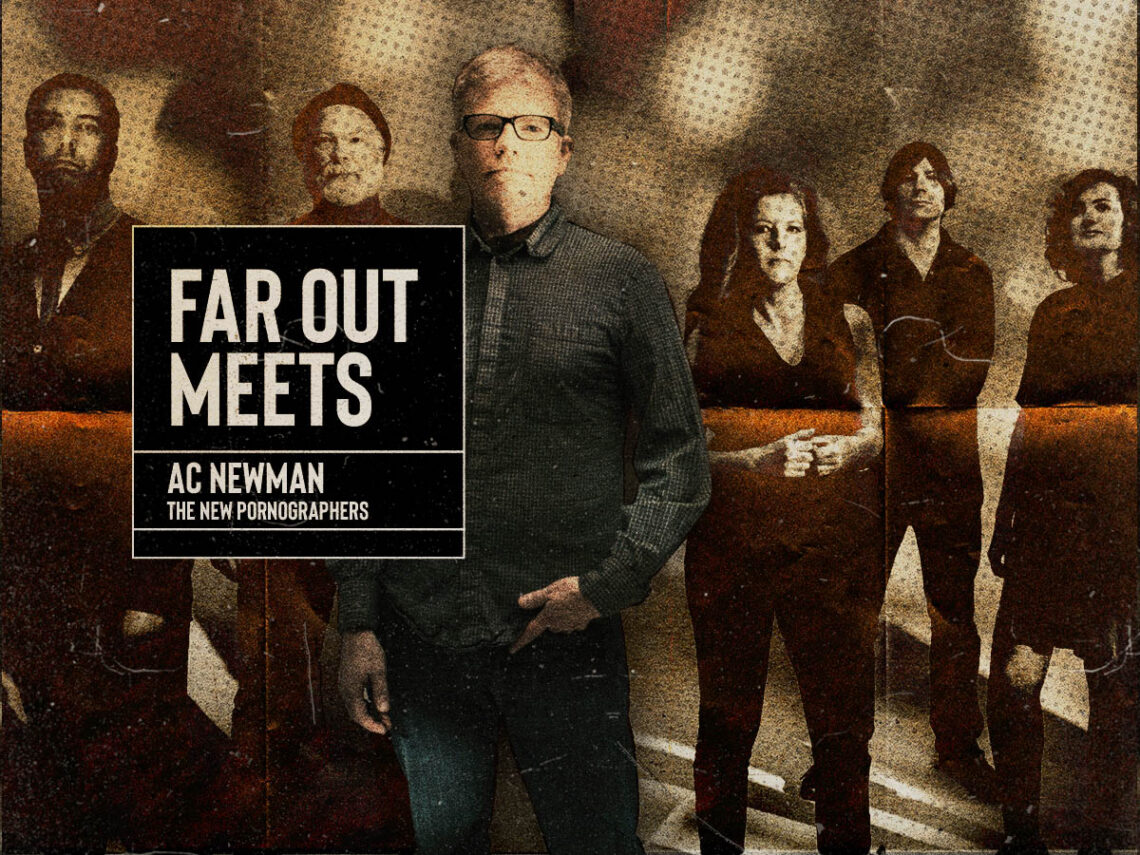
Far Out Meets: The New Pornographers leader AC Newman discusses life in music

When meeting a person whose reputation precedes them, you never know quite what to expect, as often they have the license to take certain liberties. Accordingly, while waiting for a phone call with The New Pornographers‘ leader AC Newman, I was uncertain how things would pan out. After all, this is a man who has spent the best part of four decades honing his craft, masterminding one of Canada’s most influential rock bands and a well-respected solo career.
It was fairly surprising, then, that Newman was perhaps the most amiable individual I’ve had the luck to interview. He didn’t have to be, is all I’m saying. However, only minutes into a winding 40-minute phone call, it became clear that Newman is not your average professional musician, and to be completely honest, our conversation could have carried on for much longer. It was like speaking to a good friend, albeit a much wiser one, admittedly. It also affirmed why The New Pornographer’s music has avoided being trapped by any zeitgeist and has continued to be a place of solace for many of us: sincerity.
We were speaking in advance of the band’s latest album, Continue as a Guest, which arrived on March 31st. The project marked a marvellous return, fuelled by Newman understanding the studio in greater depth than ever before and reappraising how he approaches songwriting and vocal melodies. In addition, the overarching theme is that the band is now at peace with their place in the world after such a long career where multiple periods have come and gone. Unsurprisingly, it sounds like the most refined they have ever been, with contentment permeating the record. Brimming with earworms, sonic textures and lyrical moments coloured by unfettered earnestness, it’s been a welcome surprise amongst a sea of acts perhaps trying a little too hard.
Given that Newman, who I was addressing as Carl for the interview, has spent more of his life as a professional musician than not, he could have been anywhere at the time of the call — and he was.
He was in Wilmington, North Carolina, touring as part of Neko Case’s band – one of the other members of The New Pornographers. Opening our account, customarily, I asked him how he was doing, to which he responded: “I’m in Wilmington, North Carolina, a place I’ve never been.” How was it? Setting our chat’s often comical tone, he quips, “It’s very America. It feels like a giant strip mall so far.”
Listening back to the recording of this section nearly made me fall off my chair. “I can’t imagine what that looks like,” I replied. It might be a paradox, but at this moment, I could hear Newman’s grin from nearly 4,000 miles away. “Lucky. You’re very lucky,” he says deadpan. “You can’t imagine it. Keep your innocence intact”.
Moving from the surreal, almost Hunter S. Thompson-esque account of Wilmington into a genuine downside of touring, Newman says: “It’s that weird thing. When you’re on tour, you just see this weird spot, you see the area where the venue is, but it doesn’t really give you…you don’t always have the best idea of what the town is; you just know the area around the venue.”
Given the scope of his career, this is a sentiment that Newman has harboured for a long time. Perhaps, then, these strange and fleeting experiences in places leave a skewed impression that would otherwise be unfair if he had visited for longer and experienced the full breadth of what’s on offer.
“It’s very true,” he says. “And sometimes, the venue is in an amazing place. There’s a venue we play outside of San Diego that’s right on the ocean. So it always feels like, ‘Oh, this is idyllic’. You know, that’s when you think, ‘I love the touring life; I’m just hanging out on the beach.’ But there aren’t many venues that are a block or two from the beach”. Returning to his current setting, Newman noted that he believes they might be near the water in Wilmington, but if they are, he can’t see it.
Whilst we were on the topic of touring, Newman outlined that when on the road, the bus drives through the night, so you usually get to that day’s destination around 7am. That means that even on show days, there are eight or nine hours to kill. “Just what am I going to do here?” is a question he constantly asks himself, painting a far bleaker picture of a touring musician’s day-to-day.
So, what had he actually been doing with his time in Wilmington? A sobering point emerged, fuelled by years of going through the motions of touring. “Not much,” he starts. “You know, trying to stay sane, trying to write, trying exercise. Trying not to drink. Touring is fun, but I think there’s a point after you’ve done it for years and years where you’re just trying to stay normal. If you treat touring like this is gonna be a big party, that’s a cool way to do it, but it doesn’t work in the long run.” In another amusing but pertinent line, he supposes: “I think it’s killed a few people, actually.”
So now that I was safe in the knowledge that AC Newman wasn’t going out and getting loaded every night, there was another pressing question at hand. Is it different working with Neko Case in her band than when in The New Pornographers? In his answer, Newman stumbled upon what might be the key to The New Pornographers’ longevity and why many bands fizzle out.

“We work pretty well together, and I think we know each other’s boundaries very well,” he tells me. “When I’m playing with her, it’s like, ‘This is your thing. What do you want me to play? Tell me what you want me to do, and I’ll do it.’ I think she feels the same way about The New Pornographers. I think she likes playing with us and that it’s not all resting on her shoulders. It’s the same way I feel when I’m playing with her – ‘Hey, I’ll just show up and do what I’m told.’ You know, I’m not gonna be difficult.”
Newman supposes that the individual members of The New Pornographers having outlets has helped them stay together for so long. “I think when everybody puts everything they got into one band, that can get weird, you know?” Turning to a famous example, he continues: “If you’re the George Harrison in the band and you’re just fighting to get a song on the album, that doesn’t always work out so well.”
There’s not a stringent distinction between projects, though. Newman explains that cross-pollination can occur, where they find they’ve influenced each other. As he’s always looking for new ways of writing – another undoubted reason for his and the band’s longevity – Newman thinks that he’s started to write like Neko over the past couple of years. When stuck for a new creative modus operandi, he asks himself questions like “what does Neko do?” and “what does Dan Bejar do?” Expressing deep gratitude for having associates of such magnitude, he concedes: “I don’t have to move very far outside my circle of friends to find influence.”
This aptly brought us to Continue as a Guest and how Newman’s writing changed between it and its predecessor, 2019’s In the Morse Code of Brake Lights. Over the last few years, he’s sought to move into something more narrative and lyrics based, away from the bizarre lines he thought “sounded cool” à la Brian Eno and David Byrne. Although Neko Case might write what Newman describes as “surreal short stories that you can’t quite place”, there’s still a narrative there, and that’s an area he’s started to explore.
“To me, it’s funny because it seems so obvious, because that’s how most songs are written. Look at most of the classic songs of the last 50 years; they all have that quality. And I thought that if it feels new to me, why don’t I try writing songs in a more classic style?”
Has this new tact opened The New Pornographers leader up? He certainly thinks it has. “It actually has, in a way. I mean, the funny thing is that this record, Continue as a Guest, feels like the first chapter or two in this bigger record that I’m making. There are still a tonne of songs that I’m trying to finish right now that I was working on concurrently with Continue as a Guest. I’m now thinking about how to write, and I found it’s a real breakthrough just to figure out what the song is about. That’s such a hard thing.”
“I don’t write the lyrics first. It starts with music. So, I have these chords and melodies and have a song, but it’s essentially instrumental. Then, even though it has a melody, it is a breakthrough when I figure out what the song is about. I feel like it makes everything a lot easier,” he explains. “So now, my approach with every song is ‘OK, what is it about? Before you go any further, what is the song about?’ Sometimes it’s just a few words or just one sentence, and once you figure that out, it’s like, OK, the rest of it is pretty easy”.
As this new approach to songwriting has been an enlightening shift for Newman, it also came with its heavier, more profound moments. During his latest creative metamorphosis, he realised that the subjects he wants to sing about are not usually the happiest. “That’s why there are so many sad songs in the world,” he states. In one of the conversation’s most weighty comments, he enquires: “How much can you say about being happy?” There’s much more to say about being grateful, he posits.
Despite this realisation of his penchant for the solemn, Newman’s newfound approach has made things more enjoyable, with him “so proud” of his sad songs.
Things then took a more philosophical turn, with me looking to the eminent Milan Kundera and asking Newman if songs contain more substance when they’re sad. Traditionally, they do, he says. However, he counters this by noting that there have been many optimistic songs throughout history that contain weight. These are mostly about hope and faith, with an undercurrent that not everything is “super great”. For example, he named Sam Cooke’s 1964 classic ‘A Change Is Gonna Come’. Famously, the song is both moving and moderately optimistic, but there’s the subtext that change hasn’t come yet.
It was an interesting point, as Continues as a Guest is brimming with profound moments wrapped in lighter music. Take the musically ethereal single, ‘Really Really Light’, for example. It contains the line: “What were the odds on this bait and the switch / Knowing your choices was the pantheon or the ditch”. A stark comment seemingly about this game we call life; I was intrigued to know what was behind it.
Newman explains: “I was thinking about what it’s been like to make the choice of, ‘I’m a musician; this is what I do.’ I’ve always felt like when you’re a musician, you’re either a hero or zero. Before you get successful, and you’re the guy carrying around your guitar case, people just think you’re a loser, like, ‘Oh, you’re a musician huh?’ But then, all of a sudden, you have some success. And it’s like, ‘Oh, you’re awesome. Look at you. You’ve made all your dreams come true.’ I realised I didn’t really have a choice there.”
It was here that Newman hit another six. When writing the song and line in question, he was contemplating a quote by the late postmodern author William Gaddis, the man behind The Recognitions. “A great writer,” Newman says. “Somebody asked him about the writing life when he was in his 60’s or whatever, and said, ‘What’s it like to be a writer?’ And he said, ‘Well, it’s too late to be any of the things I never wanted to be, so I guess I’m doing fine.'”
Newman acknowledges that to do what he does takes “a certain amount of delusion”. In his mind, he always has to be shooting for the Pantheon. Even if he fails and ends up in the ditch every time, he’s compelled to aim as high as possible. Does this stem from natural competitiveness? No, it just seemed logical, he explains. “If you’re going to do something, you want to be the best. Even if you know you aren’t, it’s still worth going for gold. It’s like that Belle and Sebastian song, ‘Get Me Away From Here, I’m Dying’,” he says: “Nobody writes them like they used to / So it may as well be me”.
Our conversation took many twists and turns. One of the most compelling stops concerned Newman’s home in Woodstock, New York. Discussing its obvious connections to the counterculture, The New Pornographers leader painted a vivid image by explaining that he occasionally sees Steely Dan’s Donald Fagen and The Fugs’ Ed Sanders around, as well as several other big names from the era. However, things are changing there, and a new breed has come to town. Apparently, he tells me, Four Tet lives down the road. Elsewhere, Newman’s heightened familiarity with the studio was analysed, as was the role osmosis played in finding his way, as he’s “still not truly a tech guy”.
So what does Continue as a Guest actually mean? In a press release, Newman talks about how the title feels very apropos for our times. It and the title track allude to not feeling part of the zeitgeist, and being happy to be separate from it, living a simple life and experiencing “a long fade out”. On the face of it, this point seems fairly bleak, regardless of Newman admitting he tends to write about sad topics. Yet, was it a throwaway comment?
Not at all. This is how Newman honestly feels. He doesn’t know if he put it well, but he thinks he always wants to make music. Although, he doesn’t want to constantly worry about the business side of things. Here, the sentiment of the title and album comes into play. It’s only about the music. It always was and always will be. This is why Newman is still incredibly cordial even after all his creative triumphs.
He concludes: “I don’t want to always worry about the career. So like, at this point in my life, I find myself being as idealistic as I’ve ever been about all things creative. I feel excited about the idea of writing more songs and improving and getting better. But there’s this whole side of it that’s also your job, and you have to figure out the business. And that’s the part where I think, ‘continue as a guest’. I’m happy to be the guy that writes songs and makes music. But you know, the whole business… The idea of fame and money, and your reputation or whatever. That part, I feel like I’m just at peace with. Let it all fall where it may, you know.”
Whilst the idea behind Continue as a Guest stems from AC Newman’s personal experiences and career, the idea of being at peace is something we could all do with hearing in such dark times. As is the latest album by The New Pornographers.
