


The mystic origins of Goat: “What happens in Korpilombolo stays in Korpilombolo”

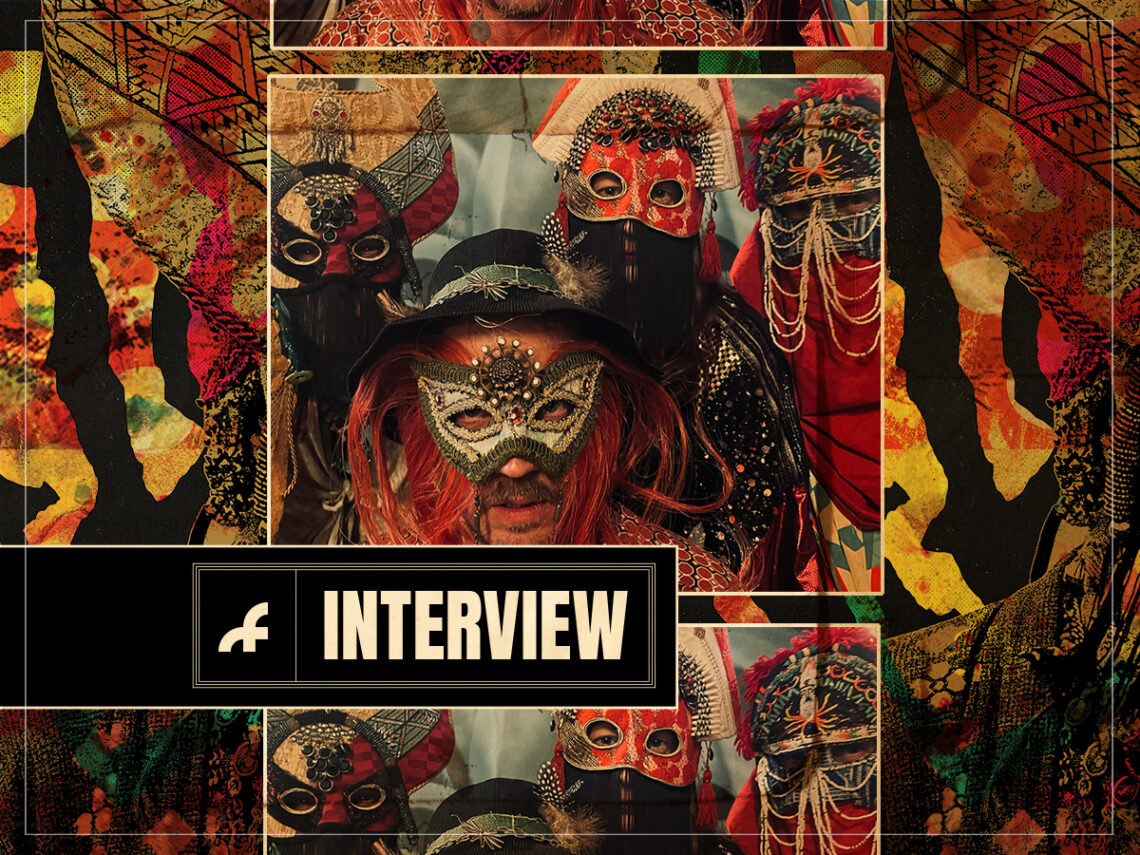
The Northern Lights swirl above a snow-dusted church spire, casting the green-purple hue of a week-old bruise amid the blackness of midnight’s twinkling firmament. All seems peaceful in the picturesque Swedish town of Korpilombolo, slumbering beneath a dazzled Arctic sky. Nearby, a car mechanic in a shamanised chimp mask pounds a turnip off a drum, trying to ward off the Christian curse that was cast on the quaint village in the late 1500s. This is where Goat, one of the best bands of this century, hail from, obviously.
At the last census check, its population only hit 529 inhabitants. Yet, it seems fitting that this minuscule oddity near the Finnish border has produced a heavy hitter in today’s psychedelic scene. On the surface, Korpilombolo is a typical falu red Swedish town, its buildings’ scarlet complexion the product of hundreds of years of copper mining. But delve into its strange lore and stay around long enough to see its rituals unfurl, and you’ll be privy to one of the most bohemian settlements in Europe. “It’s a very psychedelic place,” the band tell me.
Legend has it that one evening, when the snow was falling as thick as a vicar’s dandruff, and the wind roared in an angry language of its own, a strange man arrived in Korpilombolo. The weird fellow, as would become immediately apparent, was a witch doctor. Little is known of this man, where he came from – a mystery unto itself given that many of the practices handed down seem to originate from 12,000kms away in Tanzania – or what his intentions in the village were, but his legacy still looms large.
As the band explain, they grew up around “rituals and stuff beyond imagination”, though there’s a vagueness when the masked group are pressed on the particulars. “‘What happens in Korpilombolo stays in Korpilombolo’ is an old saying,” they add. For the most part, that pertains to playing soccer and listening to music, but look in the nooks and crannies, or anywhere in the open at the right time, for that matter, and the lingering leverage of the witch doctor still abounds.
Its place in the culture of Korpilombolo is proof of that which you try to quash often merely condenses. When Christian missionaries arrived shortly after the witch doctor departed, like a cartoon caper of revolving doors, they were horrified by the ungodly village and their percussive ceremonies. They razed the place to the ground and then cursed it for good measure as a symbol of the wrath of their actually very forgiving god.

But this only plunged the hardy residents deeper into psychedelia—harnessing its emancipating power to produce Goat, the culminating band of blistering sonic enlightenment, who soon got a sniff of success and settled in the cafes, bars and mortgaged suburbs of Gothenburg. Alas, they did not abandon the lore of their lands, commenting, “The place has surely influenced our music by simply being an open-minded haven”. And now it has delivered perhaps its crowning masterpiece in their latest album, fittingly titled Goat.
The record—as the title suggests—sees the band delve back into the origins of Goat, exploring what it means to be Goat in this mad world. They harness the power of the all-accepting hometown that raised them, a place where they “can rest their souls from this world’s irrational human behaviour”.
Was the volley of jubilation that reverberates from this backwards gaze a response to the world’s startling present? “Not a conscious reaction—but maybe an unconscious one. I don’t know because if it is, we are not aware of it. But you are right that these times are heavy. I’m not sure why this heavy feeling has a grip on people, making them feel so lost at the moment,” Fuzzface muses.
“Some lack of hope for the future that leads to a certain resignation,” the masked musician continues. “Something tells me that this is how it looks before something bad happens. That needs to happen to start something good and new I guess. It’s our belief that art and music are very important now to show off the many meanings of being alive”. Whether this wisdom hails from a mystic ancient witch doctor or not, it certainly reverberated in the life-affirming lambast of their latest album.
It might welcome some “hip hop influences” into their unique sound and delve into the orphic world of “The Tarot”, but above all, the album finds Goat facing up to being Goat—not only a brilliant band but a boho commune of its own. “It’s kind of a home with friends and a place to be free and creative,” they say of the band at this stage, now six albums in. “It is also a way to give our contribution to humanity and to a positive evolution”.
They do this “by bringing some joy through” their music. “It is not much, but it’s what we can do and we understand that it is what we are here for”. It is their decree, perhaps as laid out by a strange travelling man who arrived in a summer snowstorm many moons ago—and that mad bastard couldn’t help but be proud as punch about the masterpiece that is Goat, a record that could save the world on a good day.
