


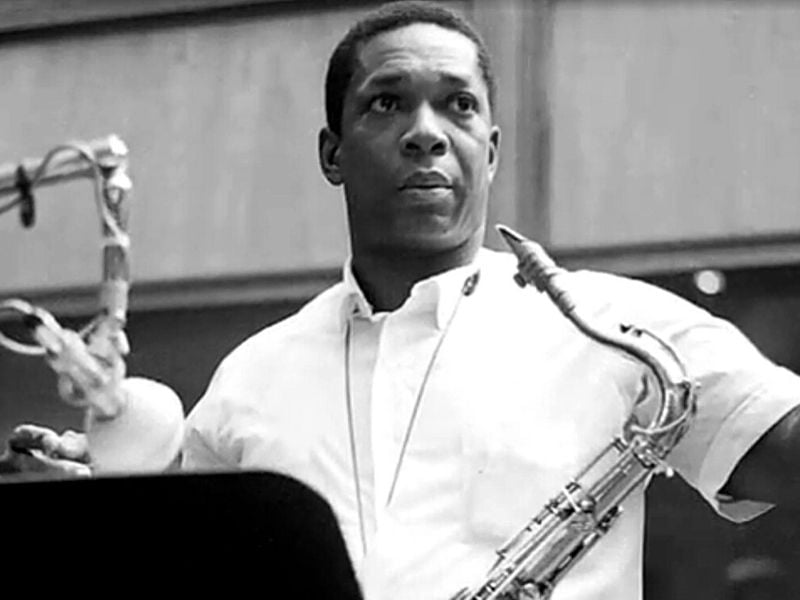
The mystery of John Coltrane’s unsolvable musical code

When we talk about the existence of genius in the world of music, one name that gets thrown into the discussion more often than not is that of John Coltrane. Even those who only have a minor interest in jazz music either recognise his brilliance or have heard others around them who are more knowledgeable in the field discuss the importance of his work as a saxophonist, composer and bandleader enough times to understand how people feel about his work. He is, undoubtedly, one of the greatest musical minds to have ever lived, and there have been few since him who have even come close to having been blessed with the same abilities.
It is quite common for other jazz musicians to be decorated with the same sort of praise, and when you consider the achievements of artists like Miles Davis, Ornette Coleman and John Coltrane’s wife, Alice Coltrane, their grand ambitions to push jazz and music in general to greater limits can be heard across their releases. There’s plenty of good reason their names are also regularly thrown up in the air as being prodigies in the same context.
Many will be aware of the spiritual masterpiece that is A Love Supreme or have seen various video essays that attempt to break down the theoretical aspects of his famous 1960 composition ‘Giant Steps’, but there are so many other releases, compositions and contributions to music that Coltrane made during his life that are proof of his brilliance. The emphatic bebop of Blue Train is about as remarkable as an early career statement can get, and his voyage into the world of flamenco on Olé Coltrane in 1961 is a stunning left turn in a career full of surprises. Coltrane’s compositions and arrangements were so complex yet managed to be so moving and emotive at the same time.
His genius as a musician is undeniable, but there is enough to suggest that he was also a genius in other regards, one who displayed a keen interest in maths and physics, and their interconnectedness with music. There are many elements to music where numbers and counting very clearly come into play, such as with rhythm and metre, but the ideas that Coltrane conjured up were stretching beyond that and tying aspects of musical theory to geometry, and he seemingly made light work of it despite its intricate presentation.
Heavily based on the pre-existing ‘circle of fifths’, a wheel-like diagram that demonstrates the relationships between different key signatures by visually showing how far away from each other they are, the saxophonist created the ‘Coltrane Circle of Tones’, which was also greatly inspired by his study of Indian classical music and the works of esteemed physicist Albert Einstein.
Rather than demonstrate the connections between the twelve notes of a chromatic scale and their notation, Coltrane’s circle goes even deeper into an inner ring that shows a whole-tone scale, while the outer ring displays the notes of a hexatonic scale, with lines running between them all to demonstrate the ways in which each part of these separate scales can be linked in a musical sense. It’s incredibly confusing for anyone not well versed in music theory, but it is an intuitive drawing that shows just how much of a link there is between music and maths.
Coltrane’s music is no more connected to maths than that of others. Still, his understanding of why his music was so connected to mathematical theorems separates him from simply being a musical genius to being a fully certified brainbox. There’s so much detail in his diagram that upon first glance, it looks like it could be the scrawlings of a madman, but upon closer inspection, the level of precision he went to to ensure that everything was connected correctly is indicative of how he treated all of his work – with the utmost care.
