


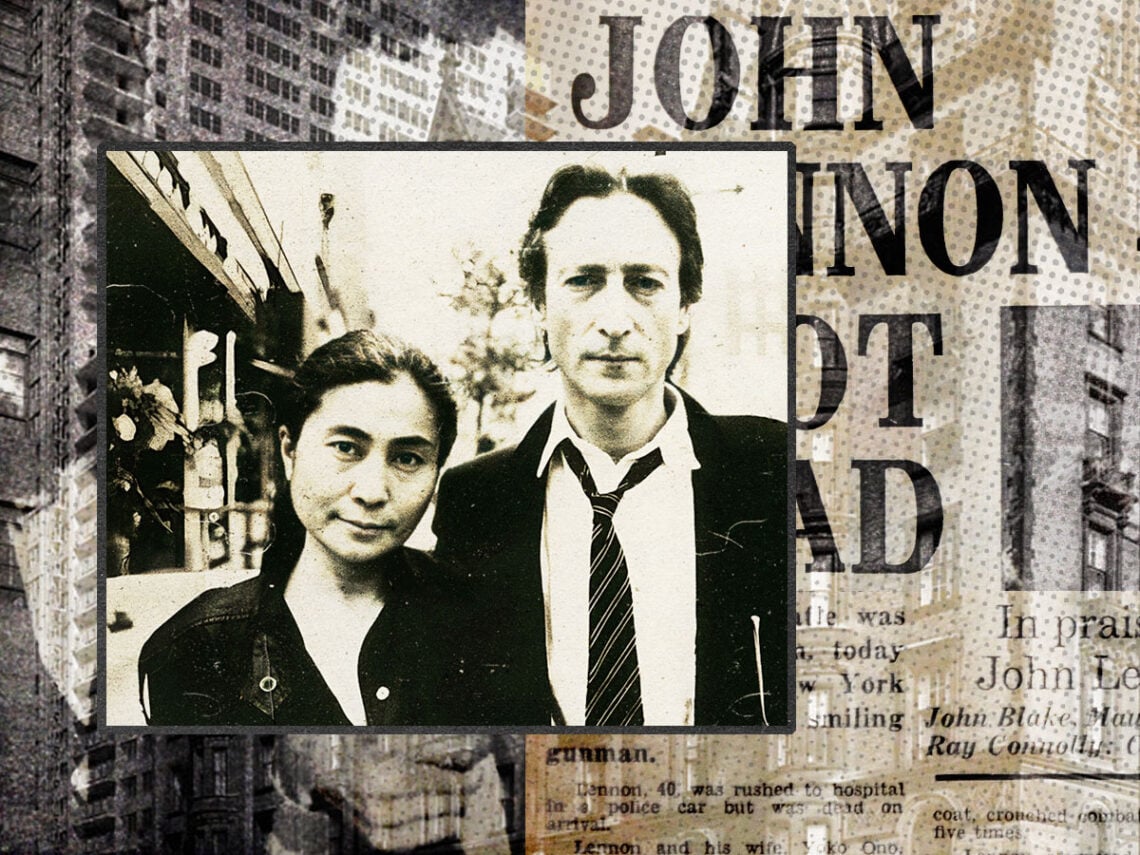
The murder of John Lennon

There was a point in John Lennon’s life when he said, “[The Beatles] are more popular than Jesus now”. The uproar that followed simply claimed he was being blasphemous rather than inaccurate. At the time, he had reached a rarified status where he has remained ever since – an icon in every sense of the word.
He was atop a pedestal of veneration, representing a set of beliefs for which he was a living symbol. This made him larger than his output. He had transcended art and became emblematic of a fraction of evolving society. So, while the popularity of his music may have waned by 1980, only scoring one number one in ten years as a solo artist, his status was positively unimpeached.
However, this represented a problem for him. By being larger than life, it was hard for people to recognise the fallible human beneath it all. This was the crux of Mark David Chapman’s gripe with the rock star. During the midst of a mental episode, the 25-year-old from Honolulu, Hawaii, who had recently lost his job as a security guard, became obsessed with J.D. Salinger’s 1951 novel The Catcher in the Rye. Chapman wanted to live his life according to the morals of the iconoclastic protagonist Holden Caulfield.
It is perhaps telling that the phrase that J.D. Salinger’s The Catcher in the Rye helped to popularise was “screw up”. These days, that term is even in the Oxford English Dictionary, and it comes with the concise definition: “To make something go wrong.” In that regard, Caulfield would remark in the prose that “people always clap for the wrong things”, but he didn’t provide much to clap for other than calling adults “phonies” and hypocrites.
This sense of disgruntlement against what the world called worthy drove Chapman – a former Beatles fan – to develop a vendetta against Lennon. Initially triggered by Lennon’s “more popular than Jesus” comment, Chapman’s rage would fester over the years. “I would listen to this music, and I would get angry at him for saying [in the song ‘God’] that he didn’t believe in God, that he just believed in him and Yoko, and that he didn’t believe in the Beatles. This was another thing that angered me, even though this record had been done at least ten years previously,” he said, as per Jack Jones’ Let Me Take You Down.
Continuing: “I just wanted to scream out loud, ‘Who does he think he is, saying these things about God and heaven and the Beatles?’ Saying that he doesn’t believe in Jesus and things like that. At that point, my mind was going through a total blackness of anger and rage. So I brought the Lennon book home into this The Catcher in the Rye milieu where my mindset is Holden Caulfield and anti-phoniness.”
So, in this mindset of wanting to put the duplicitous world to rights, he purchased a revolver and flew to New York on October 29th, 1980. For days, he plotted his wicked deed and tried to gather his thoughts. On the 12th or 13th of November, he left New York. But on December 6th, he flew back. Two days later, on the 8th, he decided that he was going to murder John Lennon.
It was one of the warmest December days on record in New York when Lennon quietly arose at 7:30am and gazed out of his Dakota building apartment over the city’s skyline to the clear azure blue skies beyond. Ahead of him was a busy day with a photo session and radio interview promoting Double Fantasy. The joint Yoko Ono and Lennon record had been his biggest success for almost a decade. When Yoko Ono emerged in the living room later that morning, she found her husband lost in contemplative thought, looking out over Manhattan.
He continued his morning as normal. After breakfast, a haircut, and a quick photoshoot, Dave Sholin arrived to conduct a radio interview with Lennon. Their chat lasted for a whopping three hours as they mused on a range of subjects. Given what followed, the line: “We’re either going to live or we’re going to die. I consider that my work won’t be finished until I’m dead and buried – and I hope that’s a long time” remains the most profoundly tragic.
After the conclusion of the interview at around 5pm, Lennon headed out to the street, where he encountered his killer for the first time that day. Mark David Chapman approached him as a happy fan and handed him a copy of Double Fantasy, asking Lennon to sign it. The former Beatle humorously wrote: “John Lennon, 1980. Handing it back.” In 2020, this fateful and macabre copy went on sale at auction and was purchased by a private collector for $1.5million.

After this brief and jejune interaction, Lennon went on his day as normal, it seemed to those around that Chapman did too. Lennon then jumped in a cab with Yoko Ono to head to The Record Factory, where they began work on a song called ‘Walking on Thin Ice’. During the session, David Geffen happily informed them that Double Fantasy had gone gold. Lennon was so confident that ‘Walking on Thin Ice’ would continue their success that he told Yoko Ono that she had just recorded her first number one.
After leaving the studio at around 10:30pm, a limousine dropped Lennon and Yoko Ono off at the Dakota building where they were residents. Yoko Ono quickly shuffled towards the lobby while Lennon collected cassettes of the day’s recordings and a few pieces of equipment. As he walked towards the entrance Mark David Chapman called out “Mr Lennon” and then fired four shots into Lennon’s back, missing the fifth shot as Lennon began to slump.
In this moment, Chapman has recalled a sickening sense of clarity. “I knew what I was doing, and I knew it was evil,” he has said in subsequent parole hearings. “My big answer to everything: I wasn’t going to be a nobody anymore. “Alas, this is perhaps why he didn’t flee the scene and later pled guilty.
Before him, Lennon crawled up the steps towards the lobby and cried out, “I’m shot”. Meanwhile, Chapman watched on, removed his coat and began reading The Catcher in the Rye. He was arrested as soon as the police arrived on the scene two minutes later. At 22:51pm, Lennon was asked by an attending officer who rushed to his side, “Are you John Lennon?” he was able to reply, “Yes,” but had lost so much blood that he lost consciousness upon uttering the response. These were Lennon’s last words.
Later that evening, Lennon was declared dead.
The tragedy may remain stark when laid out, but more often than not, when we look back, it is a cataclysm subsumed by a legacy that far outstrips the despair of its end. With music and a mantra that changed the world, the boon he offered is one that could never be taken away. As Yoko Ono would poetically put it with reflection to the sanguine morning when she saw him gazing out: “I saw John smiling in the sky. I saw sorrow changing into clarity. I saw all of us becoming one mind.”
Lennon was a great many things to millions of people, and his loss had a seismic impact. In the immediate hours following the attack, word began to spread. Stevie Wonder was performing at the Oakland Coliseum and was tasked with announcing the news. “I want you all to understand that I’m not a person who likes to be the [bearer of] bad news,” Wonder announced.
Clearly shaken, he informed a shocked audience, “For those of you who don’t know this … it’s been really hard for me to do this show tonight, but [I] did it in memory of people like this man. … He was shot tonight. … I’m talking about Mr. John Lennon. … I know that you would want me to continue to express the same feelings as he has in his life.”
Thereafter, people began to focus on how something like this could happen in the first place and America’s views on gun control were called into consideration. As ever, questions regarding the perpetrator, Mark David Chapman, began to enter the conversation and the big questions of how and why begged to be answered. In stark contrast to Lennon’s sky-gazing final moments, when the courts accused Chapman of killing The Beatles star as the easy route to fame and asked him if he had anything to say for himself, he simply rose and read the following passage from The Catcher in the Rye:
I keep picturing all these little kids playing some game in this big field of rye and all. Thousands of little kids, and nobody’s around – nobody big, I mean – except me. And I’m standing on the edge of some crazy cliff. What I have to do, I have to catch everybody if they start to go over the cliff – I mean if they’re running and they don’t look where they’re going, I have to come out from somewhere and catch them. That’s all I do all day. I’d just be the catcher in the rye and all.
Chapman was sentenced to 20 years to life in prison. He remains incarcerated to this date.
“Now Daddy is part of God,” Sean Ono Lennon poignantly reflected upon the death of his father, John Lennon, “I guess when you die, you become much more bigger because you’re part of everything.” These prescient words had tremendous resonance for a grieving world amid the frenzied aftermath of the event. From this brutal slaying, there came a profound outpouring of love.

Never Miss A Beat
The Far Out Beatles Newsletter
All the latest stories about The Beatles from the independent voice of culture.
Straight to your inbox.