


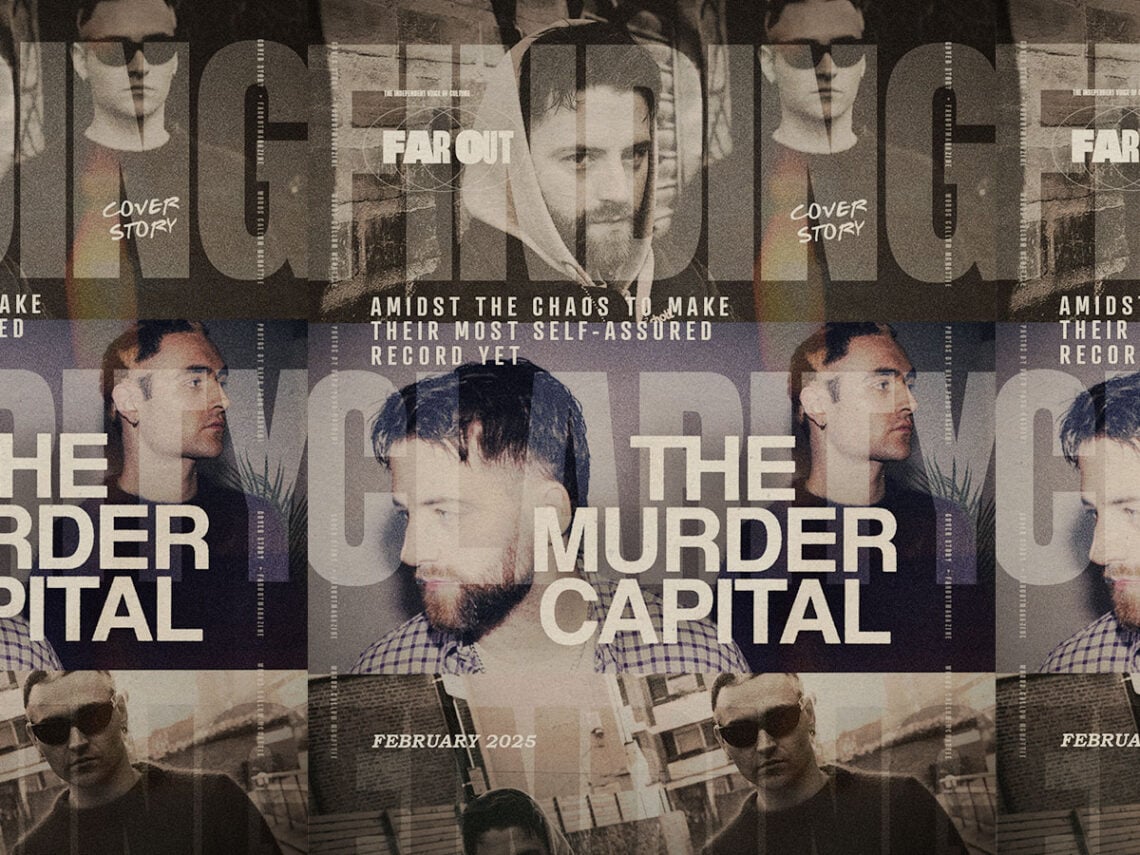
The Murder Capital: Finding clarity amidst the chaos to make their most self-assured album yet

Whenever a scorching summer’s day descends upon a British festival, I always look away from the main stage and peer directly at the bill for the ‘big top’ tents. Not only is the sound infinitely better, but it also happily gives the Factor 50 a moment’s rest. Luckily for me, during the unrelenting heat of the Saturday afternoon of Glastonbury 2023, The Murder Capital was set to play on the Woodsies stage. But as I rubbed shoulders with fellow sunburnt music fans, cramming ourselves into the tented shade and eagerly awaiting the walk-on, the bubble of excitement burst.
“We have that nightmare of going on stage, and you can’t plug in your guitar, or it’s like not tuned, just nothing’s working on stage,” bassist Gabriel Paschal Blake told me. “But once we got to that Glastonbury stage, literally nothing was working, the whole fucking power went”. It was a rug-pull moment that seemed symptomatic of a band whose momentum has been continuously scuppered.
“That was the amazing thing about Glastonbury. Any other festival, they have to cut your timeslot, but they were so kind to us. They were like, no, play it. They understood our history and how much it meant to us,” Gabriel continued. “They probably saw the life draining from our eyes backstage”, frontman James McGovern added. It was a show they simply had to play—a destiny of sorts.
And so, the history of The Murder Capital? Forged in the streets of Dublin and in the echoes of one its most famous venues, Workman’s, they introduced themselves to the world with their debut album When I Have Fears—a record that traversed the tender and energetic, delivered with an unflinching honesty and poetic complexity. Their sophomore record, Gigi’s Recovery, saw them flex their artistic muscles with a deeper and grander sonic environment that was sure to stun audiences on a forthcoming tour. But in the throes of Covid-19, their momentum felt somewhat halted.
“We were literally on the escalator in Dublin airport, heading for our first American tour and as we were on the escalator, we looked at our phones and Coachella was cancelled,” Paschal Blake remembered. “There were so many first opportunities we had got: our first Glastonbury, our first Coachella, playing KEXP was a big one for us as well and overnight, it was just all gone”.

Just as they were set to soar off the back of two hard-fought albums, their wings were clipped, and they faced an uncertain reality, not knowing when their artistic endeavours would again be nourished. They are a band who are not only deeply reliant on the live portrayal of their discography but they are also artists whose creativity thrives on capturing the real-life landscape that exists outside their studio.
Perhaps their music has never been more connected to reality than it is on their upcoming third album, Blindness. With the mission statement of the album’s title serving as a touchstone throughout the record, the band bob and weave through the introspective and collective. Raising deep questions on the conditions of modern love, while delivering scathing assessments of a divided society in one fell swoop.
“I went away for a couple of weeks, really just sifted through it, sat with it for a bit,” McGovern said in relation to how the narrative direction of the record was eventually crystalised. “And then I went back to the lads, and I was like, ‘Well, as far as I can see anyway, it’s about love’,” he continued. “There’s elements of introspection in there, which is always in our records, and there’s also themes about nationalist ideologies and distorted patriotism, and at that point, we were like, ‘Right, yeah, so what are we going to call this?’”.
Perhaps what revealed itself in the retrospective take of this record is how collective sentiments are punctuated by personal ones, with the state of the world framed within the context of their experiences in Ireland and subsequent journeys beyond it.
“I listened to it on the plane and I was like, I think is one of the best rock records ever made.”
Gabriel Paschal Blake
“More than ever on our work, there’s a sense of Irishness being explored, exploring our own relationship with Ireland, the Ireland we grew up in, the hangover of our parents’ Ireland and the Catholic church,” McGovern explained. “After a while, I started to realise what brought these things together was the sort of limited perspective of the human experience”.
Simply continuing on the same path as Gigi’s Recovery would’ve been expansive enough, but as the first chord of their opening track ‘Moonshot’ hits, it’s clear that this is a band who have put their difficult past of cancelled tours in the rearview mirror, and with a white-knuckled grip on the steering wheel, are driving into the future.
“I listened to it on the plane, and I was like, ‘I think it is one of the best rock records ever made’,” Paschal Blake said. “That’s actually how I feel about it,” he continued earnestly, while McGovern laughed and added, “You do have to believe you’re in the best band, to keep going as a band”.
But it tapped into something deeper for the bassist, whose pride in a new record is steeped equally in its sonic result and the wider sentiment of what it means for the band’s lifelong pursuits. “The reason that I make music and that we make music is to hear something we haven’t heard before and to hear something that maybe relates to who we are in a deeper and accurate way.”
There’s one moment in particular where that notion stands out. On a song that is McGovern’s finest lyrical take throughout the whole album and will undoubtedly go on to be marked as the standout moment on Blindness. In ‘Love of Country’, McGovern’s voice bleeds through the speakers, with compelling vulnerability, pondering nationalist conflict rooted in a misguided sense of alliance. As the track crescendoes, he asks: “Could you blame me for mistaking your love of country / for your hate of man?”.

As Paschal Blake and I praised McGovern for such a succinct delivery of a topic shrouded in lengthy discourse, the bass guitarist gave a simple reason as to why the lyric and perfected projection are so potent on the song: “For me, it completely sums up what is so rife in Ireland and so rife in the world at the minute”.
He continued, “It felt important for us as artists to comment on some of the things that are happening in the world at the minute, but the thing that we know how to do best is music”.
While questions of society are sharply posed to the listener, there seems to be an artistic self-assurance that runs through the record. More often than not, for bands who share the sort of sentimental kinship of The Murder Capital, the story reads of a rag-tag group of musicians who walk the battered streets of some roughshod, rain-slicked city and collectively conjure ideas together at the local pub. And while that may have been the case in the band’s formative years, the tale is vastly different today.
“He sort of took the shackles off our ankles and turned them into a necklace.”
James MCGovern
With members of the band dotted between Paris, Berlin, and London, there’s a sharper, more holistic worldview that can be funnelled into the band’s messaging. But perhaps more importantly, as McGovern explains, “it means everyone is happy to be living where they are living.”
So when it came to the nuts and bolts of album production, it was the role of Grammy-winning producer John Congleton to help realise a creative vision. “He sort of took the shackles off our ankles and turned them into a necklace,” McGovern explained.
“When we made our second record with him, we were in La Frette in Paris and towards the end of making Gigi, he was like ‘This has been great, but I’m looking forward to making the real one with you next time’”. McGovern continued to explain the subtext of that comment, “You know when someone comes in and looks at your process, and they can see these idiosyncrasies within it, he saw those very clearly”.
From the very outset of their career, The Murder Capital have never been a band short of ideas. They’ve had a unique ability to play within the expansive and claustrophobic with relative ease, but on this record, those sensibilities are married with a serving of swagger. Anyone who has seen The Murder Capital live since their emergence in 2019 would know that the essence of that quality has always been at the kernel of their performance, but this time, they transpose it perfectly onto acetate.
So perhaps the somewhat hurried recording process that saw the band enter a Dublin studio a mere two days after the end of their Clown’s Reflection tour was an attempt by the band to capture that. “Although I don’t like to compare writing trips,” McGovern prefaced, “A lot of tunes from that record came out of those two weeks in Dublin”.

Fending off any threats of road-worn weariness, the band re-emerges on Blindness with a deft touch and a buoyed aura. Like a boxer harnessing their second wind in the seventh round, they come out swinging on ‘Moonshot’, capture the raucous energy so prominent in their live shows, and distil it into a coherent artistic vision.
It slaps you in the face before sitting you down to provide harsh and honest lessons on the state of modern humanity. ‘Words Lost Meaning’, ‘Love of Country’ and ‘Can’t Pretend to know’ bring a key sense of observational clarity and vulnerability that can only be described in layman’s terms as the sort of crystalised sensitivity you feel on a hangover. This vulnerability exudes through the record and lays open the heart of a band who have been at the creative coalface.
While Blindness speaks to a sentiment of ignorance, miseducation and observational confusion for The Murder Capital, it’s anything but. They’ve collected the fragments of a broken society and glued them back together with an artistic coherence to, in turn, hold up a mirror to a somewhat sightless world.
There’s no telling the sort of depths that exist within their honesty well, nor how they can excavate it again for future records, but what is obvious is the sense of self-assuredness that exists within their demeanour. As the chaos of sonic innovation and relentless artistry swirls around them, they stand in the eye of the storm with complete stillness, with the knowledge that, if nothing else, they’ve created something unflinchingly honest.
