


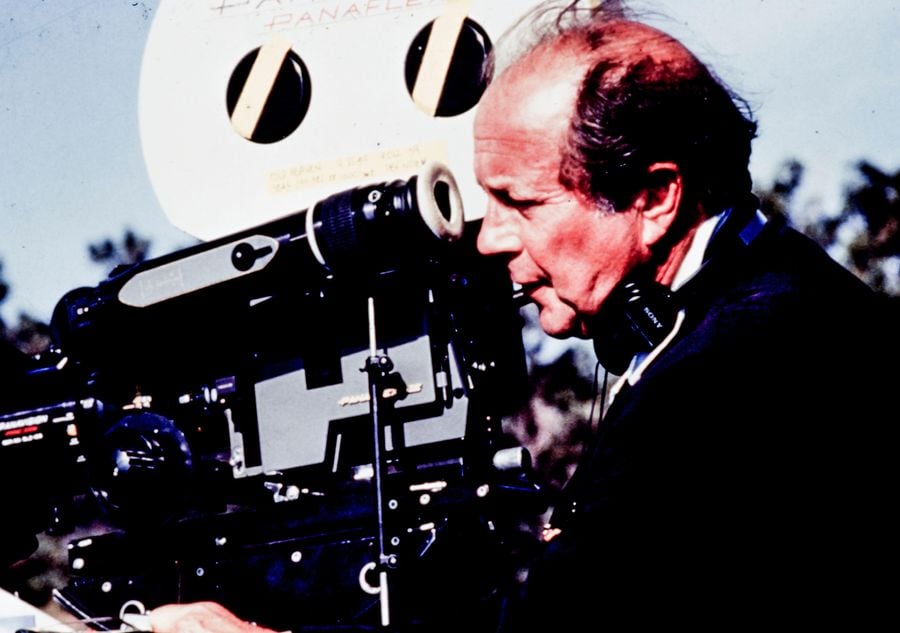
The movies that made Nicolas Roeg

In the late 1970s and early ’80s, Nicolas Roeg directed a wave of excellent movies that truly pushed the boundaries of cinema. Starting with Performance, Roeg delivered the story of a gangster hiding from the mob in the home of a rockstar, played by Mick Jagger. What followed was the mesmerising and genre-defying Walkabout, and then the cult classics Don’t Look Now and The Man Who Fell From Earth, the latter starring David Bowie, as well as the equally brilliant, though lesser-known, Bad Timing and Eureka.
What’s interesting is that much of Roeg’s work has gone under the radar for mainstream audiences, and yet his influence on many of the modern filmmakers working today is significant. It feels fitting, therefore, to take a look at some of the films that Roeg has said have had an effect on his own career.
Roeg cites Stanley Kubrick’s 2001: A Space Odyssey as having a significant impact on his work. When directors acknowledge Kubrick as influencing them, it can seem a rather obvious choice, considering he arguably made some of the best films ever. However, the connection between Roeg’s films and 2001 is tangible.
“Stanley Kubrick was a film milestone for me – to choose one, I think probably 2001: A Space Odyssey,” Roeg told Damien Love. “That preempted all the Star Wars and things, and I remember when he made it the studios were all very nervous: ‘God, what’s he doing, it doesn’t make sense…’ So I liked that” It’s clear Roeg shares Kubrick’s bold approach of fusing genres and challenging the audience.
The most striking similarity with another filmmaker is Federico Fellini. Like the Italian auteur, Roeg’s films embrace the powerful magic of filmmaking itself – incredibly personal human dramas mixed with epic and beautiful cinematography and set pieces. “If it had to be one Fellini, I’d have La Dolce Vita,” Roeg said. “For the whole period, the time in Rome. I love the idea of the journalist coming back for confirmation of hope and finding that the man he’s come to look for, the shrink, has shot himself, his wife, and his two beautiful children. I think that’s fantastic. It’s a beautiful film.”
It’s also modern filmmakers that have affected Roeg’s filmmaking, referencing Quentin Tarantino’s Reservoir Dogs as a pivotal moment. “More recently, I liked Reservoir Dogs, the energy of the thing, the idea of the people in it, breaking form and cliché,” he said. “I thought it was exciting that Quentin Tarantino patently loves film, he’s not in it just for the business or the glory.”
When looking at the landscape of cinema today, Roeg’s fingerprints are all over it. Edgar Wright has often mentioned how Roeg’s films impact him. Wright’s recent Last Night In Soho and Roeg’s Don’t Look Now would make brilliant companion viewings. Equally, Roeg’s mad and brilliant Eureka, starring Gene Hackman as a gold prospector who strikes rich and becomes the wealthiest man in the world, must have had an influence on Paul Thomas Anderson when making the equally fantastic There Will Be Blood.
Directors can often be coy or even misleading at times when discussing the films that have influenced them, reluctant to let us peek behind the curtain and risk losing the mystique or kudos around their work. It’s refreshing to hear a director as important as Roeg being as gushing and honest about the movies that have affected him as a filmmaker. For anyone who has yet to discover Roeg’s body of work, it’s a journey I thoroughly suggest you take. You won’t regret it.

Never Miss A Take
The Far Out Quentin Tarantino Newsletter
All the latest Quentin Tarantino content from the independent voice of culture.
Straight to your inbox.