


‘The Monk and the Gun’ movie review: political satire between the lines

This charming, deceptively simple comedy/drama is set in rural Bhutan in 2006, two years before the nation held its first election, and provides funny and thoughtful insights into the competing benefits of modernisation and tradition. As the film begins, television and the internet have recently been made available in Bhutan after years of avoidance. The king decided that the time was right to introduce democracy and allow the people of Bhutan to choose their own leader by popular vote. The Monk and the Gun follows the preparations for the nation’s first election and its effects on a selection of characters in an isolated village in an engaging story which offers a funny but respectful overview of the villagers’ lives while managing to insert political satire between the lines.
Writer-director Pawo Choyning Dorji is a significant figure in the minimal Bhutanese film industry. His debut, the family drama Lunana: A Yak in the Classroom, also set in Bhutan, earned an Oscar nomination. This second feature, a Bhutan-France-US-Taiwan collaboration, deals with the more adult themes of politics, tradition, and the inescapable influence of the past in a way that combines lighthearted humour with sober reflection.
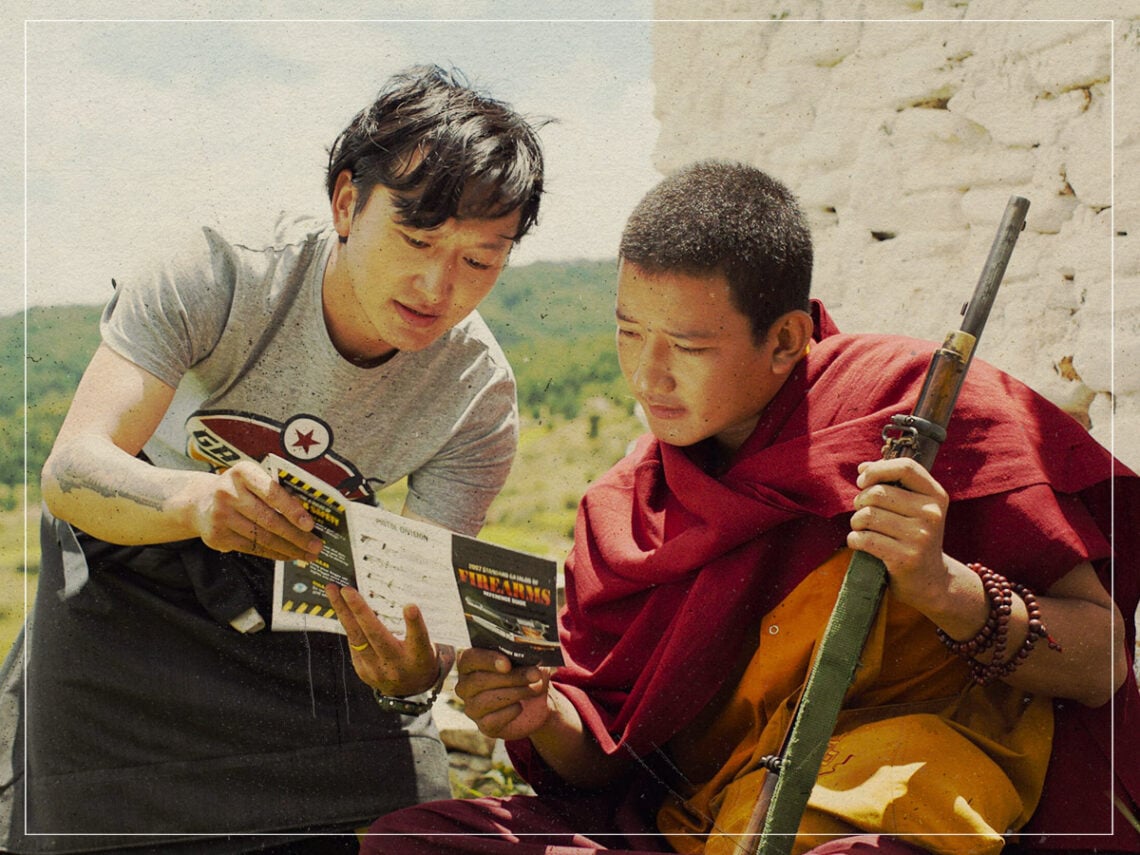
As the story opens, a preliminary mock election is planned, to introduce the concept and process of voting to people unfamiliar with it, and is stalled by unexpected issues, such as few rural residents knowing their own birthdate. As news of the king’s decision reaches an unnamed village, a few ambitious residents welcome modernisation, while the majority are bemused by changes they don’t fully understand. In the nearby Buddhist monastery, however, the news is received more soberly. The elderly lama, leader of the small monastic community, expresses vague concerns that “our country is changing” and “things need to be made right again.” He instructs young monk Tashi (Tandin Wangchuk) to find some guns and bring them back to the monastery without providing a reason. Tashi’s quest for firearms carries on as background to the other characters’ stories.
The film unobtrusively points out the changes taking place in Bhutan. Despite the relative lack of industry and current technology in the region, popular Western music plays in shops, and residents gather to watch television in public spaces. A villager is seen attaching a satellite dish to the side of his rustic cabin. Some one-upmanship is taking place between neighbours over ownership of newly available technology.
When one forward-thinking villager (Tandin Sonam) sets out to meet an American man (Harry Einhorn) at the airport, seemingly for some secret financial dealings, the plot thickens, and hints of trouble begin to emerge, including the appearance of suspicious police officers. Gradually, the actions of the various characters are shown to have elements or intentions that connect them. Only in the last act, however, are all mysteries solved and questions answered, in a surprisingly upbeat plot twist that brings every faction together in a final scene.
The ensemble cast, including many amateur actors, are excellent without exception, apparently directed to be naturalistic in their performances. The movie is a pleasure to watch because of the striking cinematography of Bhutanese technician and filmmaker Jigme Tenzing, who collaborated with director Dorji on an earlier film. The sweeping views of the local landscape are gorgeous and suitably impressive, especially when the camera allows it to loom imposingly over the comparatively tiny human presence; the indoor gatherings are appropriately cosy; and the close-ups of characters at key moments are expressive, allowing the camera to tell part of the story at each stage. The use of traditional Bhutanese music in the score is also well-chosen.
As the central election story unfolds, jokes at the expense of the woefully uninformed electorate expand to take in more than Bhutan, allowing their situation to satirise politics worldwide. The election planners’ dismay at potential voters’ real, largely irrational reasons for choosing a candidate or party, the simplification of serious issues, and the partisan bullying that emerges as the election campaign proceeds could easily refer to grander political activity in wealthier nations. Conflicting attitudes toward wealth create amusing moments between American visitors and locals. The script also has fun with sly references to guns and their symbolic significance.
Despite its comedic take, the film does get across legitimate fears for Bhutan under the onslaught of modernity and unaccustomed cultural forms. Many of the parallel storylines create suspense over the question of just how damaging one or another change will be for the community. The scriptwriter deftly gathers these threads together in a finale that explains and resolves matters, mainly by acknowledging both the threat of change and the unavoidable power and potential value of acknowledging the past. Despite being very explicitly about Bhutan, this is a story that could easily apply to, and certainly be enjoyed by, any person, anywhere.
