


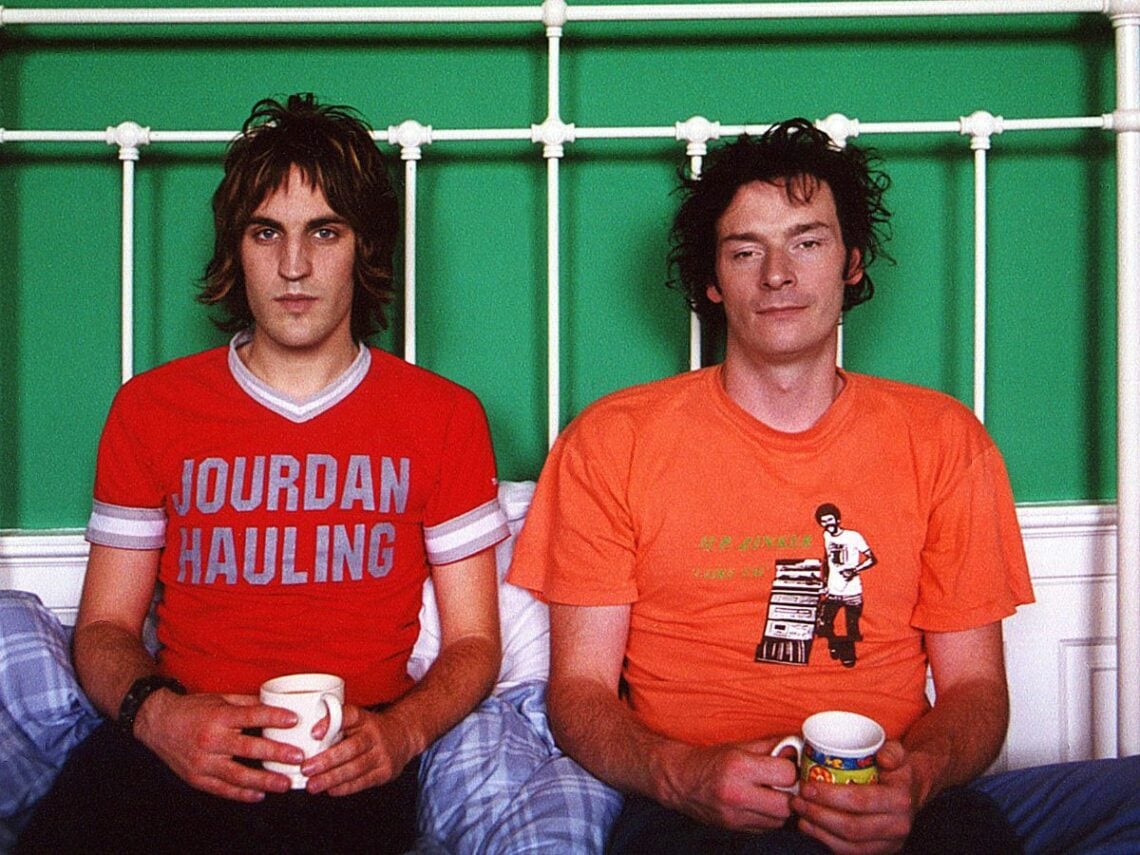
Remembering The Mighty Boosh through the lens of actor and photographer Dave Brown

“Come with us now on a journey through time and space,” I heard for the fifth time during a recent binge of the beloved BBC comedy series The Mighty Boosh. The televisual project, which stars creators Noel Fielding and Julian Barratt in various workplaces, is how most fans will remember the Boosh, but the legendary comedy troupe scaled the pages of books, the retro realm of radio and the live stage too.
Like Monty Python, the Boosh thrived on surrealism, but while the former made lengthy strides in religious satire and social commentary, the latter specialised in pop culture references, scaly man fish, talking naan bread and virtually anything Fielding and Barratt could conjure from the colourful cauldron of their unfiltered psyches. Ever awoken from a strange dream and decided not to tell the story? “No, it’s too weird,” you might think. Thankfully, the Boosh never held back.
On the topic of naan bread, I’d like to introduce you to today’s featured photographer, Dave Brown. As well as sporting gorilla garb for his role as Bollo, Brown played several other minor characters, including the deadly Black Frost and, of course, an anthropomorphic naan. While coordinating crimps and marshalling the mayhem as the troupe’s self-confessed “organised control freak”, Brown was never far from his camera. Much to our benefit, he took thousands of photos, documenting the Mighty Boosh’s meteoric journey to the big screen and beyond.
Last week, I had the great pleasure of chatting with Brown to sort through his extensive photography collection and discuss his time as a member of the Mighty Boosh. “I was at university with Noel,” he began, revealing how the Boosh came about in the 1990s. “We lived together at uni and, before I specialised in graphic design, in the course that we did, I was Noel’s partner. He was the copywriter, and I was an art director. We used to write various things and do crazy shit that always got horrendous marks, but actually turned out to be way ahead of its time because it was so ridiculous.”
“We used to be into comedy; Noel always wanted to be a comedian,” he continued. “We were basically comedy trainspotters. And there was a comedy club near where we were in Buckinghamshire called Hellfire Comedy Club. We’d been to see everyone, Kevin Eldon and Harry Hill – all of the greats of that era. Julian was on that bill as a comedian, and me, Noel and Nige [Coan; he and his partner Ivana Zorn conducted the animation for The Mighty Boosh] went to see him do the stand-up and then chatted to him after.”
The students became well-acquainted with Barratt, who told Fielding he had won the Daily Telegraph open mic award. Inspired, Fielding also entered the open mic competition, and there began his first foray into Britain’s comedy underworld. “When [Noel] did that, me and Nige kind of shadowed him through the whole journey, which was extremely stressful. I think Frankie Boyle won it, and I don’t think they have a second place, but I think Noel pretty much came in second.”
Energised by the open mic success, Fielding became involved with the Edinburgh festival alongside Chris Addison, Julian Barratt and Frankie Boyle, among others and eventually began working on the first incarnation of the Mighty Boosh stage show with Julian. “They started realising they were kindred spirits and started writing together,” Brown remembered. “They did Mighty Boosh, which was the first live show. They had met Rich Fulcher while doing a sketch called Unnatural Acts. They liked him and asked Rich to be the zookeeper in their first live show, which won the Perrier Newcomer Award.”
The troupe began to take shape in the late 1990s, a time when Brown was working a steady job as a graphic designer. “I was just living with Noel in Hackney, mucking about and helping them out and getting involved in that Monday night stuff [at the Hen & Chickens theatre in Highbury & Islington], playing music dressed up as different shit. Then I went to Australia to work,” he told me. “When I came back from Australia, [Fielding and Barratt] were writing their third live Edinburgh show [Auto Boosh] and wanted a third person in it because they wanted to do various characters and wanted two people on stage while the other changed into different characters. So they asked me, and I agreed to do that.”
Following the success of Auto Boosh in 2000, Fielding and Barratt were commissioned to partake in a six-part radio series, The Boosh. The show aired in October 2001 on BBC Radio 4 and served as a golden gateway to their popular television adaption, The Mighty Boosh, which aired on BBC Three for three series between 2004 and 2007. “My job varied from helping out with props and playing stupid characters when they needed,” Brown said of his role on the set of the TV show. “I was quite influential in the live direction of it and them two [Noel and Barratt], I was a therapist between those two most of the time [laughs].”
With a fine cast including Brown, Fulcher, Michael Fielding (Noel’s brother), Richard Ayoade and Matt Berry, Barratt and Fielding created a world unlike any other that gave fans a chance to escape. It could be hard to fathom how this silly world of surrealism could offer anything beyond laughter and release; however, in 2020, Netflix removed The Mighty Boosh from its catalogue, citing the use of blackface in episodes like ‘The Spirit of Jazz’ and ‘Jungle’.


As we touched upon this delicate topic, Brown recalled the show’s censorship as a particularly distressing period for the Mighty Boosh group. While Netflix cancelled the show, the BBC decided to keep it on iPlayer, instead issuing a warning that needs to be accepted before proceeding to the stream. “I love the fact that the BBC stood by us; Netflix just pulled us,” Brown said. “You know, you gotta tread so carefully. I’d hate to think that we ever offended anyone. I think most of our characters were so fantastical and based on surrealism and fantasy, based on our heroes. And everything was a celebration of those heroes and of a surrealist, fantastical, dreamlike child angle on all of that. So when you get accused of something so dark, it really hurts; we were all really hurt by it.”
“We always made sure that everything we did was based on fun, humour and silliness and never wanted to offend, upset or alienate anyone,” he continued. “We had so many people [fans] who felt like they were on the fringes of society all getting together because of their love of the Boosh. And we’d have people sending us letters saying, ‘I was suicidal’ or ‘I was being bullied, then I got together with this Boosh community. You’ve saved my life – you’ve improved my life’. We were always getting beautiful letters and feedback from fans. To then hear that we were getting cancelled for being inappropriate, it was like a double-edged sword where you go, ‘OK, times have changed, and we would never write that stuff now.’ But at the same time, there was never any malice.”
Brown added: “We weren’t dressing up or doing voices to alienate a particular race or particular section of society. But if we did offend anyone or if anyone watches it now and is offended, then that’s really sad, and we’re sorry.”
Towards the end of our conversation, I was keen to ask the question on all fans’ lips: “Have we seen the end of the Mighty Boosh?”
“All of us are still very close,” Brown affirmed. “We talk to each other all the time. I talk to Noel more than anyone else, but still, Julian was down here a couple of weekends ago. You know, life becomes life. Most of us have got children now. Rich has now moved from America to Richmond. We all meet up occasionally. We met up before Christmas at a Kim Noble gig, which was incredible.”
“We have a massive following in Australia; hence, this gallery have contacted me and asked me to put these exhibitions on. I was like, ‘Does anyone give a shit anymore?’ And they’re like, ‘Yeah, it’s massive!’ So there was always talk of doing a reunion show or something. But it’s a hard one, you know – I try and think of Noel squeezing back into it. It would have to be relevant to the time. I don’t know how it would be or what it would be, or whether it be as a band.”
Brown then revealed that, beyond the group’s near-constant musical references and sonic tangents in the various live and TV episodes, they had actually put a lot of work into an album. “We went to Electric Lady Studios in New York and recorded a whole album,” he revealed. “Like 25 tracks properly produced in one of the best Studios in New York, and it never got released because of disputes between the American representatives and English representatives. And Noel and Julian had a meltdown over that.”
As well as their huge following in Australia, The Mighty Boosh aired in the US on Adult Swim and dredged a cult following. “A cult following over there is like ten times bigger than a popular following over here,” Brown said.
They weren’t totally aware of the scale of their influence across the Atlantic until they visited on a DJ tour. “We went to New York and LA and did the big Comic Con in San Diego, and it was just fucking insane,” Brown remembered. “The following was mental. We went to the Bowery Ballroom in New York, and we were just meant to be doing a DJ set. But we ended up doing a bit of a live ad-lib thing, finding costumes and stuff because it was sold out. There were queues like four blocks down the road trying to get in, and the Roxy was the same.”
Dave Brown currently works in partnership with ‘Behind the Gallery’, and we’ve heard something top secret could occur this August in Australia. If you follow these links, you’ll discover when something might happen in Melbourne and Sydney. Brown’s Mighty Boosh photography prints are also currently available for sale on the ‘Behind the Gallery’ website where, until the end of April 2023, Far Out readers can order at a discounted price by using the following code: faroutboosh10.
Below, we present a collection of photographs from Brown’s colossal archive, some of which you may recognise; others have been shared exclusively for his feature. The photographs are arranged chronologically, mapping out The Mighty Boosh’s epic journey from 1997 to 2013.
Dave Brown’s photographic journey with The Mighty Boosh:


