


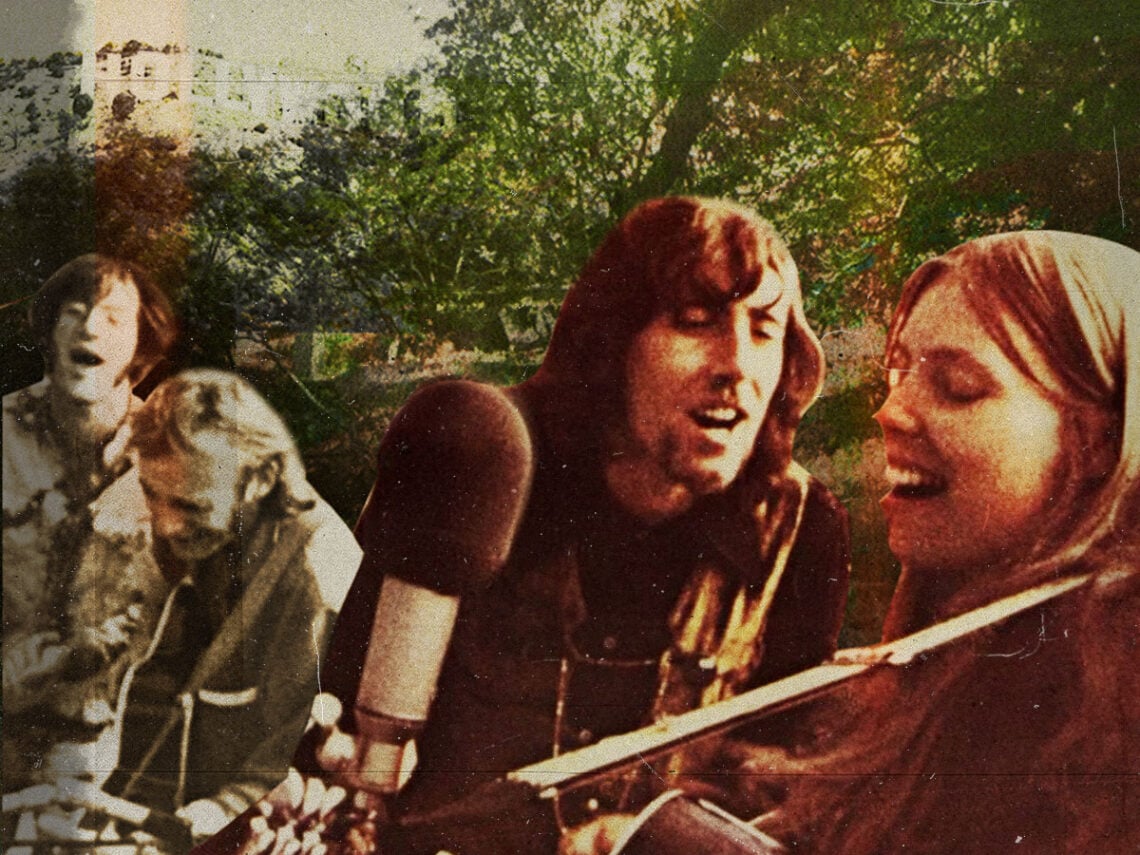
The Celebrity Love Island of Laurel Canyon: Untangling the complex love triangles of counterculture

Laurel Canyon in the late 1960s was where everything came together and everything fell apart: bands, relationships, counterculture, the Earth’s crust, you name it. In fact, there were so many love triangles on the go that Pythagoras would’ve had a difficult job wading through the geometrical makeup of the culture zenith—everything was coalescing, and that led to fractures, these cracks showed that triangles aren’t always the strongest shape. The fractures were inevitable, considering everyone was playing music, taking drugs and having sex with each other in a creative, liberated frenzy. It was all extremely Californian.
This melee was prognosticated to Joni Mitchell on the dogeared page of a second hand book. “Ask anyone in America where the craziest people live and they’ll tell you California,” she recalls reading. “Ask anyone in California where the craziest people live and they’ll say Los Angeles. Ask anyone in Los Angeles where the craziest people live and they’ll tell you Hollywood. Ask anyone in Hollywood where the craziest people live and they’ll say Laurel Canyon. And ask anyone in Laurel Canyon where the craziest people live and they’ll say Lookout Mountain. So, I bought a house on Lookout Mountain.” And frankly, if you ask anyone outside of the States where the craziest people live, they’ll tell you America—so we’re dealing the craziest in the world here.
One of those folks was the late David Crosby. However, in the summer of 1967, the musician was spiritually homeless. So he ventured over to Florida, where fate would thrust an alluring songbird his way. “She was standing there singing all those songs: ‘Michael From Mountains,’ ‘Both Sides Now,’ and I was just floored,” Crosby later remembered of his first encounter with Joni Mitchell. “I couldn’t believe that there was anybody that good.” Naturally, this auspicious meeting meant that they simply had to end up in a relationship, the counterculture scene wouldn’t let it play out any other way.
The two then had a brief – and admittedly volatile love affair – which Crosby later described as being like “falling into a cement mixer. She is a turbulent woman and very, very crazy”. In his view, however, the romance may well have inspired his self-professed “best song” in ‘Guinnevere’. “It was very easy to love her,” he remembered, “but turbulent.” So, there flame was brief – so brief that Mitchell undermines the seriousness of it – but Crosby felt like he was burned by it.
Nevertheless, he was more than happy to introduce his bandmate Graham Nash to her like a Svengali of great music and heartbreak. As Nash recalls: “I first met Joan in Ottawa, Canada in 1967. The Hollies were playing a show there and Joni was playing at a local club. There was a party thrown for us after our show, and when I entered the room, I noticed a beautiful woman sitting down with what appeared to be a large bible on her knees. I kept staring at her and our manager at the time, Robin Britten, was saying something into my ear and distracting me from my quest.”
Nash continues, “I asked him to be quiet as I was checking Joni out. He said, ‘if you’d just listen to me I’m trying to tell you that she wants to meet you’. David Crosby had told me earlier that year to look out for Joni should I ever get the chance to meet her. Joni and I hit it off immediately, and I ended up in her room at the Chateau Laurier and she beguiled me with 15 or so of the most incredible songs I’d ever heard. Obviously, I fell in love right there and then. She touched my heart and soul in a way that they had never been touched before.”
As he concludes in the book 101 Essential Rock Records: “I watched her write some of those songs and I believe that one or two of them were about me, but who really knows?” And his days as a muse stretched beyond the end of their ill-fated relationship, as Mitchell mulled: “I’m so hard to handle, I’m selfish and I’m sad, Now I’ve gone and lost the best baby, That I ever had.”
Just as things had been getting serious between the pair, Mitchell packed up from their home that once seemed so idyllic and travelled to Europe alone. Therein, she sent Nash a telegram explaining that the relationship was over. While her ambivalent feelings were complex at the time they came to the fore with clarity in her lovelorn songs. “He tried hard to help me, you know he put me at ease/ He loved me so naughty he made me weak in the knees/ I wish I had a river I could skate away on,” she sang mournfully.
But just a few doors down from their broken home things were even more fractious, for that was the house of The Mamas and the Papas. It had been a friendly home at first where the loving married couple of Michelle Phillips and John Phillips resided. However, the group’s tenor had eyes of desire and soon enough two became three as Denny Doherty entered the picture and as we so often learn, three never works.
Four works even less, and although John Phillips had forgiven this first indiscretion, writing the song ‘I Saw Her Again’ and (perhaps fiendishly) gave Doherty the lead vocal line, he fired Michelle from the band when he found out that she also slept with Gene Clark from the Byrds. She was later reinstated when fans threatened a boycott, but a rift had formed. And the rift went in every direction.
Michelle recalls Cass Elliot, confiding: “I don’t get it. You could have any man you want. Why would you take mine?” You see, this whole time, Elliot had been in love with Doherty, but it proved tragically unrequited. This would forever be the case as Doherty pursued other Laurel Canyon love interests and tried to turn a blind eye to the open secret of Elliot’s infatuation. Sadly, this ordeal ultimately caused the band to split on 1969, and the Phillips’ marriage ended that same year. In some ways, the fiasco and the amazing music that went along with it makes them just about the ultimate counterculture band.
All the while, you had Jim Morrison just down the road making love to just about everyone, and Frank Zappa in the middle of it all simply being weird, and Brian Wilson was busy filling his entire apartment with sand and writing the masterpiece of Pet Sounds. To have all this going on in one single suburb which had a population of less than 30,000 at the time, you’re looking at one wild love island of luminary Lotharios triumphing in music but sorely failing in love.
