


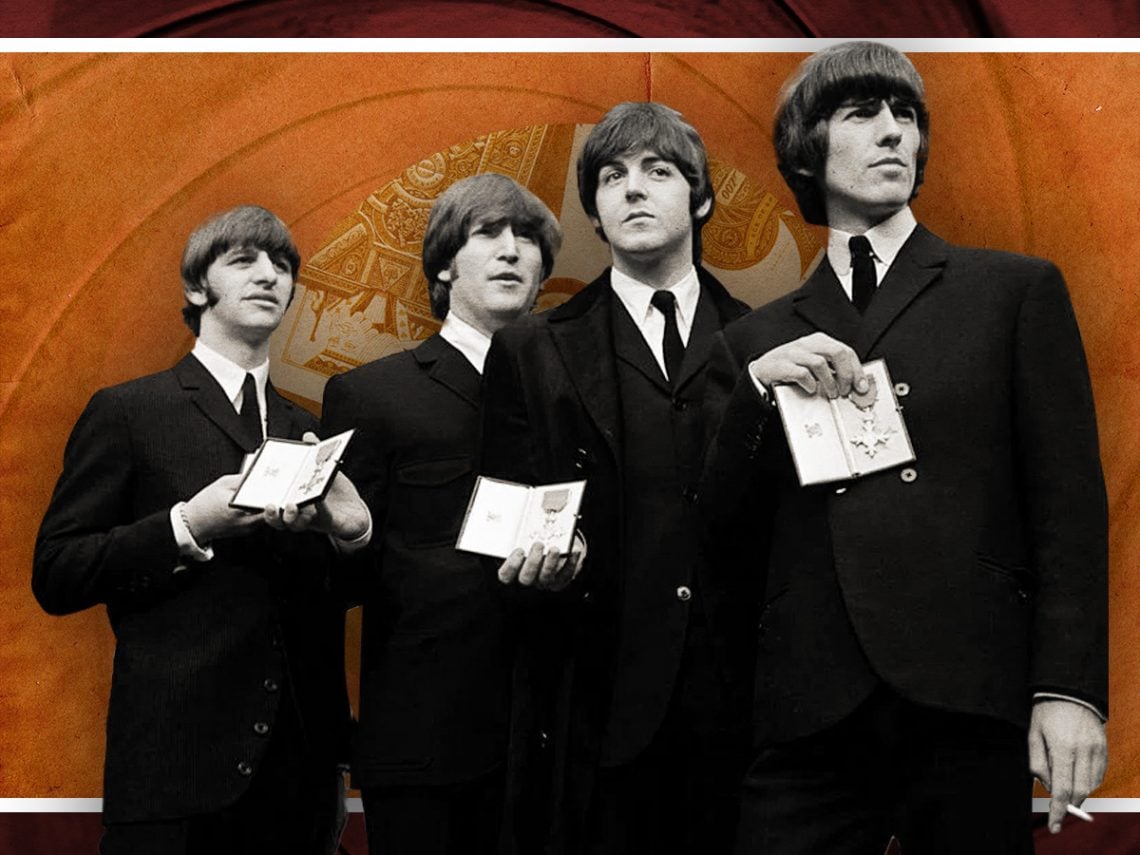
The longstanding links between The Beatles and James Bond

October 5th, 1962, was a sunny and dry Friday. News that day was sparse, but on a cultural front, it was one of the most auspicious days in British history. That Friday, two big debuts were made: Dr No hit the box office and The Beatles’ first single ‘Love Me Do’ rattled the radio. With suits cut from separate cloth and tailored at disparate ends of town, James Bond and the ‘Fab Four’ wandered into public view and changed the world they emerged into. They continue to offer the tale of two countries in a cultural sense.
Aside from the date, there are plenty of other direct ties. For instance, Ringo Starr married ‘Bond girl’ Barbara Bach, Paul McCartney went on the write a theme tune, and Bond himself bedded a woman called Strawberry Fields, but not before Sean Connery’s incarnation quipped the following line in 1964’s Goldfinger: “My dear girl, there are some things that just aren’t done; such as drinking Dom Perignon ’53 above the temperature of 38 degrees Fahrenheit. That’s as bad as listening to the Beatles without earmuffs”.
This insult was indicative of the cultural divide at play. If Bond, James Bond ever found himself joining the Maharishi in India then he would surely be there for the purpose of undercover reconnaissance and not a jot more. The irony is, if anyone in the world is in need of a break for some spiritual meditation then it’s 007. In fact, according to FBI analysts, Bond (specifically the Connery years) ranks number six on the list of the most faithful psychopaths in cinema history. That might sound strange, but chopping a man’s head off in a turbine engine and immediate making a pun about it, is not normal behaviour.
The fact that it was done “for Queen and country” is beside the point. Even when your actions are perpetrated against villains, it is only natural that there would be some empathetic response. At the very least, you’d take a breath before digging out the joke book, but not good old Connery. Sexual promiscuity, poor behavioural controls, superficial charm, callousness, a lack of empathy and more –all the psychopathic checklist traits are there when it comes to Bond, and it makes for a romp. This is precisely why at first it seems peculiar to see him sit between the likes of Norman Bates and Hannibal Lecter on the loony list. And it is also where Bond forms an artistic divergence with The Beatles.
You see, those working-class lads from Liverpool quickly moved away from bedding birds, holding hands, and scoring riches (at least in their artistic output). Thanks to the illuminating beacon that Bob Dylan set off, they got introspective and troublesomely questioning, putting the bourgeois status quo to rights. Both of these words, introspective and questioning, were foreign to Bond up until a few years ago when he suddenly got a little bit sad at the start of the movie and then subsequently differed slightly from the plan in an act of individual defiance about two-fifths of the way in.
His old psychopathic ways were subsumed by the pure entertainment on offer. While The Beatles were dipping into the bottomless depth of existentialism or at least looking at relationships with a sense of maturity, the gunslinger Lothario of espionage was running over crocodile’s heads to escape his tricking mooring in the middle of an infested lake. With that sort of suave madness on display, why would you stop to do some psychological analysis?
Bond was the guy who would make a new pair of loafers out of the hippie-dippy wackadoodles of the counterculture scene. He’d call a spade a spade because he didn’t have time for bullshit as he served Queen and country and bashed some new bastard’s head in. With his clean-cut ways, irresistible charm and absolutely impenetrable persona, he was the ultimate man in the eyes of many.
In reality, he is probably the most insufferable man in history. I mean, can you imagine this joker in your local — standing at the bar as slick and polished as a manicured penguin’s back, ordering his drinks in a ludicrously pretentious fashion, entirely disengaging from the common man, never once cracking even a slither of a smile, and then proceeding to spread his slew of STDs in highly manipulated and sus sexual encounters.
Weirdly, not much of this comes across through the filter of cinema though. He’s just a wildly entertaining figure for many and there is little else to add. However, with The Beatles, the mythology of John Lennon and the likes have always been probed at. There is more to them by design. I wouldn’t go as far as to say that it’s because one is entertainment and one is art, but it’s not a million miles off the mark. Bond is content to be quick, fast, and sexy entertainment, while The Beatles yearned for ‘a deeper understanding’.
However, both are oddities undoubtedly linked in another sense: they have transcended their place on the screen or the radio and become permanent figures of fun brightening our dismal daily lives. They might differ in so many ways and illuminate variant elements of British society as they do so. However, they share the singular bond of still being talked about 60 years later. They will always be part of our lives. The Bond pose will have been pulled at a wedding today, and someone will have whistled ‘Hey Jude’. After all, the British like to celebrate their conquests and very few cultural creations (if any) have reached as many people as these two.
And strangely neither define the proletariat. Perhaps this is a measure of our interests. It’s not often you’ll come across a John Lennon or a James Bond, it’s not often you’ll meditate in India or order a drink “shaken”, but we are inherently interested in the extremes of our society—the oddities that help to place us. Betwixt the conservative, macho, duty-bound ways of Bond and the radical liberation of The Beatles lies most of Britain and its culture, but these two forces live on, defining and underpinning the art and entertainment 60 years on.

Never Miss A Beat
The Far Out Beatles Newsletter
All the latest stories about The Beatles from the independent voice of culture.
Straight to your inbox.