


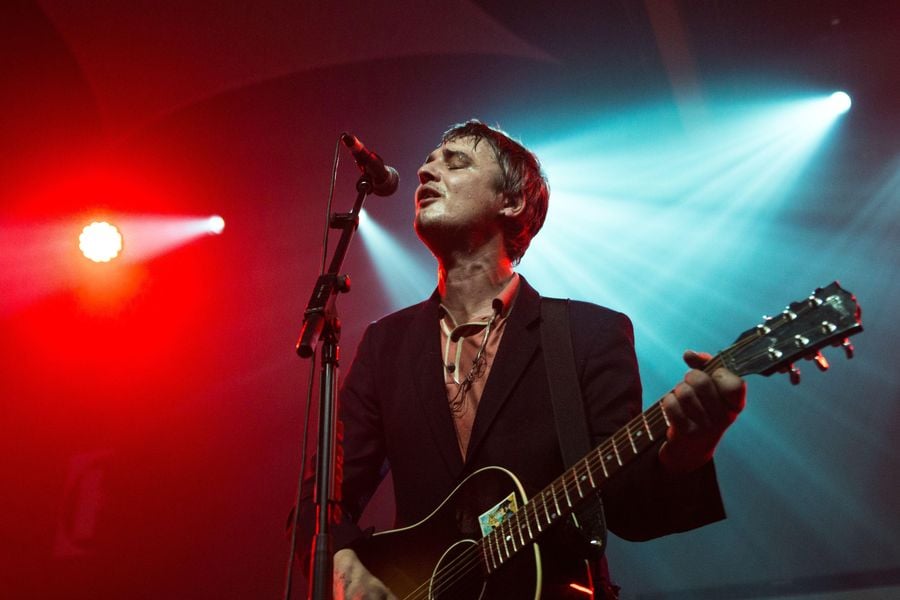
The life of Pete Doherty through 10 of his best lyrics

“If you’ve lost your faith in love and music, the end won’t be long.” — The Libertines
There’s not much about Pete Doherty that hasn’t been bastardised in one form or another. Undoubtedly a controversial figure in the rock ‘n’ roll scene of the ’00s, one thing that has always been pure about Doherty (no, not that) is his complete immersion in his work, especially the act of writing lyrics. Below, we’ve picked out ten of our favourites as a reminder that beneath the tabloid headlines, there’s some serious talent.
Doherty, the son of a military family, grew up in the UK and Europe’s army barracks. Floating around the grounds, Doherty found solace in the written word and soon began composing his own poetry. At age 11, he picked up a guitar, and the world seemed to click for the naturally charismatic Doherty. Achieving 11 GCSE’s with seven at A* showcased that Doherty was a truly gifted kid. But it would take him meeting his songwriting counterpart for his talent to be truly unearthed.
Meeting Carl Barat is certainly the moment that Doherty’s journey to stardom began. Starting up The Libertines in 1997, the band cultivated a guerilla following that only reached mainstream attention with the band’s release of their 2002 debut, Up The Bracket. Unfortunately, it was here that things started to awry for the musician as his escalating drug habit had begun to cause rifts within the group and, namely, Barat himself.
In 2003, Doherty was jailed for burgling Barat’s flat; it would start the chain of events that would see Doherty yo-yo within the group alongside swirling heroin and crack habit. It marked a sad time in British rock music. Doherty was largely championed as one of the finest songwriters Britain had produced in a generation. Not since Oasis had a band gathered up such a cultural impact in such a short time. As Noel Gallagher once put it: “If Oasis was the sound of the council estate singing its heart out, The Libertines were the tramps behind the dumpster.”
The Libertines formally split after their second self-titled album, and Doherty sought pastures new, turning his romantic poetical stylings to a band of his own, Babyshambles. The group, still plagued by Doherty’s drug addiction and now his continuous positioning in the tabloid press, owing to his relationship with supermodel Kate Moss, struggled to match the intensity of The Libertines rise to fame but still delivered some classic songs to boot.
Thankfully, unlike many others, this story has a happy ending. Doherty soon found sobriety, in some form or another, and has moved to the seaside with his old pal Carl Barat. As well as enacting their own dreams of Albion, the duo also got the old band back together and were relentlessly touring pre-COVID. The duo even have an idyllic bed and breakfast in Margate called The Albion Rooms, which is a must for any fan.
That’s all well and good, but the iconic figure of Pete Doherty will always loom largest in his songs. Through his lyrics, Doherty was the archetypal starry-eyed poet, the romantic trapped in a rock star shell, and he transformed the British rock scene with his style. Below, we’ve got the proof.
Pete Doherty’s 10 best lyrics:
‘Music When The Lights Go Out’
“Is it cruel or kind not to speak my mind and to lie to you rather than hurt you?”
When you think of a great Pete Doherty lyric, this is likely the first place you’ll land, so it feels only right that it should be the first on our list too. A touching refrain constructed within one of the band’s more lilting numbers, ‘Music When The Lights Go Out’ is about as typical a Doherty song as one can find.
Wrapped up in romance and delicately poised for chaos, the song sounds like the kind of diatribe one would imagine Lord Byron to have coughed up between bouts of syphilis. It’s a moment on The Libertines LP that stands out for its charm and one song that always begs for a sing-a-long at live shows.
‘Hooray for the 21st Century’
“What became of the working class?/ Nike Air, Reebok, Adidas/ Scratch cards, Pitbulls, ecstasy/ Hooray for the 21st Century”
One of the lesser travelled songs from The Libertines back catalogue, ‘Hooray For The 21st Century’, is fast, furious and ferocious in equal measure. A scathing indictment of the new century and its commercialisation, it once again sees Doherty harking back to the past for his emotional grounding and lamenting the future unfurling in front of him.
Powerful and precise in its punk delivery, the song is a remarkable moment at any Libs live show because they rarely play it. However, when they do, expect a certain section of diehard fans to lose their cool. It’s a song that captures Doherty at his incendiary best.
‘The Man Who Would Be King’
“I lived my dream today/ I lived it yesterday/ And I’ll be living yours tomorrow/ Don’t look at me that way”
There’s no doubt that by the time The Libertines released their debut album in 2002, rock ‘n’ roll had changed. The Strokes had carved a perfect garage rock gap for The Libs to slot into neatly, and they didn’t disappoint, becoming Britain’s answer to the rock revolution. While the debut LP is rich with punkified skiffle moments, the follow-up was much more diverse and focused on the fame that surrounded them. ‘The Man Who Would Be King’ is one of the most vitriolic tracks on the record.
Inspired by the 1975 film of the same name, it sees Doherty and Barat offer up their opinions for the proposed King, “I would say only one thing: lie, lie, lie, lie, lie”. But the most blistering moment comes in the refrain as Doherty holds a mirror up to all of those people who looked down on him as a penniless poet and roaming rock star.
‘You’re My Waterloo’
“You’ll never fumigate the demons/ No matter how much you smoke/ So just say you love me/ For three good reasons/ And I’ll throw you the rope”
One of the earlier songs in The Libertines back catalogue, the track remained one of their untested demos before they eventually added a new version of ‘You’re My Waterloo’ to the band’s latest release, 2015’s Anthems for Doomed Youth. It’s fitting that the song should land on such a named album, as it is so intrinsically linked to Doherty’s own childhood.
Constantly moving and never settling down, Doherty struggled to make meaningful connections early on in his life; it’s part of why his and Barat’s relationship was so linked to their survival. Here, Doherty uses his own feelings of alienation and casts it through the paradigm of an old piano ballad, the kind you might expect to hear a forlorn lover singing after closing time with a gin in hand. It’s a motif that Doherty found appealing and used throughout his career — the crumbling British Empire put through the wringer as a romantic rite.
‘Can’t Stand Me Now’
“Cornered the boy kicked out at the world / The world kicked back a lot fuckin’ harder now”
Another track from The Libertines, there’s very little to say about ‘Can’t Stand Me Now’ that hasn’t already been said or that the band don’t say in their lyrics. One of the more explicit comeback songs you’ll ever come across, Barat and Doherty detail extensively the plight of their friendship, with Barat singing “light fingers through the dark, shattered a lamp and a darkness it cast,” as a direct reference to Doherty’s jail time.
Equally, Doherty returns fire with “No, you’ve got it the wrong way round/ You shut me up and blamed it on the brown,” hinting at Barat’s zero tolerance for Doherty’s antics. But following this line, Doherty provided lyrics that not only showcases his state of mind at the time but exactly why The Libertines found an audience: “Cornered the boy, kicked out at the world/ The world kicked back a lot fuckin’ harder now.” This was why a generation connected with Doherty, he was dangerous and talented, of course, but he was also attainable and fallible — he was an everyman.
‘Fuck Forever’
“So what’s the use between death and glory/ I can’t tell between death and glory/ New Labour and Tory/ Purgatory and happy families”
With Babyshambles, Doherty had a brand new route to take. He was no longer battling with Barat for lyric space like a 21st century Lennon-McCartney. Now, the singer had free rein to enact his own sound and his own vision. One song that perhaps typifies that feeling is ‘Fuck Forever’, which featured on Babysdhambles’ record Down in Albion.
Never one to turn down a fight, Doherty began to politicise his work and once again shine a light on the working class who, in his opinion, were being royally shafted. But, while our favourite lyrics are far more universal, the song’s basis was a break-up. The track was a direct attack on Barat and the love that was now lost between them.
‘What A Waster’
“She wakes up in the morning, and writes down all her dreams/ reads like the book of revelations, or the Beano or the unabridged Ulysses”
An avid reader himself, there’s some gravitas to his words on ‘What A Waster’ that may otherwise be lost. Add to that the extra authenticity Doherty brings to the idea of what a ‘waster’ actually is, and this song takes on a new level of realness for the listener. Doherty becomes our narrator for this song as he details the trials and tribulations of his lover, singing, “Where does all the money go? Straight up her nose.”
Drenched in punk rhythm and a refusal to slow down, the song is a riot when played live. What perhaps lands most poignantly of all is the fact that the song acts as a self-fulfilling prophecy. Doherty was poised to be the saviour of British rock music but threw it all away fro narcotics. Nevertheless, this self-flagellating masterclass is still one of the band’s best songs.
‘Time For Heroes’
“We will die in the class we were born, but that’s a class of our own my love.”
Famously inspired by the moment Pete Doherty was cracked on the head by riot police for checking his hair in the reflection of their riot shield during the 2001 May Day protests, ‘Time For Heroes’ was always likely to be entrenched in class warfare. “Did you see the stylish kids in the riot? Shovelled up like muck and set the night on fire” sings Doherty with gusto. While the upper class controls the establishment, one thing the working class has always had under its spell is music. It seems only fitting that Doherty should choose the savage song to make his feelings clear.
Everything that makes a great Libertines song is here. There’s romance, violence and misaligned patriotism all of which makes this song feel like a William Turner painting being enacted in front of our eyes. The lyric above best encapsulates all of these feelings into one of the most sincere lyrics Doherty has ever written.
‘The Good Old Days’
“If you’ve lost your faith in love and music then the end won’t be long”
Few lyrics speak as clearly for Doherty’s character and eventual downfall than the beautiful ‘The Good Old Days’. Another moment in which Barat and Doherty are happy to look backwards for their visions of the future, the band sing their hearts out with the permeating idea that when they stop the choral renditions their lives will come to an end.
While it may seem the sort of thing you’d expect scrawled on the back of teenage diaries, there’s a certain grandness to the lyric that still feels authentic. While Doherty and Barat were happy to place themselves at the bottom of London’s underbelly, they were able to provide grandiose moments of reflection, too, solid in the knowledge that they’d stand by the sentiment if needs be. Always putting music and art at the forefront of everything he did, Doherty lived out this lyric time and time again.
‘Albion’
“Down in Albion/ They’re black and blue/ But we don’t talk about that/ Are you from ’round here?/ How do you do?/ I’d like to talk about that”
While the classic line of “gin in teacups and leave son the lawn” is the lyric endlessly quoted from this 2006 song from Babyshambles album Down in Albion, the song’s opening lines say far more than that. They offer up a crystalline vision of Britain, or Albion, as Doherty refers to it. Not only noting the continuous fistfights that seem to litter our streets, nor just the stiff upper lip that stops us from talking about it but also the need for change.
Lacking any strong narrative to the song, Doherty instead provides modern Britain vignettes, and it’s a harsh reflection. Drenched in violence and a refusal to connect, Britain has spent many of its glory years as a prisoner of itself, never truly unfurling and evolving. The singer notes that demise and instead tries to conjure up a new land, a new Albion, where the past is celebrated, and the future welcomed.
