


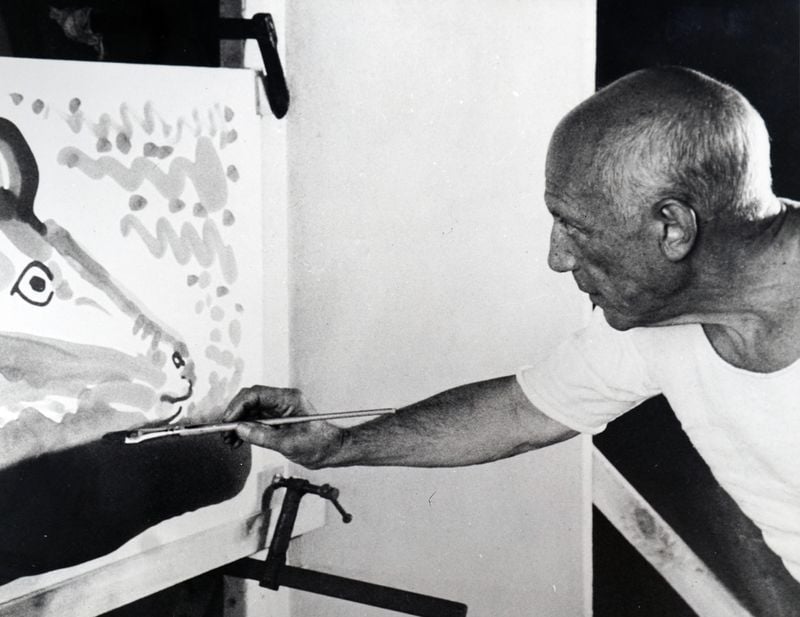
The invaluable Pablo Picasso piece that tragically sank to the bottom of the ocean

One man’s child-like scribble is another’s depiction of what something truly is rather than what it looks like on the surface. That sentence alone sounds awfully pretentious, but that didn’t stop Pablo Picasso from becoming one of the most definitive artists of the 20th century and, as a result, one of the most expensive artists of all time.
The highest fee that the Spaniard ever fetched was the world record-smashing $179.4million for ‘Les femmes d’Alger (Version O),’ at an auction in 2015. Picasso completed that iconic work in 1955. By 1963 he had refined his work further and one of the most distinctive pieces in his new style was Le Peintre. The painting was one of six that followed the meta-narrative of capturing a bearded artist at work.
Now, that sextet is incomplete, however, the tragedy that sent it to the bottom of the ocean illuminates the true value of art when all is said and done. Alas, alongside Le Peintre was far more valuable cargo aboard the Swissair jet travelling from New York to Geneva: 229 passengers and crew.
As the plane coasted over the Atlantic Ocean, the pilots sent out a distress call after their cockpit began to fill with smoke. A mere 5+ minutes from an emergency landing site in Halifax, the plane sadly spiralled into the ocean resulting in the deaths of everyone onboard. This, of course, was the true tragedy, the manifest is simply a fateful footnote.
Included in the manifest were 110lbs of cash and gold, 4lbs of diamonds, a trove of jewellery and watches, and most notably of all, Le Peintre. At the time, this Picasso piece was valued at just over $1.5milllion, but since then, a similar piece in the set sold for $179.4million in 2015, so the true price is hard to know, especially given its history.
However, it is unlikely that salvagers will scour the ocean in search for the lost painting at this stage. While rescue efforts after the crash were able to recover the human remains and much of the wreckage, the painting remains missing. As it happens, in order to cut shipping costs, Le Peintre was not registered as valuable cargo and was sent in a standard wooden crate. This led Swissair to conclude that if it wasn’t simply destroyed on impact, then the damage would now have rendered the painting ruined.
Thus, the piece remains one of the most notorious destroyed pieces of art in history… or at least as far as we know.
