


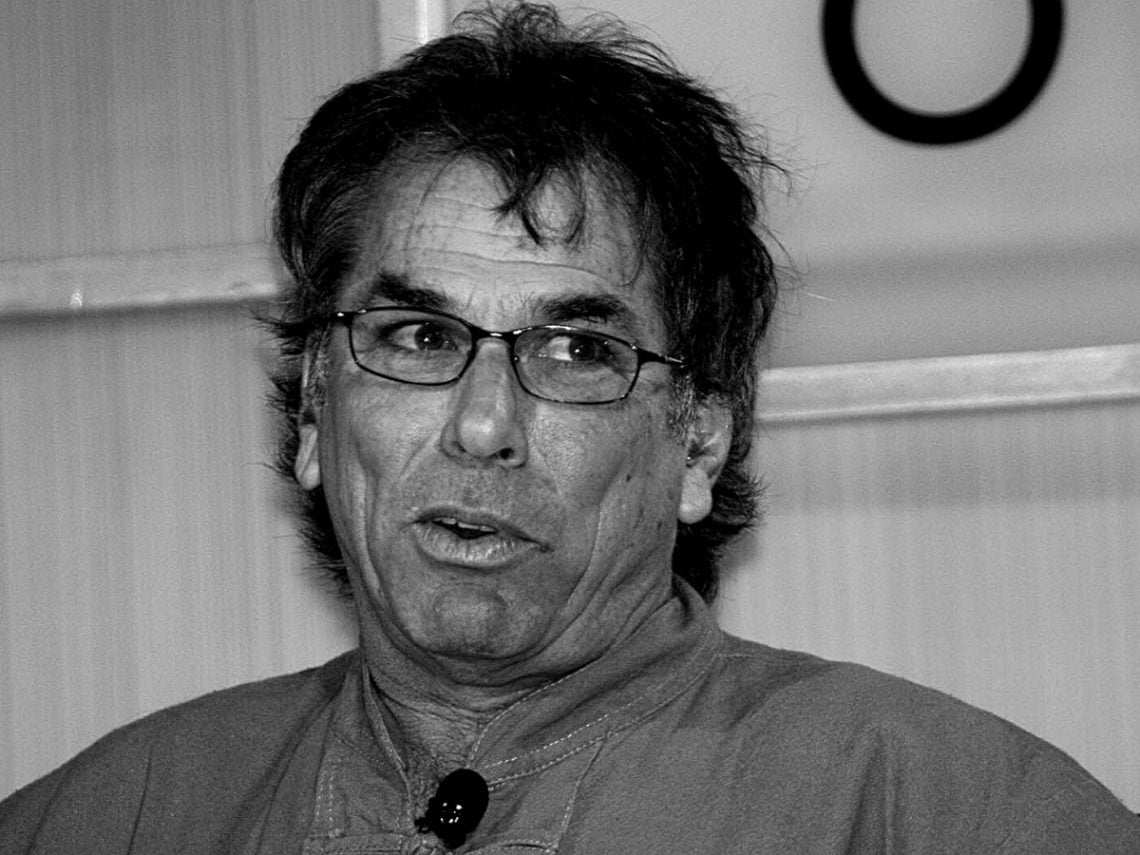
The instrument that Grateful Dead drummer Mickey Hart made himself

If you ever heard the Grateful Dead or one of its offshoots play a concert in the last 40 years, you’ve almost certainly heard a low, guttural buzz of noise blast out of the ‘Space’ section of the show. Taking various shapes and sonic identities, the noise can be traced back to Dead co-drummer Mickey Hart, who can often be seen hunched over an elaborate metallic object that seems to be producing the sounds. It’s a Grateful Dead signature, but what is it?
The story begins back in the early 1970s, when instrument builder John Lazelle constructed the first blaster beam. A long C-shaped slab of metal fitted with guitar pickups and piano strings, the blaster beam was capable of producing startling low tones. Actor/musician Craig Huxley refined the design and used the instrument as a sound effect in the 1979 movie Star Trek: The Motion Picture. That’s when Micke Hart stepped into the role of evolving the beam for the modern day.
Since their earliest days, the Grateful Dead were fascinated by noise. Throughout the 1960s, it wasn’t uncommon to hear long stretches of concerts devoted to guitar feedback, ambient drones, and improvised distortion jams. It complemented the Dead’s psychedelic and experimental ethos, but once the band began to add more traditional songs to their setlists starting in 1970, ‘Feedback’ was largely dropped in favour of either compact tracks or long improvisations rooted in chord changes and regular sequences.
Then, in 1979, Francis Ford Coppola asked Hart and Bill Kreutzmann to record music for his new film, Apocalypse Now. Coppola thought that the pair’s ‘Drums’ sequence, soon to become a standard part of every Dead set, was exactly the sound that he wanted underscoring the jungles of Vietnam. But Hart and Kreutzmann weren’t just going to beat on drums: the pair brought in a host of musicians and instruments to create improvised pieces. Hart brought his own blaster beam to the sessions, leading to an ongoing fascination with the instrument.
The low growls of the beam could be heard throughout the band’s 1980s concerts, but Hart wanted more for the instrument. His vision was to make the beam a universal instrument, one that could reproduce any sound in the world. While the piano strings would all be tuned to one pitch, different samples would be fed into the electronics attached to the beam, often filtered through a memory bank that Hart has attached to the device.
Once MIDI expert Bob Bralove became acquainted with the Dead, the beam was given new life. Hart continued to add elements to the instrument, recording as many samples of other instruments as he could to diversify the beam’s sound. In concert, Hart could gently stroke the strings, twiddle the knobs, or even violently strike it in order to produce different sounds. An up close and personal explanation of the beam comes in the second episode of the documentary series Long Strange Trip, showing that Hart’s dedication to the instrument continued well beyond the initial disbandment of the Grateful Dead.
Check out Hart showing off the beam in his gear tour down below.
