


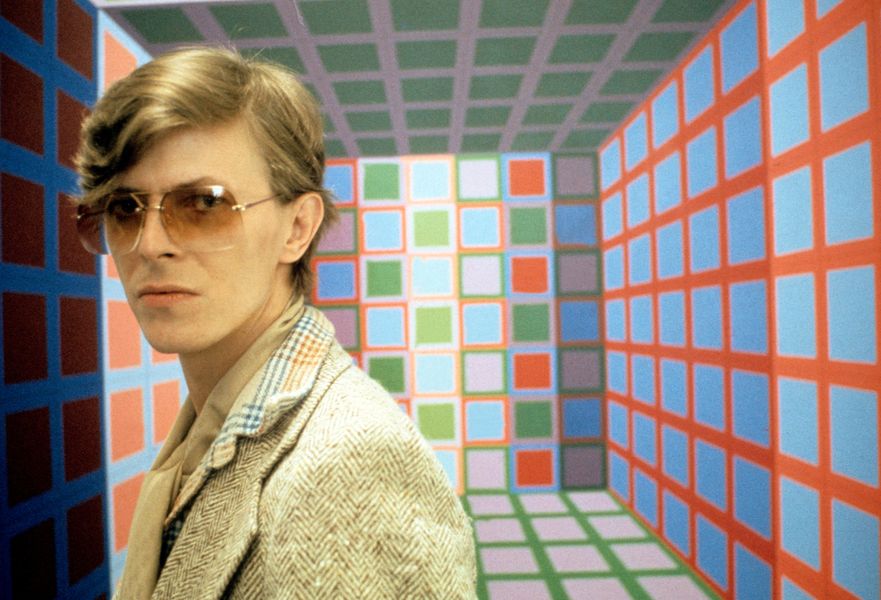
The incredible influence of Owen Frampton on David Bowie

In the history of music, many figures have had defining impacts on iconic artists, ranging from Chas Chandler plucking Jimi Hendrix out of obscurity and giving him the means to become a world beater to Malcolm McLaren facilitating the Sex Pistols’ anarchic rebellion. However, these instances do not always come in the form of managers and have been partners, friends and family members. For two of south London’s most significant exports, David Bowie and Peter Frampton, it was Owen Frampton, the father of the latter and teacher of both.
A genuine pioneer for his generation, Owen Frampton was born in 1919. It was via him that the pair were encouraged to express themselves artistically and aesthetically, a point that cannot be understated when noting just how conservative the 1950s and ’60s were when it came to self-expression. Through his enablement, the budding musicians would start their paths to becoming two of the biggest stars of the 1970s and, in Bowie, one of the most influential in history.
After serving in the Second World War, where he fought in the North African Campaign, invasion of Sicily and the momentous Battle of Monte Cassino, Owen Frampton returned to Britain in 1946. He had married his childhood sweetheart Peggy in 1941, and they had two sons, Peter and Clive.
Naturally, it was Owen who first introduced Peter to music, gifting him a banjolele that had belonged to his mother. After the young prodigy had mastered the instrument, he and Peggy bought him a full-sized guitar for Christmas when he was only eight years old, displaying the extent of his talent. Peter Frampton later said: “The guitar was at the foot of my bed when I woke up on Christmas morning — and I saw ‘Santa’ leave the room, and I knew it was Dad. It was kind of bittersweet: Yes, I got a guitar, but Santa isn’t real, he’s Dad!”
It was also Owen who introduced Peter to the music of folk legend Django Reinhardt, and it would have such an impact on him that, to this day, he notes how the French guitarist’s work still finds its way into his playing.
When asked about Owen playing him Reinhardt during his youth and whether this had a lasting impact on his artistry, Frampton told Premier Guitar in 2012: “I think so even probably more today than it did back then. When I was starting to play I wasn’t thrilled with the sound on Django’s recordings. I wanted to hear electric and he was playing acoustic. But it didn’t take long for me to think, ‘Holy crap, nobody plays like him’. To this day, I’ll sometimes find that a Django part I’ve learned has filtered into my repertoire of licks and penetrated my style.”
In 1946, when Owen took classes at Beckenham Art School in South London, he also started teaching in the art department at the Beckenham Technical School, which is now Ravens Wood School. This would prove to be a momentous decision not only for him and his family but for broader popular culture as well. In the not-too-distant future of the early 1960s, his students included David Jones – who would later become David Bowie – and George Underwood, who is now a famous artist and the mind behind the artwork of Bowie’s Hunky Dory and the iconic Ziggy Stardust. Together, Peter, David and George formed a trio of musically interested teenagers, helping each other to develop.
Of his friendship with Bowie and Underwood, Frampton recalled to CNN in 2013: “I asked my father, who was head of the art department at the school, who was into music… …and he said well there’s this David Jones character — he seems to play guitar and sax. So it was the three of us [Jones, Underwood, and Peter Frampton] exchanging licks really — they taught me Buddy Holly numbers and I showed them what I knew on guitar –so that’s when our friendship started on those stone steps.”
In his unpublished autobiography, Owen Frampton remembered the young David Bowie, explaining that the “unpredictable” teenager was already a cult figure at the green age of 14. He revealed that when he found Bowie and Underwood working at their jobs in an advertising studio, he thought he would never hear of them again. However, in a testament to the brilliance of Bowie and Underwood, this was not the case.
Owen wrote: “David was quite unpredictable. He was completely misunderstood by most of my teaching colleagues, but in those days, cults were unfashionable and David, by the age of 14, was already a cult figure. At this period in my teaching career, I was thoroughly used to very individualistic pupils and was rarely surprised by anything that occurred.”
He concluded: “Even when David varied the colour of his hair or cropped it short, or plucked his eyebrows, I accepted his actions as a means of projecting his personality, and of that he had plenty! I did however experience a sense of relief when I obtained employment for both him and George Underwood in advertising studios and at the time I thought that probably it would be the last I would hear of either of them”.
