


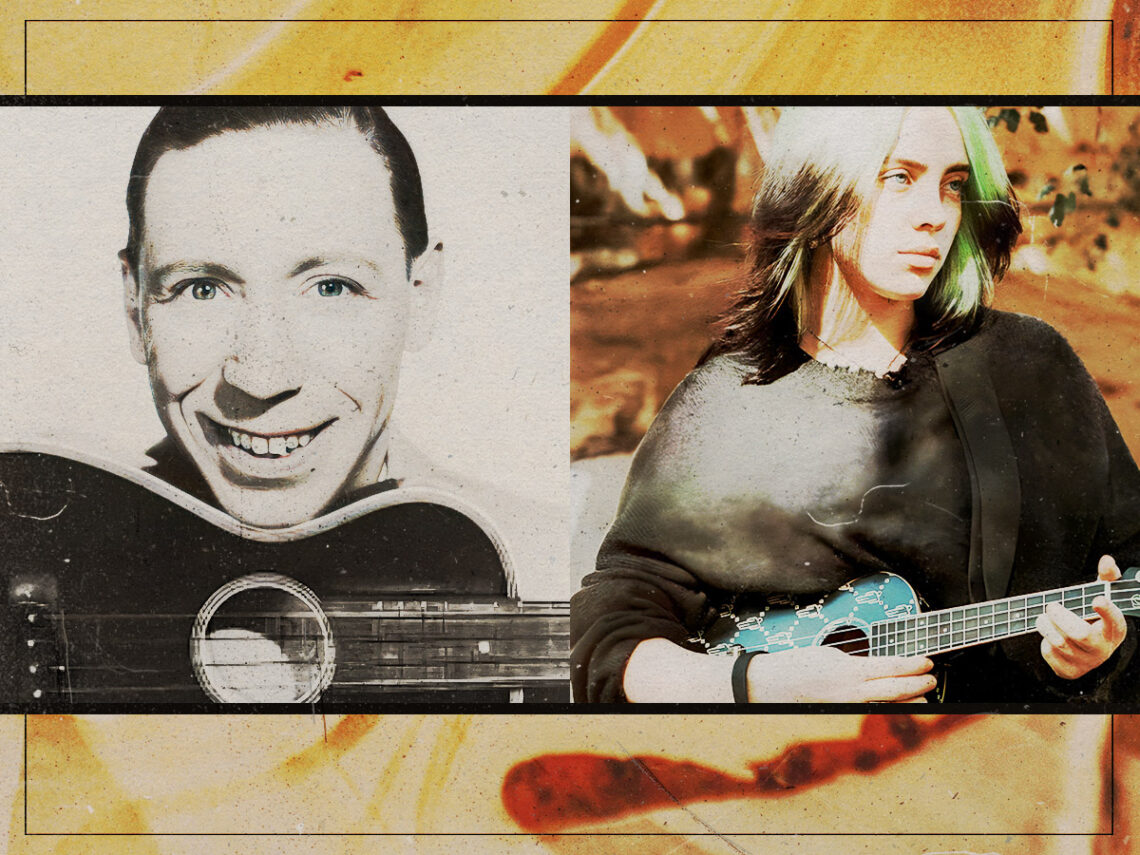
From George Formby to Billie Eilish: a brief history of pop ukulele

It’s no secret that some instruments are more respected than others. The piano, the violin, and even the guitar are placed on a pedestal, while others are viewed as somewhat plebeian or childish. One of the instruments that often falls into that category is the ukulele. A simplistic instrument composed of four strings on a shrunken guitar body, the uke has been the subject of musical snobbery for years. However, the instrument has a valuable place in pop history.
Although Portuguese in origin, the ukulele was first popularised in Hawaii. In 1915, a Hawaiian pavilion at the Panama International Exposition in San Francisco entranced visitors with the unmistakable sounds of the ukulele accompanied by hula dancing. This helped the plucky instrument to become viewed as an archetypal characteristic of America’s 50th state. Its position as a stereotypical sound of Hawaii allowed the ukulele to witness mainland success in the US, and it still remains a popular trope in film and music to use a ukulele to evoke images of Hawaii.
Though the uke was first developed in the latter part of the 19th century, it was not until the 1930s that the UK was fully exposed to its charms. The incredibly popular comic George Formby is largely responsible for introducing the instrument to mainstream audiences in the UK. Captivating audiences with his comedy songs, the music hall star was characterised by his high-pitched voice and his penchant for the ukulele. While most of his songs have aged fairly poorly, the impact of Formby on the British public was huge, and he remains a recognisable figure nearly a century after his heyday.
His risque track ‘When I’m Cleaning Windows’ became infamous after being banned by the BBC, and Formby became a hugely popular entertainer during the Second World War. In fact, the comic used his instrument to boost the spirits of the British public during the conflict, once releasing the frankly ridiculous statement, “I’ll hang up my uke on Sundays only when our lads stop fighting and getting killed on Sundays.”
Although its small size and light-hearted sound lend the instrument to comedy songs pretty well, the ukulele has not always been used for novelty purposes. In the US, the cheap abundance of ukes made them popular enough that television soon caught on, broadcasting tutorials on how to play the instrument. The ukulele found favour with huge stars like Elvis or Betty Grable, which seemed to legitimise the instrument in the minds of the public. This success was short-lived, however, with the electric guitars of rock ‘n’ roll soon eclipsing the humble ukulele, which was once again reduced to a novelty item or a child’s toy.
The uke faced something of a renaissance in the latter part of the 20th century. The pocket-sized instrument received favour from a variety of pop and rock musicians, the most famous example being ex-Beatle George Harrison. A disciple of music hall, Harrison had a special place in his heart for the ukulele, once asserting that “Everybody should have and play a uke. It’s so simple to carry with you, and it is one instrument you can’t play and not laugh! It’s so sweet and also very old.”
In more recent years, the uke has been repopularised by the pop star Billie Eilish. The songwriter and regular festival headliner had been playing the instrument from a young age and recently released a line of custom ukes with Fender. Whether the instrument will remain a respected part of popular music or once again be resigned to musical novelty is anyone’s guess, but its impact on popular music cannot be forgotten.
