


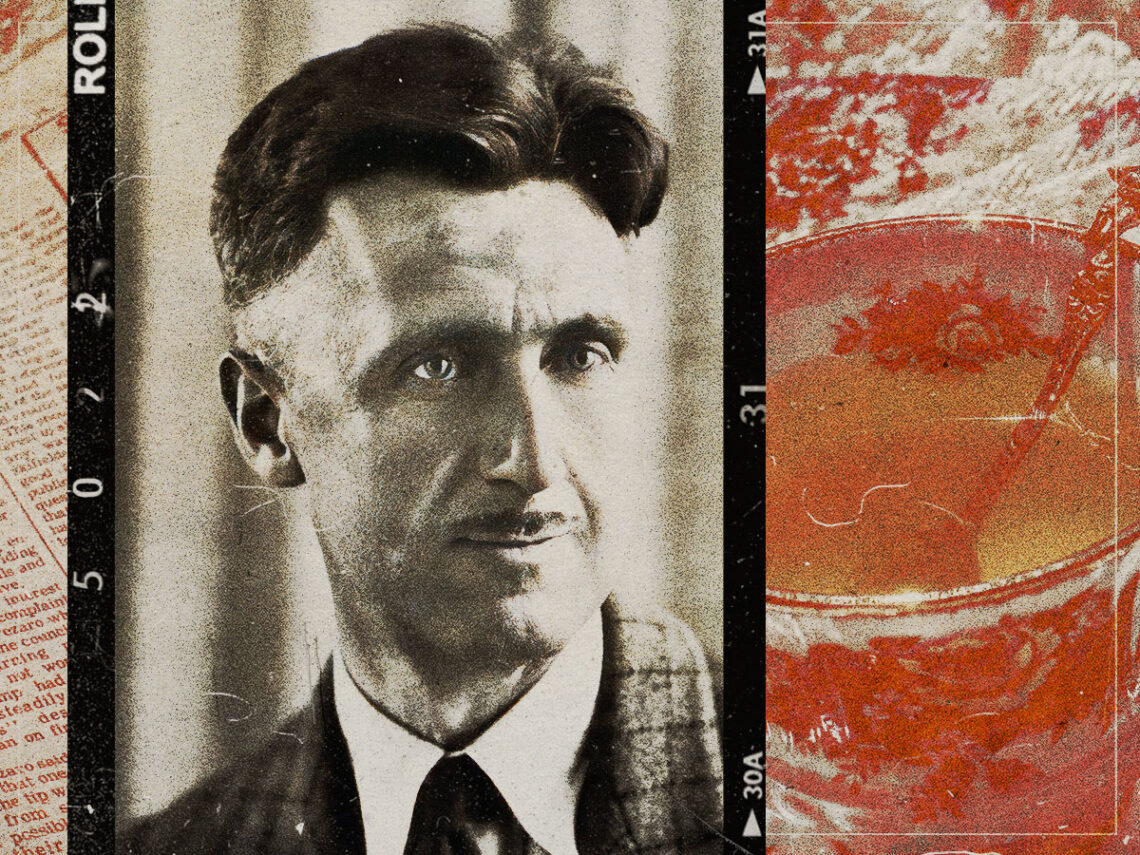
The George Orwell guide to the perfect cup of tea

British novelist George Orwell dedicated his writing to unravelling complex societal structures. Best known for penning Animal Farm and Nineteen Eighty-Four, his opposition to totalitarianism and ardent support of socialism undercut his most major works. He tackled class inequality, bleak dystopian futures, and capitalism in his poetry, fiction, and journalism – but in 1946, he tackled his most divisive subject yet. How to make the perfect cup of tea.
In a dazzlingly elaborate guide published in the Evening Standard, Orwell extols the universal joy of a good cup of tea. While it might be one of the “mainstays of civilization,” it’s making, he writes, “is often the subject of violent disputes”, and anyone who has watched someone pour the milk first will attest to the same. Luckily, one of the greatest literary minds to come out of the 20th century nailed down the finer points of tea-making in an 11-rule guide.
The first golden rule is to use Ceylonese or Indian tea. He said Chinese tea might be a more economical choice, seeing as you can drink it without milk, but there’s no “stimulation” in that. “One does not feel wiser, braver, or more optimistic after drinking it,” he advised. “Anyone who has used that comforting phrase ‘a nice cup of tea’ invariably means Indian tea.”
The next step is a teapot, which he demands be china or earthenware. “Silver or Britanniaware teapots produce inferior tea, and enamel pots are worse; though curiously enough a pewter teapot (a rarity nowadays) is not so bad,” he muses. “Once you’ve located a suitable pot, it must be warmed before you’ve even entertained the idea of putting the actual tea in it. This, apparently, is best done by putting it on a hob, not “swilling it out with hot water”.
The idea here is to make the tea strong. As his tea-making manifesto was published, Britain was in a period of rationing, which, among other glaring hardships, made it hard to make a decent cuppa. “In a time of rationing, this is not an idea that can be realised on every day of the week, but I maintain that one strong cup of tea is better than twenty weak ones,” he said. “All true tea lovers not only like their tea strong but like it a little stronger with each year that passes – a fact which is recognised in the extra ration issued to old-age pensioners.”
As Orwell’s rules go on, they become increasingly detail-oriented, down to the type of strainers, cups and even stirring technique. The most important rule, namely that the correct order is tea first, milk second, is saved for last. “This is one of the most controversial points of all,” he concedes. “Indeed in every family in Britain, there are probably two schools of thought on the subject. The milk-first school can bring forward some fairly strong arguments, but I maintain that my own argument is unanswerable.”
The controversy follows with his disdain for sugar, although, in a nod to his political leanings, the utilitarian uses of tea get a mention: “Much might be written about the subsidiary uses of tea leaves, such as telling fortunes, predicting the arrival of visitors, feeding rabbits, healing burns and sweeping the carpet.” While the brilliant writer made many astute observations about democratic socialism and authoritarianism in his time, the brilliance of a good old-fashioned sugary tea clearly went over his head.
George Orwell’s 11 rules for making the perfect cup of tea:
- Only make tea with Indian or Ceylonese tea
- Tea should be made in small quantities
- The pot should be warmed beforehand
- The tea should be strong
- The tea should be put straight into the pot
- One should take the teapot to the kettle and not the other way about
- After making the tea, one should stir it, or better, give the pot a good shake
- One should drink out of a good breakfast cup
- One should pour the cream off the milk before using it for tea
- One should pour tea into the cup first
- Tea should be drunk without sugar
