


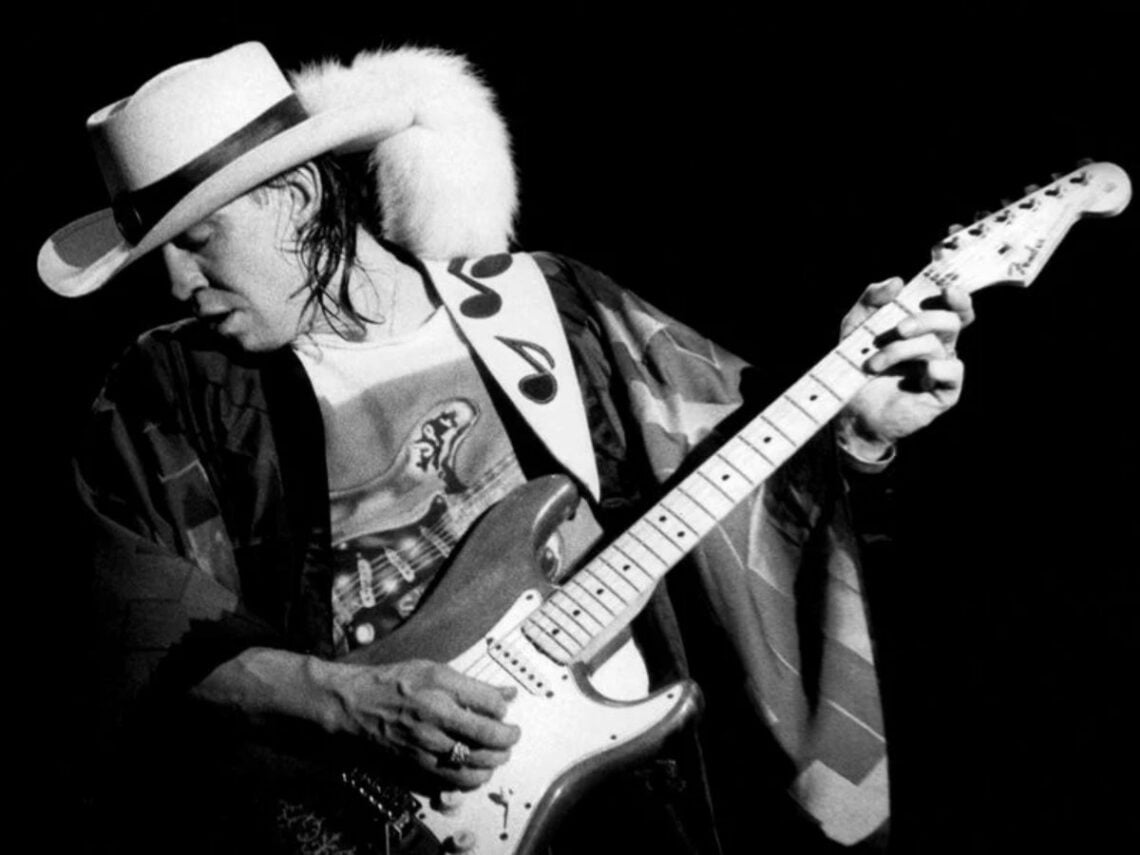
The four guitarists Stevie Ray Vaughan called “pioneers”

The late Stevie Ray Vaughan was one of the finest blues-rock guitarists the world has ever known. Despite his tragic death in a 1990 helicopter crash at age 35, he left behind an impressive legacy. Vaughan ranks among the most technically gifted players of all time, sitting at the table with the influential bluesmen he once cited as heroes.
Because of his unquestionable talent on the six-string, Vaughan was often asked to give his opinions of the work of other guitarists. When sitting down with Guitar World in 1988, he turned his attention to four guitarists who inspired him: Albert Collins, Albert King, B.B. King and Otis Rush. He described them as “the pioneers and the innovators”, labelling all their respective records as “unbelievable”.
“They’re the pioneers and the innovators, and they deserve respect for that,” Stevie Ray said. “Listening to all the great records by Albert King and Albert Collins, Otis Rush, B.B. King. There’s millions of records we could talk about, and each one of them is unbelievable in its own right”.
Nicknamed ‘The Master of the Telecaster’, Albert Collins was one of the most consequential electric blues guitarists and singers, complete with a distinctive playing style that fused natural power with alternate tunings and a capo. His most memorable efforts include ‘Cold, Cold Feeling’ and ‘Blues Monday Hangover’. Notably, in 1989, Stevie Ray Vaughan and his brother Jimmie shared the stage with Collins at the 1989 Bush inaugural ball.
As for Albert King, he was one of the first guitarists to popularise Gibson’s Flying V guitar model. Combining soul and blues with genuine grit, his most famous track is ‘Born Under a Bad Sign’, which was later covered by British blues obsessives Cream. Famously, King also once claimed that Jimi Hendrix couldn’t play the blues. Vaughan and King were good friends and played together in 1983 for the Canadian network CHCH-TV, demonstrating the lofty company that Stevie Ray Vaughan kept.
Otis Rush was another guitarist who had a tremendous impact on modern blues. A fan of slower moments and elongated string bending à la Buddy Guy, he popularised West Side Chicago blues and influenced the likes of Eric Clapton, Peter Green and late Bob Dylan guitarist Michael Bloomfield. Rush was also known for his unconventional approach to the set-up of his guitars, with the low E string strung at the bottom of the set.
B.B. King, meanwhile, is undoubtedly the most famous of the four “pioneers” Stevie Ray Vaughan mentioned, with his soulful playing and vocals so instrumental in spreading the gospel of the blues that he is dubbed ‘The King of the Blues’. Carving out his own space, King took the genre in a more profound direction than ever before, aided by the emotive call of his trusty guitar, ‘Lucille’.
Speaking as part of the 1996 TV special, A Tribute to Stevie Ray Vaughan, B.B. King had his own praise for the late guitarist. He said: “Stevie had many ways of showing you that he had not only talent but he had the feel for playing Blues. His hands seemed to be flawless the way he moved with it.”
B.B. King continued: “When I play, I play sort of like talking, you know, syllables. You say a sentence here, a sentence there. Then I have to stop and think for something else to keep my conversation going. But his didn’t seem to be that at all. It was fluent. He flowed when he played. So he could get something going, and it was like a song, and it would just go on and on. Ideas continuously flowed. I don’t have that. There is not a lot of people that I hear that have that. But Stevie had it.”
Watch Stevie Ray Vaughan and BB King in action below.
