


The five most preposterous age gaps in cinema history

We’ve all seen movies where the age of the actors is so distracting that it’s hard to pay attention to anything else. Think of all those high school movies and TV shows in which 30-year-olds are playing 16 and 17-year-olds. It’s a bit insulting to the audience’s intelligence, but at least they all look the same age. The most annoying version of this is when the gap between the actors’ ages makes zero narrative sense.
It seems like half of all cinematic romances involve a male character who is clearly old enough to be the father of his female love interest. Sean Connery, for example, was 69 when he wooed a 30-year-old Catherine Zeta-Jones in the 1999 movie Entrapment. In that instance, the discrepancy was so glaring that some critics called it out, but more often than not, it’s treated as completely normal for an actor who is in his fifties to be dating a woman in her 30s.
These sorts of romances happen in real life, of course, and lead to very happy long-term relationships, but the age discrepancy is almost certainly a topic of conversation for those couples, unlike in movies. Sylvester Stallone was 18 years older than Sandra Bullock in Demolition Man, a fact that did not come up in the script, even in passing. Gene Kelly was 21 years older than Debbie Reynolds in Singin’ in the Rain, and again, this is not part of the dialogue, let alone the plot. It would probably be easier to make a list of the on-screen couples who aren’t a decade or more apart rather than those who are.
And yet, romantic pairings featuring an older man and a younger woman are not the most horrendous examples of age gaps in movies. The worst age gap, hands down, was in a film that won the ‘Best Picture’ Oscar, and it was only 11 years.
The five most outrageous age gaps in movie history:
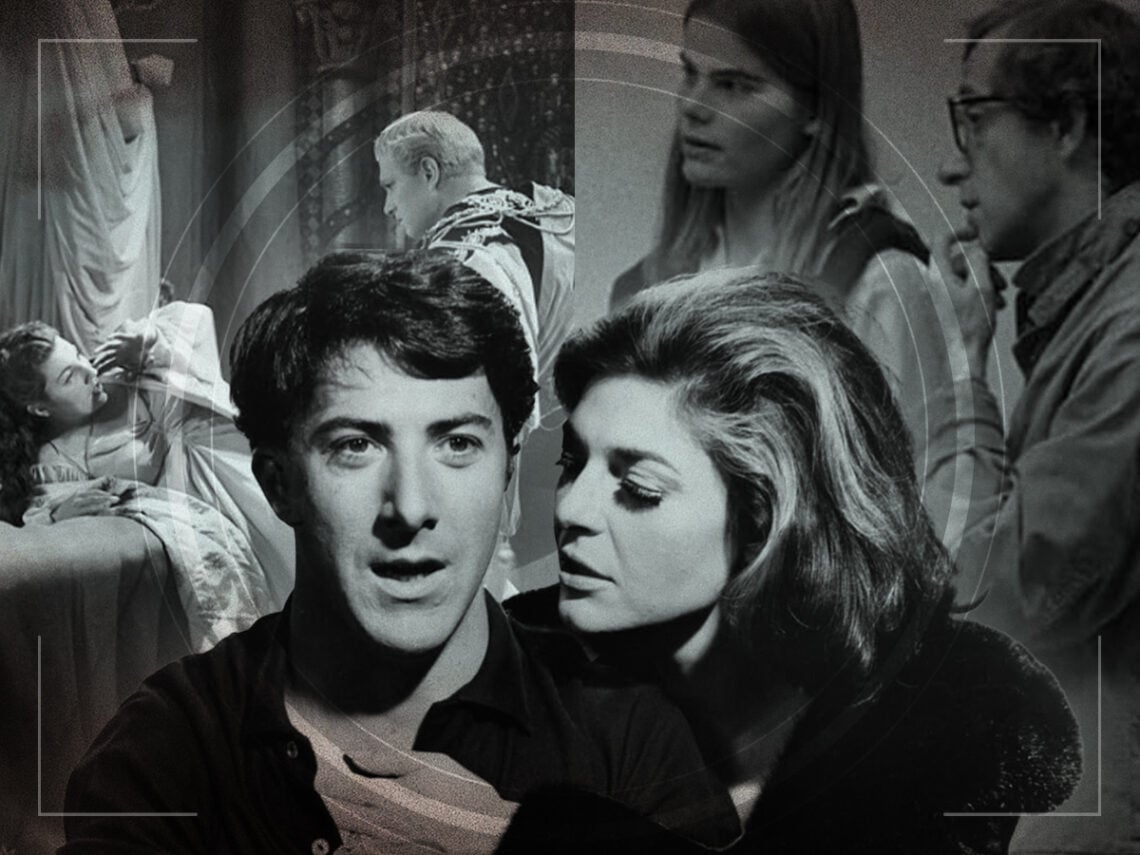
Anne Bancroft and Dustin Hoffman in ‘The Graduate’ (1967)

It was, by all accounts, surprisingly easy to cast the character of Mrs Robinson in Mike Nichols’ The Graduate. As a suburban housewife who has an affair with her college-age daughter’s boyfriend, the role had to be played by a middle-aged actor, but there weren’t many well-known actors in that demographic who Nichols wanted. Doris Day, Ava Gardner, Ingrid Bergman, and Rita Hayworth were all considered, but from the beginning, he had his heart set on Anne Bancroft, a Tony and Oscar winner with an ability to portray cold, hard rage like few others.
The only trouble was that Bancroft was 35. If you’re doing the math, 35 is pretty young to be the mother of a 20-something. The math is even worse when you realise that Dustin Hoffman, who plays the graduate with whom Mrs Robinson has a passionless affair, was only six years younger. Katharine Ross, who played Bancroft’s daughter, was only eight years younger. All of them look exactly as old as they are, which is to say that Bancroft and Hoffman look very age-appropriate for each other, even though a key point of the script is that she’s from a completely different generation.
Jessie Royce-Landis and Cary Grant in ‘North by Northwest’ (1959)

In the latter part of his career, Cary Grant was consistently paired with much younger co-stars. Audrey Hepburn, Grace Kelly, and Eva Marie Saint were all more than two decades younger. He turned down plenty of these pairings on various occasions because he didn’t like the optics, but he did look preternaturally youthful and glamorous in his 50s. Most of those age gaps are relatively easy to forgive, especially given that his characters often address the fact head-on, but the one that is more insidious is with Jessie Royce-Landis in North by Northwest, Alfred Hitchcock’s thriller about mistaken identity.
Landis played his mother in the film even though, at 63, she was a mere seven years older than he was. The costume department worked overtime (presumably) to get around this inconvenient fact by dressing her as if she were an elderly woman. Meanwhile, Grant had a spiffy tan, tailored suits, and several scenes that involved running. Still, they look more like siblings than like parent and child.
Angela Lansbury and Laurence Harvey in ‘The Manchurian Candidate’ (1962)<br>

The age gap in The Manchurian Candidate is so distracting that it might make you lose the thread of this famously convoluted plot, which is exactly the opposite of what casting directors should be aiming for when they pick their actors. Directed by John Frankenheimer, the film stars Frank Sinatra and Laurence Harvey as Ben Marco and Raymond Shaw, two soldiers who return home from the Korean War. Shaw has been brainwashed into becoming a sleeper agent for the communists, and Marco suffers from nightmares that become evidence of his colleague’s new assignment. Meanwhile, Angela Lansbury plays Shaw’s mother, a ruthless political operative who capitalises on her son’s supposed heroism for her own gain.
It’s all very twisty and complex, but whenever Lansbury and Harvey are on screen together, all of the political intrigue and hypnosis fades into the background and the abject absurdity of the casting comes roaring into focus. At 37, she was only three years older than he, and although they worked hard with the lighting and costumes to make her look like she was in her 60s, the facts are obvious. To her credit, Lansbury did such a stellar job playing a woman ageing out of middle age that she earned an Oscar nomination. Later, she would claim that no one had tried to make her look older and that she had simply acted her way into pensioner territory, but not even Meryl Streep could have pulled it off. Believe it or not, there were plenty of other actors who could have played the role and who would have made much more sense from a purely biological perspective.
Mariel Hemingway and Woody Allen in ‘Manhattan’ (1979)

Plenty of ink has been spilt about Woody Allen’s preoccupation with girls so young that they are still legally children. Following allegations against him of sexual abuse in recent decades, including by his daughter, Dylan Farrow, it’s impossible to look the other way when viewing this aspect of his movies. There are plenty of entries in his filmography that offer stomach-churning age gaps, but the most obvious is in 1979’s Manhattan. In the film, Allen plays a 42-year-old comedy writer ‘dating’ a 17-year-old school girl, played by Mariel Hemingway. Allen was 43 and Hemingway was 17 at the time of filming.
The movie earned rave reviews, nearly all of which ignored the elephant in the room. Because Allen almost always played self-deprecating parodies of himself, the age gap was supposedly evidence that he was simply poking fun at the kind of gross, tragic middle-aged man who would do something as sleazy and borderline illegal as dating a high school student. This is undercut by the fact that two women have claimed to be the inspiration for Hemingway’s character because – you guessed it – they started ‘dating’ Allen before they were 18.
Eileen Herlie and Laurence Olivier in ‘Hamlet’ (1948)

Without question, the weirdest, most unbelievable and egregious age gap of all time came in 1948, when Sir Laurence Olivier, that paragon of British theatrics, cast a woman who was 11 years younger than he was to play his mother. This one is so embarrassing that it’s hard not to feel sorry for him. He was, after all, a 40-year-old playing Hamlet who, at the time, most critics and theatre practitioners agreed was approximately 16 years old. Eileen Herlie, who played Queen Gertrude, was 29. The only explanation for the decision is that Olivier wanted there to be a strong Oedipal undertone to the relationship and couldn’t conceive of finding an older woman attractive.
As the director, producer, star, and script adapter, Olivier was to blame for this madness, but the Academy Awards deserve some condemnation for showering him with Oscars for it. Hamlet became the first British movie to win ‘Best Picture’, and Olivier took home the statuette for ‘Best Actor’.
Strangely enough, Herlie was something of a Queen Gertrude specialist, and Olivier wasn’t the first (or worst) director to cast her at a blatantly incongruous age. Two years before, when she was a mere 27 years old, she played the role opposite Peter Glenville, who was 32. In 1964, she was slightly more age-appropriate, though Richard Burton, who played Hamlet, was 39.
