


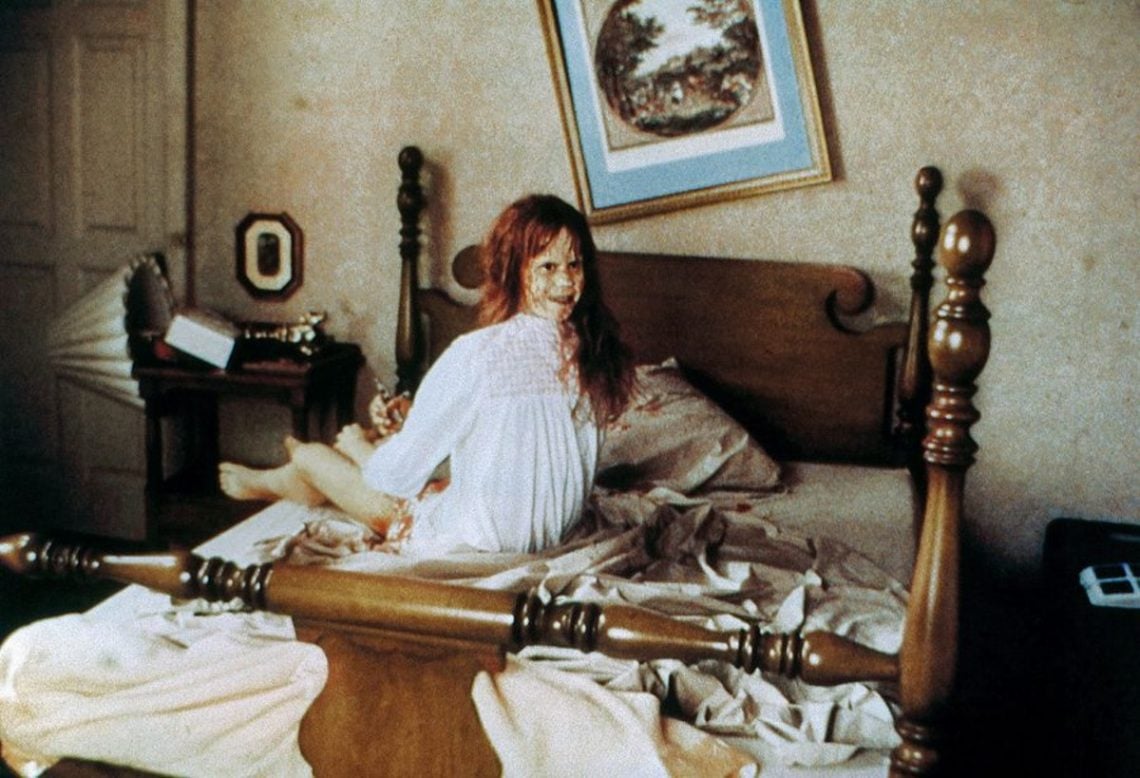
‘The Exorcist’: still the greatest horror movie of all time?

The reactions to William Friedkin’s 1973 film The Exorcist were unlike anything the cinema industry had seen since the release of the Lumière brother’s Arrival of a Train in 1896, whereby viewers ran away from the screen believing that they would soon be trampled by a steaming locomotive. Reports of people fainting, experiencing severe and even suffering from heart attacks simply heightened interest in the supernatural ‘70s flick, helping the film to generate a legacy of being the greatest horror film of all time.
Released to mass public hysteria, Friedkin’s film, based on the novel and screenplay by William Peter Blatty, was initially conjured as a drama about the mysteries of faith rather than a strict horror movie with visceral moments of terror. Of course, The Exorcist, which tells the story of a teenage girl, Regan (Linda Blair), who becomes increasingly possessed by a mysterious entity, is indeed a horror film, with Friedkin’s dramatic intentions helping to give the feature a great deal of longevity.
The Exorcist may be known for its moments of guttural terror, such as when Regan’s head turns 360 degrees or when she fires green bile from her mouth, but it is the existential questions that the film asks of its audience whilst grappling with the young protagonist’s physical pain and mental suffering that really digs beneath the skin. To understand The Exorcist just as an icky body horror exploration is to miss the devil in the detail.
A perilous journey into the psychology of human faith, guilt and despair, modern viewers of Friedkin’s film might be surprised to see that moments of intimate horror screentime with Regan are few and far between. Blatty and Friedkin’s focus is instead on Max von Sydow’s Father Merrin, and particularly Jason Miller’s Father Karras, the pair of priests who are tasked with investigating the claim of demonic possession.
Whilst von Sydow was well known to arthouse audiences for his role in Ingmar Bergman’s iconic 1957 film The Seventh Seal, Miller was a total newcomer to the silver screen, having only previously acted on stage, with Friedkin choosing him thanks to his own Catholic education and past studies to be a Jesuit priest. It is Karras’ spiritual journey that lies at the heart of Friedkin’s film, with Miller providing the perfect insecure performance to make his character’s religious conflicts all the more believable.
Haunted by his own brittle faith, Karras’ insecurities follow him like an omnipotent weight, with a brief encounter with a homeless man on the subway, who utters, “Can you help an old altar boy, Father?”, coming back to pester his conscience later in the film. Alone with the young possessed girl, tied down to her bedposts, the priest says, “show me Regan, and I’ll loosen one of the straps,” to which the demon replies in the same desperate tone as the homeless man: “Can you help an old altar boy, Father?”.
Taking just a moment to internalise the utterance, Karras looks back over his shoulder to the possessed girl on the bed, who happened to tap into the most complex of his own personal anxieties. The devil’s insidious omnipotence hits him with the same force as Christ’s all-loving eye, reaffirming his belief in Christianity whilst forcing him to question his own mortality and disposition.
This central conflict is layered in-between a masterfully captured horror tale that incorporates an eerie soundtrack, groundbreaking special effects and a rich contemporary subtext that alludes to the growing women’s independence movement as well as the continued conflict of the Vietnam war. Where modern horror starts with visceral set pieces and works backwards to integrate a competent story, Friedkin began with a complex tale that juggled several theological quandaries and trickled in exclamations of pure terror.
