


Anatomy of a Scene: The glorious ending of Brian de Palma’s ‘Blow Out’

If Quentin Tarantino is picking something out as a quality movie, then you can damn well be sure that it’s of a high standard. The director once said that he was blown away by John Travolta’s performance in Brian De Palma’s 1981 crime thriller Blow Out, a project which famously stars the likes of Nancy Allen, John Lithgow and Dennis Franz.
Based on Michelangelo Antonioni’s 1966 film Blowup, De Palma’s work focuses on Jack Terry, a sound effects technician played by Travolta, who makes a living working on the sound for low-budget horror films. One day, Jack unintentionally captures evidence of the assassination of a presidential candidate, leading to him trying to piece together the crime.
Jack also becomes wrapped up in the life of Sally Bedina, a young woman who had been in the car with the presidential hopeful when he was killed. De Palma’s movie is nothing short of astounding and provides a new take on the neo-noir thriller genre, with Travolta giving one of his best-ever performances.
There are several memorable scenes throughout Blow Up, but its very best arrives at its conclusion. There’s a serial killer on the loose called Burke who is trying to cover up the assassination by destroying Jack’s tapes and attempting to murder the witness, Sally, having already killed three of her look-alikes.
When Sally meets with whom she presumes to be a reporter who will reveal the truth about the assassination, both she and Jack are distressed to find that it is actually Burke who leads her up to a rooftop overlooking a parade. Jack is alerted to Burke’s involvement and races to rescue his new lover.
Jack barges his way through the parade as fireworks litter the sky. The score is poignantly sombre and tears at the heartstrings. The crowd is oblivious to Jack’s plight as Burke drags Sally towards the Liberty Bell. A piano motif amplifies Jack’s desperation as Sally’s weeps and moans echo out into the night sky.
Travolta displays a genuine sense of torment, and it becomes clear that he is indeed in love with Sally, amplified by the tense drama of the score. It’s easy to see why Tarantino admires Travolta’s effort so much and why it led him to cast the actor in Pulp Fiction, and the final scene of Blow Out is more than enough proof of his performative quality.
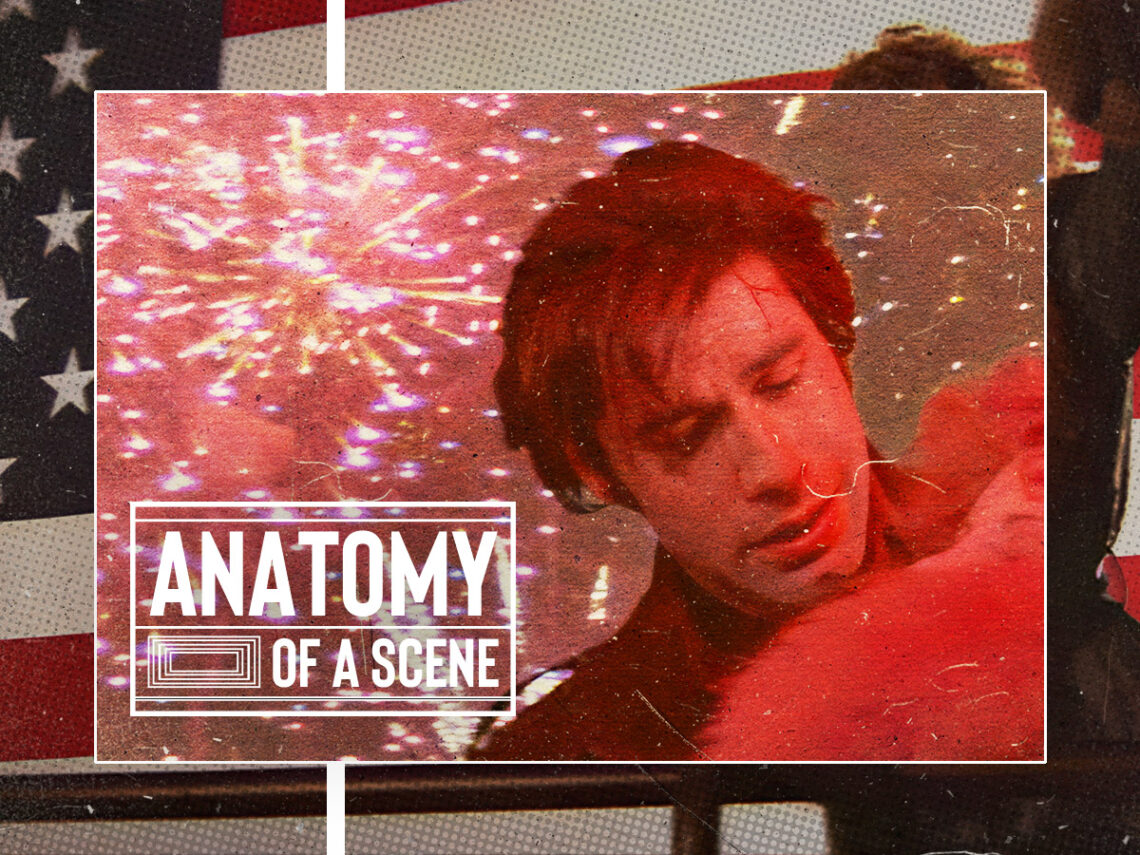
There’s a beautiful slow-motion-tracked sequence of Jack running to Sally’s rescue against the glow of the fireworks. He finally makes his way to Sally and grabs Burke just as he is about to stab her for the final time. Jack plunges the blade into Burke’s chest against the wonderfully positioned United States flag.
And that use of the US flag is of no small significance. After all, the film details the assassination of a presidential hopeful, an event that bears significant meaning in the country itself. To put the drama of the scene against the backdrop of the American symbol goes some way to show that the very act of murder is an all too frequent occurrence across America’s many states, and perhaps the red of the flag symbolises Jack’s anger and anguish, striped against his future blue sorrow.
As a matter of fact, the sound engineer is too late. The stringed score pierces one more as De Palma zooms in on Jack’s lover. She’s dead, her neck dripping with a single horizontal line of red blood. Jack knows but can’t quite believe what he’s seeing. The best shot in the entire film sees Jack cradling the dead Sally in his arms as the fireworks blast out eternally in the sky. The piano is isolated and makes the entire scene even more heartbreaking and beautiful.
We cut to Jack on a snowy day, sitting on a park bench, listening to his tapes of Sally’s suggestions for their future together. But we’re not quite through with the heartbreak just yet as Jack sorts out the reels of recordings that he made of Burke murdering Sally, all with a forlorn and depressed look in his eyes.
As Sally makes her final scream, De Palma cuts to Jack in the editing room with his boss. He’d been looking for the perfect scream for his low-budget horror, and the scream just so happened to be Sally’s. “Now that’s a scream,” he says. Jack smokes and repeats, “It’s a good scream, it’s a good scream.” The scream rings again, and Jack puts his fingers to his ears, knowing that he will be hearing it for the rest of his life.
There’s a great irony in the film’s final moments. Jack’s boss had been on the verge of sacking him, as he was no longer interested in his menial work, instead becoming wrapped up in a quest for justice and love, and the fact that his torment is what completes the low-budget horror he’d been working on for so long is as amusing as it is tragic.
Jack’s audial capturing of Sally’s demise means that he keeps his job, but it comes at a greater cost, sacrificing his heart, echoing perhaps the Book of Mark, “For what shall it profit a man, if he shall gain the whole world, and lose his own soul?” The end of De Palma’s 1981 film is arguably one of his best and easily is most heart-destroying.
Check out the scene in full below.
