


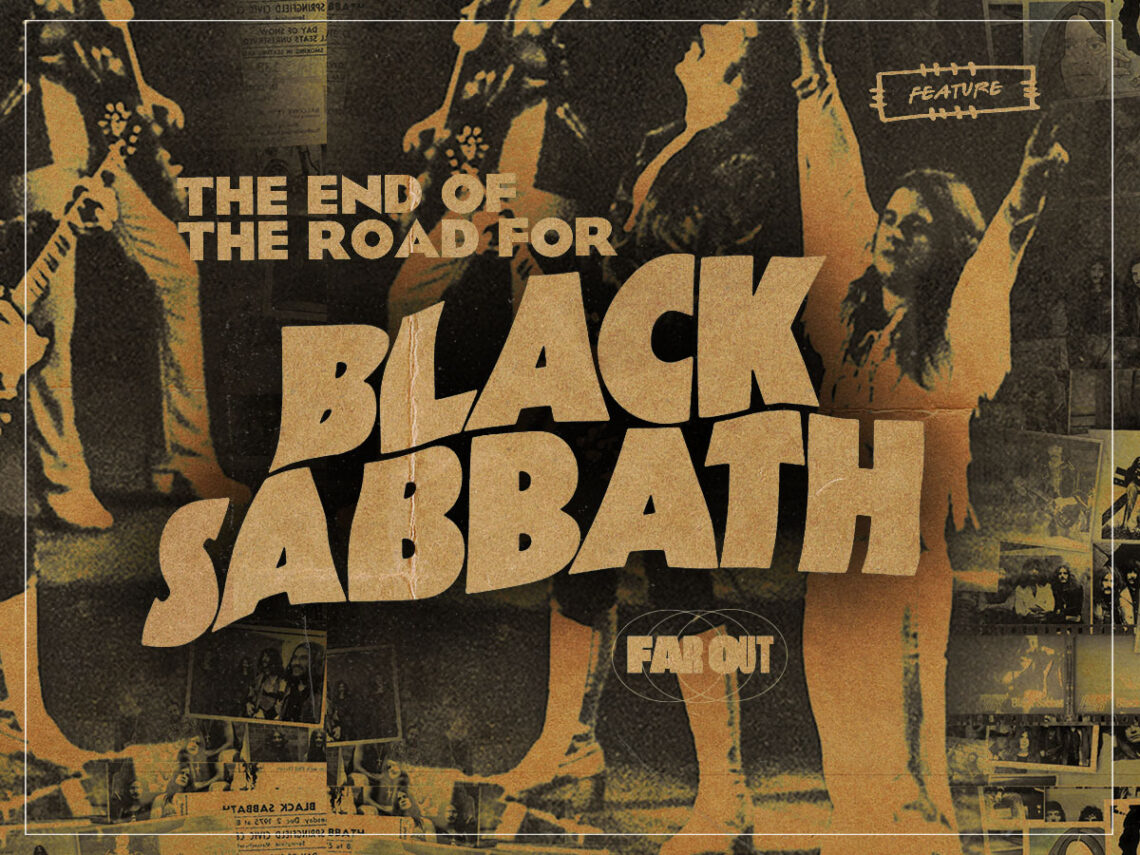
The End of the Road for Black Sabbath: The breakups, brawls and bats that led metal’s greatest band to “the greatest heavy metal show”

“If I could try to explain this situation,” Ozzy Osbourne said in 1982, facing questions about bats, tats, and everything in between, “It’s like there’s a wild man in everybody. All I am is a conductor of mayhem.” The end is nigh. It’s getting dark. But it’s not black yet. Black Sabbath are at their final curtain call.
A swan song wouldn’t taste so bittersweet if it were not for the legacy that led us to this heavy farewell. Sabbath’s final adieu wouldn’t be complete without one last riveting bow—an unfiltered echo of the darkness they transformed into legend. The poignancy of such an ending is attached to the start, when Sabbath first stood before a sea of tie-dye and peace signs, their gaze as heavy as stone.
As Osbourne, Tony Iommi, Geezer Butler, and Bill Ward quashed flower power with the fervour of unkempt musical warriors, they offered a signal of new times afoot with a sharp jolt in a new direction. The intention wasn’t supposed to be gentle, nor would it spark a brief fad. Instead, it took the band’s bleak, disillusioned surroundings and became them, embodying the type of occultist mania many had long felt lurking within.
Black Sabbath were extreme from the outset, radicalised only by the definition of their own headiness and ominous as a means of epitomising their own darkness. However, despite the longevity of their tenure and the ever-strengthening suspicion that Osbourne’s drive would far outlive his ability to adorn centre-stage, the mystical metal entity was always, without a doubt, set to burn out—or, as some may say, go out guns blazing.
Chaos has always been the common denominator within Sabbath’s story. Even when their hellish flames seemed eternal, at the peak of their prolific powers, at the crux of the mayhem was an overwhelming sense of fleeting imminence, where the beast could one day dissolve, still alive only by its own will to survive. The drugs, the disagreements, and the infamous parties fed the hunger until it didn’t, until what was once fullness turned into emptiness.

However, even after Butler, Iommi, Osbourne, and Ward seemed to run out of steam and sense, they remained at the forefront of metal, breathing life into a fickle genre with the utmost vehemence when excess pushed them to their limits. And that it did; breakups and changing lineups were always going to be threats to the infinite Black Sabbath story, but then came another concern about whether they should even continue at all.
Why did Black Sabbath break up?
These mishaps almost pushed them to call it a day multiple times. It’s undoubtedly what pushed the others to exile Osbourne in the 1970s when his abuse had grown insatiable, with a shift to Ronnie James Dio encouraging an entirely new era for the band. Over the years, however, and with a decreasing interest in everything Sabbath had worked hard to achieve, they officially ended their run in 2017, effectively giving into the temptation of a break that had been looming since the start.
It never really felt like the appropriate ending, though. And, in the years that followed, that itch only enhanced when it was clear the cards were never really off the table, at least not according to Iommi. Perhaps this started with an overwhelming sense of sentimentality, one that led them to announce their latest move to mark their departure more fittingly.
For instance, when the band delivered a final farewell show in 2017 with a career-spanning set that ended with ‘Paranoid’, it ushered Osbourne into an immense period of self-reflection as he lamented everything the band meant to him and everything that he had given it back in return. As he explained to Kerrang: “How can I say it? It was kind of emotional for me.”
Addressing their legacy, he continued: “I thought, ‘Fucking Hell, when we started this thing, we had no idea it was gonna be as successful as it is, or last as fucking long!’ We never thought that there’d be this fucking folk-hero thing about it. We were four lads from Birmingham who reached this great height. I still can’t really accept the fact that it’s never gonna happen anymore. When you start a band, of course, you want success, but to last as long as we have?”
Since then, Ward quashed any speculation about another reunion despite Iommi seemingly leaving the door open just a crack. Beyond their non-committal remarks lurked another concern among peers and fans about whether they would even be up for the physical challenge. With Osbourne’s declining health in tow, any attempt at reigniting the old flame seemed increasingly unrealistic, with Osbourne himself even saying the entire prospect seemed near impossible.
Where is Black Sabbath’s farewell concert taking place?
All of this became redundant for all intents and purposes the moment people started entertaining the old adage that always guarantees hope, no matter how unreasonable—never say never. Although Black Sabbath seemed to have attempted to hang their hat with their first goodbye in 2017, the dust never settled. At least, it never felt like it until now.
On July 5th, the band plans to mark its last and final departure with a bang, performing its final farewell concert along with some of the genre’s biggest and most legendary veterans, such as Metallica, Slayer, Pantera, Gojira, Halestorm, Alice In Chains, Lamb Of God, Anthrax, and Mastodon. “It’s my time to go Back to the Beginning….time for me to give back to the place where I was born,” Osbourne said in a statement. “How blessed am I to do it with the help of people whom I love. Birmingham is the true home of metal. Birmingham Forever.”
Rage Against The Machine also delivered the concert-defining headline fodder by describing it as “the greatest heavy metal show ever,” which, considering that all of these entities will be coming together to celebrate the legacy of one of the biggest and most genre-defining groups in history, is a bold and fitting statement. Still, it’s unclear what sort of energy might appear at the concert, just as it remains uncertain whether Sabbath will perform with the same level of intensity that defined them in the beginning.
However, with each passing moment, it becomes clear that that’s beside the point. Until now, Black Sabbath have graced every corner of the metal community by transcending the blood-soaked mania of their past endeavours. Now, there might be no bats, no brawls, or no means of losing everything they have gripped so closely tensely over the years. Now, Sabbath might adorn the stage with an unexpected level of withdrawn reverence, but in that lies a quiet confidence that has never been so loud.
The end is nigh. It’s getting dark. But Black Sabbath? Their legacy will never fade to black.
