


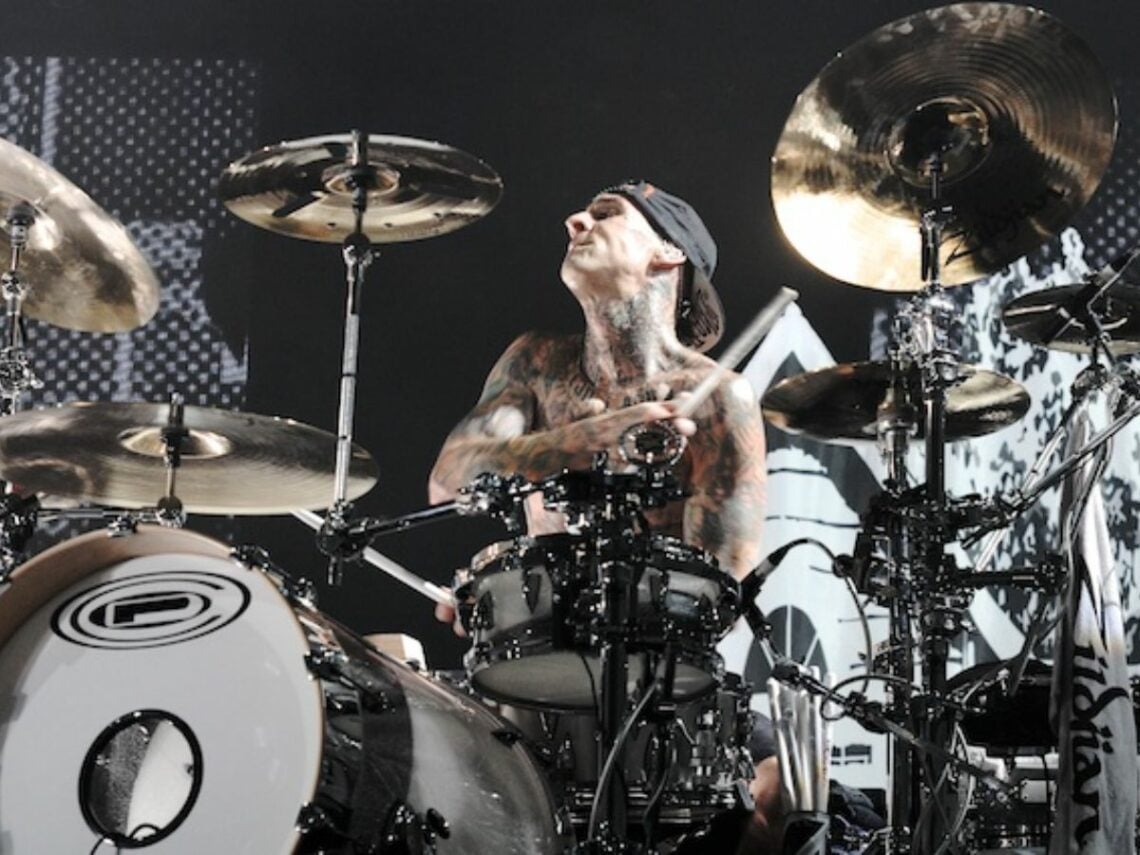
The drummer Travis Barker called one of his biggest influences

There are seldom few drummers who can hope to touch the mantle that Travis Barker set for himself. Although pop-punk music isn’t known for having the most intricate playing style among its musicians, Barker is in a league of his own, bringing a layer of production work to his roster and becoming one of the most celebrated musicians in the process. Despite his pedigree as a punk, Barker’s main hero has a few more complex parts up his sleeve than an average punk drummer.
When speaking about his influences, Barker listed some of the biggest drummers in the world of hard rock, from the pounding ferocity of John Bonham to the showmanship of Mötley Crüe’s Tommy Lee. As he got into the intricacies of his playing, though, Barker turned to Stewart Copeland of The Police for giving him his signature style.
Speaking to Drum, Barker marvelled at the different uses Copeland got out of his drum kit, remarking: “I loved him for all his hi-hat work and his unexpected parts on Police songs. ‘Message In A Bottle’ would have been so different played by a ‘normal’ drummer. How he incorporated ska and reggae into rock music was refreshing”. Despite being born and bred in the punk rock scene, The Police were always a more sophisticated band that The Sex Pistols, with Copeland infusing every genre that he could under the band’s signature sound.
Despite Sting having a knack for crafting pop melodies, Copeland was the one driving the tune most of the time, either laying back into the groove on songs like ‘So Lonely’ or playing in lockstep to create a clock-like precision on ‘Every Breath You Take’. That versatility crossed over when Barker was starting out. Initially working with The Transplants, Barker remembered using those ska rhythms to inform most of his playing at the time, either laying back in the groove or flying off the handle on a complicated piece.
As Barker switched to Blink, his approach became more about what he could add to the song. Much like Copeland, Barker was about doing something different to make the song breathe. When Barker first joined the band in the late 1990s, Tom DeLonge remembered him changing the entire dynamic when he enter the fold, saying: “He would say stuff like ‘why don’t I flip the beat around like this’, and I would say, ‘Oh well then I wouldn’t be as dynamic, I’ll maybe play a note here’. And then this thing that was starting out as pretty simple became kinda clever”.
Barker’s challenges with expanding his horizons didn’t have to come from behind the drum kit. Instead of relying on beating the hell out of his kit, Barker was about making something stand out in the mix, keeping a tight groove on ‘I Miss You’ that isn’t too dissimilar from what Copeland had done with his use of hi-hat on early Police records. By the time he was writing the intro to ‘Always’, he didn’t need to use drums, relying on his sticks to create a cascading sound before Mark Hoppus came in.
The Police might not have been the coolest band to have down as an influence, but that didn’t matter to Barker. It was all about the song and seeing how the drums could add extra flavour to what could have otherwise been a bland tune.
