


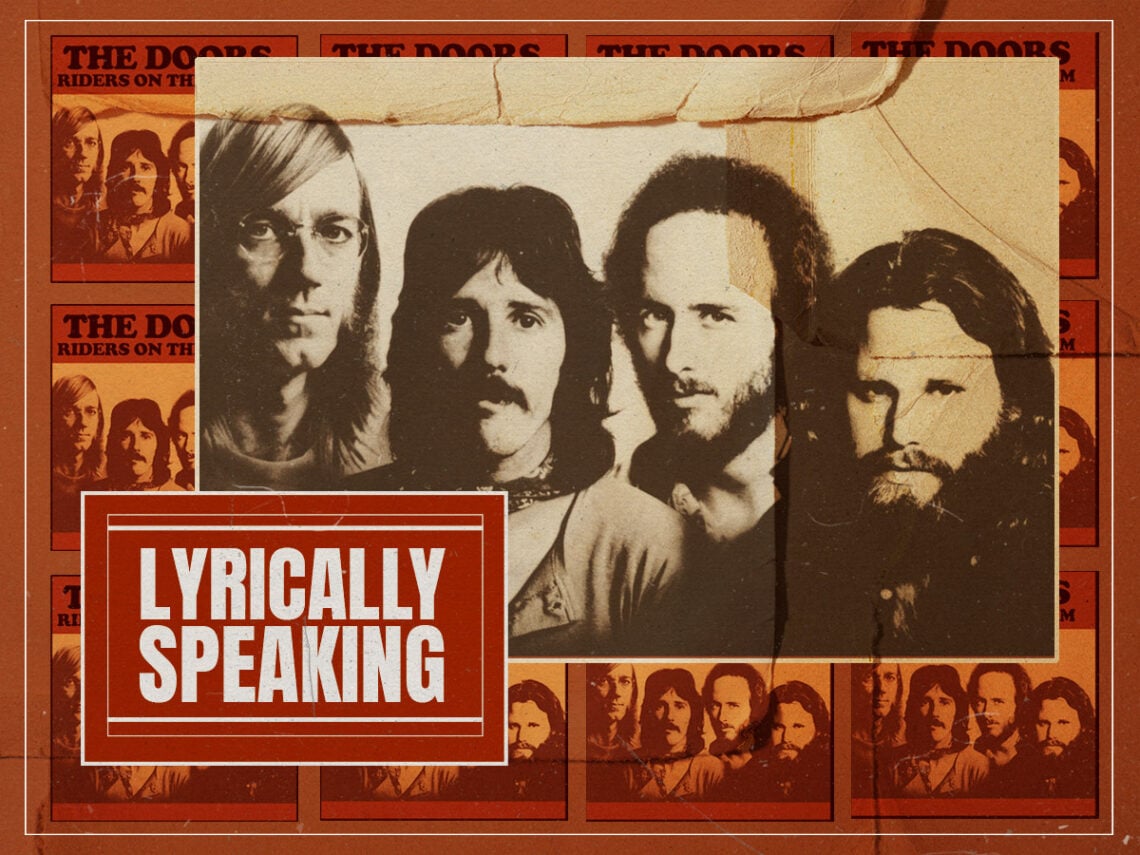
Lyrically Speaking: The Doors’ eerie swansong, ‘Riders on the Storm’

I distinctly remember the first time I heard The Doors‘ 1971 classic ‘Riders on the Storm’. The eerie intro crept into my consciousness in perfect synchronicity with a drizzly twilight scene developing through the back window of my family car. As a youngster, I wasn’t apt to appreciate the song’s instrumental nuances, but Jim Morrison’s lyrics had my full, undivided attention as I hurtled into the night with fear.
A fitting closer for LA Woman and the last song Morrison ever recorded, ‘Riders on the Storm’ is a seven-minute journey into the depths of countercultural depravity. Thanks to Morrison’s poetic mystique, the lyrics present a plot of murder on the road, which can be interpreted in various ways.
Timed to perfection with the daunting hippie hangover period, the song contains flashes of the Manson Family murders and even the brutalities in Vietnam. Such abstractions align with The Doors’ rung on the countercultural ladder, but Morrison was actually inspired by a horrific true crime story when writing ‘Riders on the Storm’.
The opening lines of the second verse, “There’s a killer on the road / His brain is squirmin’ like a toad,” unambiguously reference the story central to the song. Drawing the track ever-closer to the heart of American culture are the words “on the road,” which evoke the sense of freedom the country promises and, of course, Jack Kerouac’s 1957 novel, which a teenage Morrison consumed voraciously.
Like many of The Doors’ protracted jazz-infused tracks, ‘Riders on the Storm’ evolved from a jam session. While toying with ‘Ghost Riders In the Sky’, the 1948 cowboy song by Stan Jones that Johnny Cash and Bing Crosby later recorded, Morrison changed the titular refrain to something more personal since he had occasionally referred to himself as a “rider on the storm”.
If we picture Morrison at the wheel on a vast American highway, the “killer on the road” was inspired by the serial killer Billy Cook. This man was a hitchhiker and, as the lyrics warn, “if you give this man a ride, sweet family will die.” Unfortunately, Cook gave hitchhikers a bad rap in December 1950 when he forced a family with three children to drive him aimlessly for three days before murdering all five and dumping their bodies down a mine shaft.
While attending Florida State University, Tallahassee, in the early 1960s, Morrison would often hitchhike 280 miles to see his girlfriend in Clearwater, so it was a scene he was intimately familiar with – except for the murder part. “Taking chances on redneck truckers, fugitive homos, and predatory cruisers left an indelible psychic scar on Jimmy, whose notebooks began to obsessively feature scrawls and drawings of a lone hitchhiker,” biographer Stephen Davis wrote of Morrison’s hitchhiking experiences in Jim Morrison: Life, Death, Legend.
In his biography, Davis posits that much of Morrison’s inspiration for ‘Riders on the Storm’ came from within, as the troubled performer conjured a messianic alter ego, perhaps by the anagramatic name Mr. Mojo Risin’. “An existential traveller, faceless and dangerous, a drifting stranger with violent fantasies,” Davis added, “a mystery tramp: the killer on the road.”
As far as we know, Morrison was no “killer”, but as an enthusiastic drug abuser, his head was frequently “squirming like a toad,” a lyric suggestive of psychedelics. Perhaps Morrison imagined his alter ego to have a murderous edge. Or had he presaged his own imminent demise?
Listen to ‘Riders on the Storm’ below. Listening carefully, you can make out whispered overdubs that are especially clear towards the song’s close. This unsettling vocal track was the very last recording Jim Morrison made with The Doors before his death in July 1971.
