


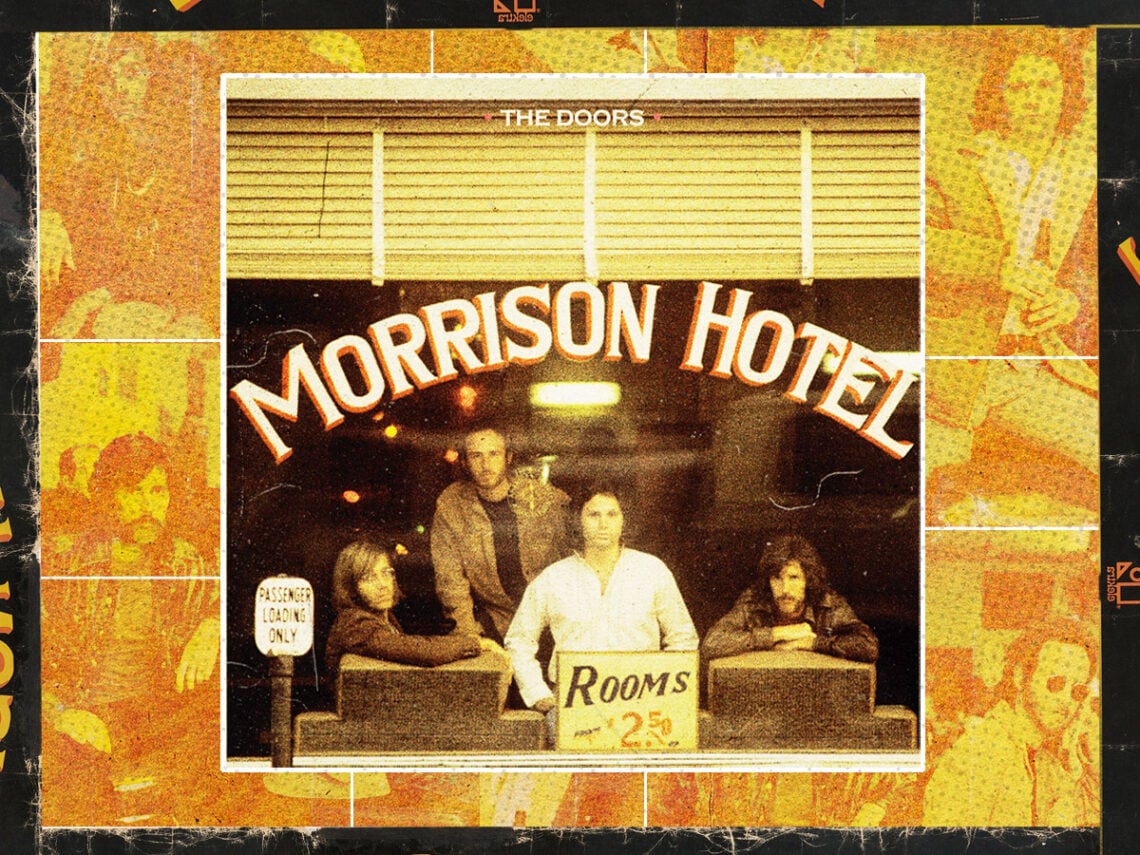
The Doors – ‘Morrison Hotel’

More than half a century has passed since the arrival of Morrison Hotel, the penultimate album by The Doors with Jim Morrison front and centre, released in 1970. The album was a welcome return to The Doors’ associated blues rock sound following 1969’s The Soft Parade. On the suggestion of producer Paul A. Rothschild, The Soft Parade was an audacious jazzy excursion noted for the inclusion of brass and string arrangements.
Morrison Hotel was consequentially a return to form in most fans’ eyes. The rather dainty compositions of the previous album were replaced by bold rock hits like ‘Roadhouse Blues’ and ‘Peace Frog’. The latter is an almost danceable hoedown that benefits from the juxtaposition of poignancy in the lyrics. The song’s introduction, “Indians scattered on dawn’s highway bleeding,” recalls a highway accident Morrison witnessed in his youth, while “Blood in the streets in the town of New Haven” refers to his onstage arrest at the New Haven Arena in December 1967.
‘Roadhouse Blues’ marks the album’s popular pinnacle with Morrison’s poetic imagery evoking an American West highway with the lines “Keep your eyes on the road/ Your hand upon the wheel” before entering a boozy roadhouse of salacious and hedonistic fantasy. Beer, at least for a short while, can help one forget that “the future’s uncertain and the end is always near.”
In one of the album’s more poignant highlights, ‘Waiting for the Sun’ hears Morrison lament the tiresome pursuit of peace amid stopping, oppressive heavy guitar drops and lighter psychedelic melodies over the titular refrain. This yearning for peace refers to the ongoing war in Vietnam, with the heavier oppressive moments no doubt channelling war’s merciless march.
Morrison continues his sociopolitical angle in ‘Ship of Fools’ as he illuminates the battle against capitalism and environmental dominion. Opening on a cheery note, he sings, “The human race was dyin’ out/ No one left to scream and shout/ People walkin’ on the moon/ Smog will get you pretty soon”.
Alas, the album isn’t without its warmer regions. ‘You Make Me Real’, the album’s only single, was written as a rather vehement declaration of Morrison’s love for his girlfriend, Pamela Courson. Returning to the hoedown energy that pervades much of the record, he passionately screams, “I really want you/ Really do/ Really need you, baby/ God knows I do.”
With all this randy roadhouse energy to one side, Morrison exercises tenderness in mellow ballads like ‘Blue Sunday’ and ‘Indian Summer’, which grants Morrison Hotel the integrity of variation, something that lacked somewhat from The Soft Parade. The former recircles romance with the simple yet effective words, “My girl is mine/ She is the world/ She is my girl.”
Of course, the bookworm that he was, Morrison wouldn’t leave us without a literary reference. ‘The Spy’, one of the album’s most inspiring moments, is a tumbling blues nod to Anaïs Nin’s erotic novel of 1954, A Spy in the House of Love. Finding himself once more in the haze of lust, Morrison sings, “I’m a spy in the house of love/ I know the dream that you’re dreamin’ of/ I know the word that you long to hear/ I know your deepest secret fear”.
The Doors undoubtedly returned to form in 1970 with this blues-rock powerhouse. Like the band’s previous successful LPs, it benefits from both sonic and topical balance. Morrison keeps the listener on their toes with tales of war, peace, lust, love, excess and hope, while the band deliver a mixture of upbeat and mellow structures to match. Morrison Hotel doesn’t impress on the level of 1967’s eponymous debut but can certainly contend as a close runner-up.
