


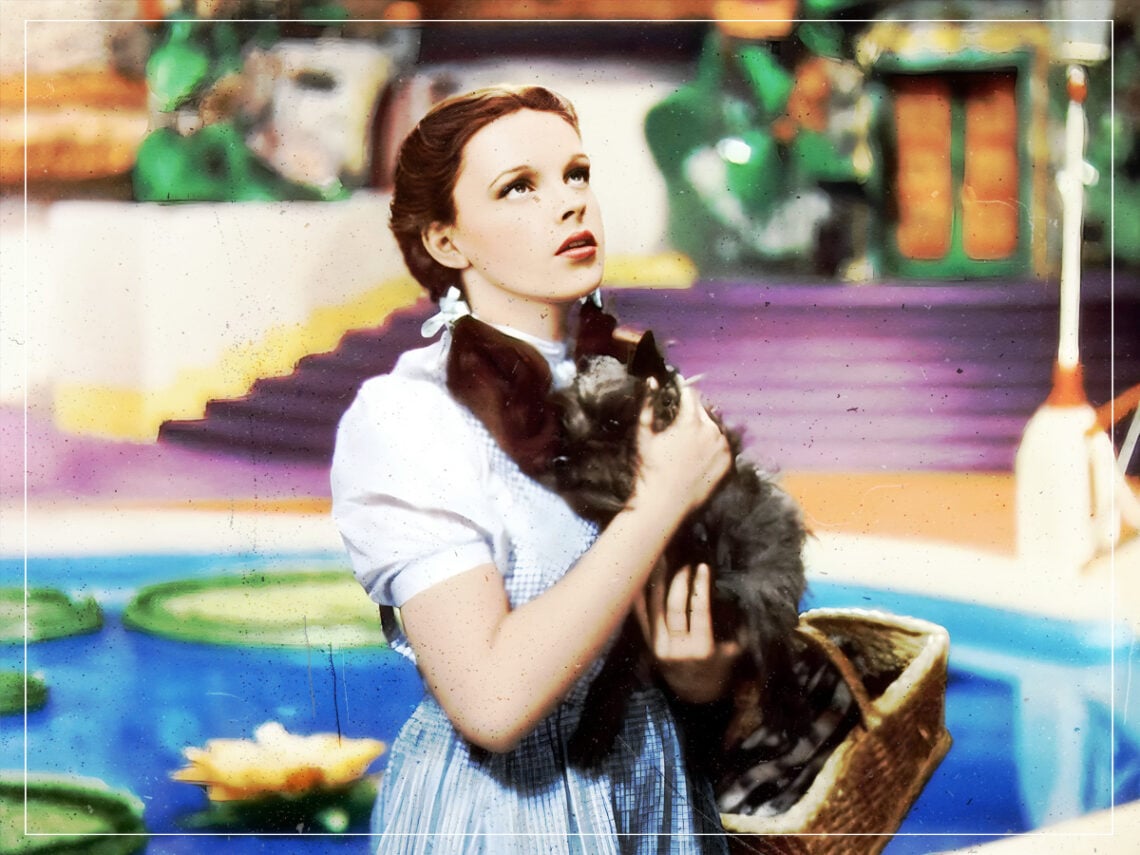
The creepy conspiracy theory about a ‘Wizard of Oz’ “hanging” scene

The Wizard of Oz might be hailed as one of the greatest fantasy and children’s films of all time, but a dark story lurks behind the silver screen.
The film’s production involved several scarcely-believable horror stories. One actor ended up in an iron lung, while another suffered third-degree burns and lead actor Judy Garland was sexually assaulted and coerced into drug addiction.
But one particularly harrowing story is more deeply rooted in the collective consciousness. For almost half a century, rumours have swirled that The Wizard of Oz set bore witness to a suicide. What’s truly disturbing is that the suicide is said to feature in the film itself. A clip of the film that preexists the internet appears to show a hanging munchkin swinging from a tree in the background of one scene.
When is the supposed Wizard of Oz hanging scene in the movie?
While Garland’s character Dorothy is on her way along the yellow brick road to meet the Wizard of Oz in the Emerald City, she comes across a Scarecrow, a Tin Man and a Lion. It is just after Dorothy meets the Tin Man that the suicide victim supposedly appears on camera.
Footage widely circulating online shows a dark oblong shape hanging from a rope between two trees in the background of the set, as Dorothy, the Scarecrow, and the Tin Man restart their journey.
The oblong shape is said to be a man hanging himself. The theory goes that the man was playing a munchkin, one of the little people who inhabit Oz in the film. His feelings for a female actor also playing a munchkin went unrequited, triggering suicidal thoughts that proved fatal.

Is the “hanging munchkin” real?
In reality, the so-called “hanging munchkin” couldn’t have been anything of the sort. Shooting of scenes involving the munchkins occurred after the shooting of the Tin Man’s introduction, along with most other scenes in the movie. This shooting chronology was because finding enough little people to play the munchkins involved talent scouting that extended into the film’s shooting schedule.
What’s more, no cast or crew member working on the movie has ever given the slightest evidence that could corroborate the theory of a suicide on set.
Instead, Metro-Goldwyn-Mayer, the studio which produced the film, has suggested that the dark shape swinging in the background of the Tin Man scene is actually a large bird. During filming, the studio hired peacocks, heroes and cranes from the Los Angeles Zoo to enhance the impression of Oz as a real living place.
It’s possible the shape is a crane or heron swinging from a perch. This possibility doesn’t exactly match up with the type of shape we see in the footage. But that doesn’t mean we have to jump to the conspiracy theory that it’s a dead person, either.

So there was no suicide related to The Wizard of Oz?
Although parents can breathe a sigh of relief that one of their children’s favourite fantasy movies doesn’t feature a dead man hanging from a rope, sadly, the story of The Wizard of Oz isn’t suicide-free. While it’s true that no actor took their own life on set, the film’s legacy is still inextricably linked with suicide.
Judy Garland attempted suicide multiple times between 1947 and 1950, as a direct result of her treatment by MGM studios during the filming of The Wizard of Oz and other movies. She became addicted to amphetamines and barbiturates during the production of Oz. The studio had prescribed them so she could stay awake for long periods of shooting before sleeping on demand.
This addiction, along with the sexual abuse she faced on set as a child, pushed her towards lifelong depression from which she’d never recover. She eventually succumbed to her struggles, inflicting on herself a fatal overdose of barbiturates 30 years on from the film she became known for.
And Clara Blandick, who plays Dorothy’s Auntie Em in The Wizard of Oz, killed herself in 1962 with an overdose of sleeping tablets and a plastic bag. She was going blind and suffering from crippling arthritis at the time. She left a suicide note stating: “I am now about to make the great adventure.” She continues to be known today for her role in one of Hollywood’s most famous pictures.
