


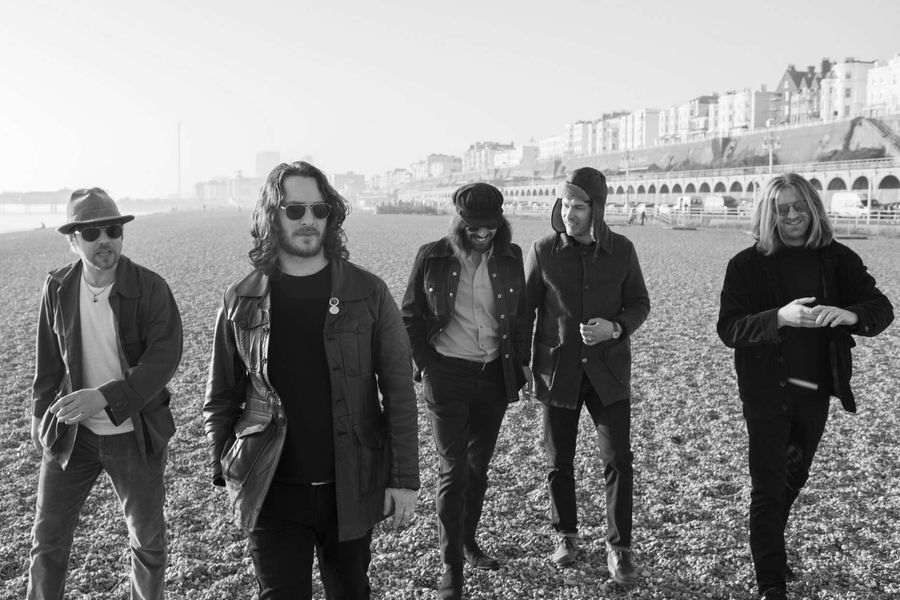
Far Out Meets: Let The Coral take you on a trip to ‘Coral Island’

20-years ago, The Coral captivated Britain with their debut single and found themselves lauded as our musical saviours sent from Liverpool with love. The two decades that followed have been full of exceptional highs and tremendous lows. For a few years, it even looked like we’d lost them for good.
The story of The Coral isn’t a straightforward or ordinary one. When they made their arrival on the music scene, they were still a bunch of fresh-faced kids from the Wirral, and in a blink of an eye, The Coral had four top-five albums to their name by 2005. Founding member Bill Ryder-Jones left the group the same year, before returning in 2006 and leaving permanently in 2008 to deal with his mental health and forge a solo career.
After touring 2010’s Butterfly House, for the first time in their career, The Coral put the breaks on and enjoyed a five-year hiatus before coming back with a point to prove in 2016.
Throughout their hiatus, the band members all still worked together through solo projects that intertwined before a resurgent Coral returned with a bang. Their last two records, Distance Inbetween and 2018’s vibrant Move Through The Dawn, have answered why The Coral still have a much-deserved seat at the table. However, Coral Island sees a change of pace and the band tee-up and swipe a speculative shot — striking it in the top corner with aplomb.
Coral Island is a double album, and is truly a record of two halves. With the first record capturing a fictional seaside resort in summer, the second is a bleak representation of the resort out of season, when all the tourists have gone home, and it’s just the locals propping up the bar. For the first half, as a listener, you taste the candyfloss, see the Waltzers and smell the burger stand — it transcends into something beautifully haunting once you enter the latter section of the record.
“It got shelved at one point. I thought, ‘Scrap it, I give up’,” frontman James Skelly tells Far Out remotely about the process of making Coral Island. “It took a while. It was supposed to be two different albums and took on different forms to get to where it got to.”
“It started as an idea of Coral Island being a place where everybody can bring their own individual thing to it,” the singer explains. “There’s Nick’s writing, Paul’s soundtracks, and there’s almost a soundtrack to the dialogue being spoken. Then there’s radio songs, experimental songs, real old songs. So we were like, ‘how do we bring this all together’?”
The answer is Coral Island. Rather than just being a figment of their collective imagination, artist Edwin Burdis turned it into a physical island emblazoned on the record’s cover. “He built it above a Japanese restaurant in Cardiff,” Skelly said proudly. “So then we started to get ideas from that, and it was always just evolving. It was a total collaboration of everything, and in the end, it was kind of left to me at the end to bring all the chaos together,” he laughs.

The group recorded the album at Parr Street Studios in Liverpool, which has become like a second home to Skelly and The Coral over the last few years. “We always wanted that in a way. It’s what The Beatles had and probably the main thing we ever wanted,” Skelly says about the studios.
“It’s got that older thing, where you take it like a day at work,” recalled the singer. “You go in at ten, or whatever, then finish at five, and it’s like a day in the office, in a way. When you’re in a residential, which you can get a good sound out of, but you can also lose your way — it depends on your personality. You can end up staying up later and later, until the day’s turn into the night.”
Coral Island is the third Coral record that they’ve made consecutively at Parr Street, and having somewhere to call home on their doorstep has allowed their music to prosper. More importantly, it has brought a much-needed structure and allowed for a delicate work/life balance that was simply non-existent during their earlier incarnation.
Since their hiatus, The Coral have sounded revitalised, and, by taking a step back to reconfigure everything, they are flourishing in 2021. Distance Inbetween was a shining way to reintroduce themselves, and Skelly notes: “In a way, I feel like everything was building up to this, and then the 20th-anniversary of the debut album. We had sort of a five, six-year plan from that point to get to a good place.”
The positive reception to material from Coral Island has taken Skelly by surprise. Given the overall fall of rock ‘n’ roll radio play and no chance to promote the songs through performances, he expected it to “go under the radar”. He speculates: “In a fucked up kind of way, it’s come at the right time. It’s soundtracking their lockdown, especially part two of it, which is basically a closed-down town.”
Skelly takes immense pride in the fact that Coral Island isn’t comparable to any other record in 2021. The unique theme has provided the perfect umbrella for The Coral’s expansive and ranging sound. “I suppose it’s like a modern-day Ogdens’ Nut Gone Flake (Small Faces) or, Sgt. Pepper (Beatles), Village Green (Kinks), we were going for that thematic British type album in a way,” Skelly explains.
Inspiration for the album came from living by the sea and stumbling upon photos of New Brighton on Twitter, which painted a romantic image in Skelly’s head about halcyon days of sticky rock and sand between your toes. “It probably never existed,” he admitted. “Weller was on a documentary about Village Green, and he said, ‘It didn’t matter if this version of England ever existed because it’s art. That stuck with me, and I took it into the album.”
Throughout the record, Skelly’s own grandfather narrates numerous tracks, which ties everything together, making Coral Island distinct and equally enchanting, providing a narrative and authenticity that would otherwise be missing.

“I said to Nick, you write some liner notes, he wrote them, and I was like ‘fucking hell, they’re good, I only wanted a few bits’,” Skelly told us. “So then, it was like, let’s get someone to talk it. I was thinking; we could get Cillian Murphy, or John Simm, who is a fan, then Ian said, ‘You’re never gonna do any of that, let’s just get Granddad’,” he laughed.
It takes a self-assured band to attempt an album like Coral Island, but after 20 years, The Coral now feel like they are in the perfect place to make a record as unorthodox and outlandish.
Next year marks two decades since their debut, and The Coral’s rise to fame happened at a lightning pace. For Skelly, it was a rollercoaster that was not without its downfalls. Only a year after releasing their debut single, they had a number one album under their belts, and it was all a whirlwind.
“I wasn’t ready for it,” Skelly says, looking back at those early years. “But, I was also brought up to be grateful for what you have, so you end up with this internal argument all the time. You end up with some kind of self-loathing for feeling anything but gratitude for it. It’s hard because if your whole thing is that you’ve got Holden Caulfield syndrome and think everyone’s a fake. Then when you go into that, and you’re part of that, you kind of become a fake, and you’ve boxed yourself into a corner.
“I don’t regret anything,” Skelly adds. “All the things that I’ve learned along the way I tell to other bands that I work with who I’m helping. It’s not like I’m in a bad position; I’ve just produced a number-one album (Blossoms record Foolish Loving Spaces). I can’t complain; I’m doing better than most,” Skelly adds sincerely.
Over the last decade, Skelly has turned Parr Street into a place where artists want to record under his unwavering stewardship in Liverpool. He’s built up a close relationship with Blossoms, producing all three of their albums and working with acts like She Drew The Gun, The Lathums, plus many more.
However, it’s not just in a musical sense that Skelly tries to help these bands. “I’ve gone through stuff and made mistakes,” he explains. “A positive I can make is maybe telling them not to make them mistakes, but whatever they do with that advice is up to them. They may think it’s bollocks. But in a way, it might have done us good if we’d had somebody there, who had done it with us.”
The fact that The Coral have survived 20 years in one of the most cut-throat industries around is a cause for celebration alone. However, The Coral haven’t just survived, limping to the finish line — they’re still prospering.
Coral Island is a masterstroke that deserves to be listened to in its entirety, and it’s their finest record since 2010’s Butterfly House and will be near the top of the pile when we all turn our attention to ‘end of year lists’. But, that won’t matter to Skelly and the band. In truth, it’s all about the art.
The Coral remain an underappreciated jewel in the crown of British music, a group who don’t get the plaudits they deserve. Coral Island is an experimental triumph that has the potential to change that and see them recognised as the heroes they are.
Coral Island is out on April 30th through Run On Run Records in association with Modern Sky. You can purchase a copy here.
