


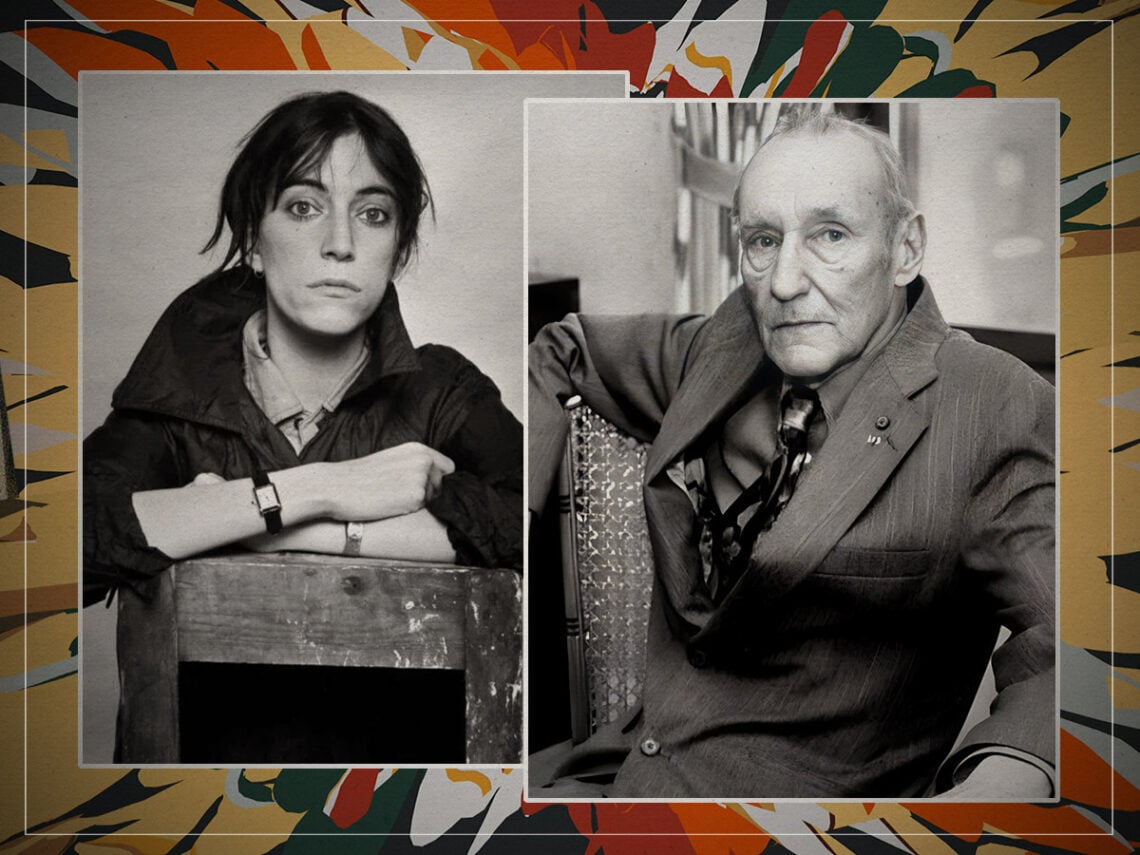
An essential mentorship: The connection between Patti Smith and William Burroughs

“Gregory Corso, Allen Ginsberg and William Burroughs were all my teachers, each one passing through the lobby of the Chelsea Hotel, my new University,” Patti Smith wrote. After running off to New York in the hopes of becoming an artist and eventually enrolling at the Chelsea for cheap rent, she also had the life-changing luck of joining the hotel’s bustling community of writers, of which Burroughs was a key figure.
In so many circles, Burroughs seemed to take on this role. In the history of the Beat Generation, he was always more of a kind of professor. While Ginsberg and Kerouac were really only just kids, along with their larger group of writers rebelling against academia in the Columbia circles, Burroughs was ten years older than them; he’d already done a lot.
By the time Patti Smith even landed in New York, writer had been a serious journalist covering police cases, graduated from Harvard, run off to Europe, married a Jewish woman to save her from wartime persecution, cut his little finger off to impress a lover, moved back the US, met the Beat circle, wowed them, aided in the killing of a man and wrote about it, got addicted to morphine—and all of this was before he even published a thing.
All of that was before 1953, when Junkie was published, over a decade before Smith ran off. After that, Burroughs made a name for himself as one of the most controversial yet fascinating and revered men in literature. His cut-up method, crafting narratives from seemingly random pieces with no clear plot or linear structure, made him a sensation. Plucked from his drug-addled brain, it was a complete rebellion against traditional literature, and what better place to rally against the institutions of art than somewhere like the Chelsea Hotel, which was truly a refuge for the left-field players of creativity.
He first landed there to finish his most famous novel, Naked Lunch, in the late 1950s. But in the 1960s and early ‘70s, when Smith was finally kicking around the city and Burroughs had finally figured out the legal issues that had previously kept him taking laps around the world, the two collided.
They collided spiritually first. Throughout Just Kids, her memoir about her time at the Chelsea, Smith repeatedly references how she’d go down to the lobby to write, feeling the influence of people like Burroughs in the room. His presence loomed around her and only grew as she began meeting people like Corso and Ginsberg, who spurred her on, encouraging her to not only write more but begin reading.

Reading would turn into performing, and by the early 1970s, as Smith performed at CBGB regularly, there would always be a seat reserved at the front. “William Burroughs was simultaneously old and young,” she writes of when she knew him as a person, calling him “part sheriff, part gumshoe. All writer”.
After a chance encounter through their then mutual friends, Burroughs became another encouraging professor as Smith wrote, “He camped in the Bunker with his typewriter, his shotgun, and his overcoat. From time to time, he’d slip on his coat, saunter our way, and take up his place at the table we reserved for him at the front of the stage.”
But just like the moments when Ginsberg would buy a broke and starving Smith a meal, or Corso would check in on her when she moved, the beauty of her connection to Burroughs was in the personable tenderness of it. Sure, he was a looming literary figure who undeniably inspired her work, with his symbols from several of his novels cropping up later in her songs and poems. But mostly, he was a mentor in life, too, almost a kind of father figure. “He did not like to see his loved ones suffer. If you were infirm, he would feed you. He’d appear at your door with a fish wrapped in newspaper and fry it up,” she wrote as a tender reflection on his character.
The two are so tethered. Something Smith’s memoir captures so beautifully as she reflects on the various idols that passed through her life and spurred her on is the way that so often happened in the form of simple care. She didn’t need Ginsberg or Corso to teach her how to write; them simply sitting with her or chatting to her was enough to push her forward. Burroughs appearing at her shows was enough of a co-sign from someone she greatly admired to make her feel assured. There is no separation between the artistic and the personal, or between artists and their life and their personal connection; Burroughs knew that.
“Build a good name,” he told Smith as his ultimate piece of advice, and a nugget of wisdom she’s dedicated to passing on, reminding the artist that being nice and undistracted by anything beyond your work, good people and being a good person will reap rewards.
