


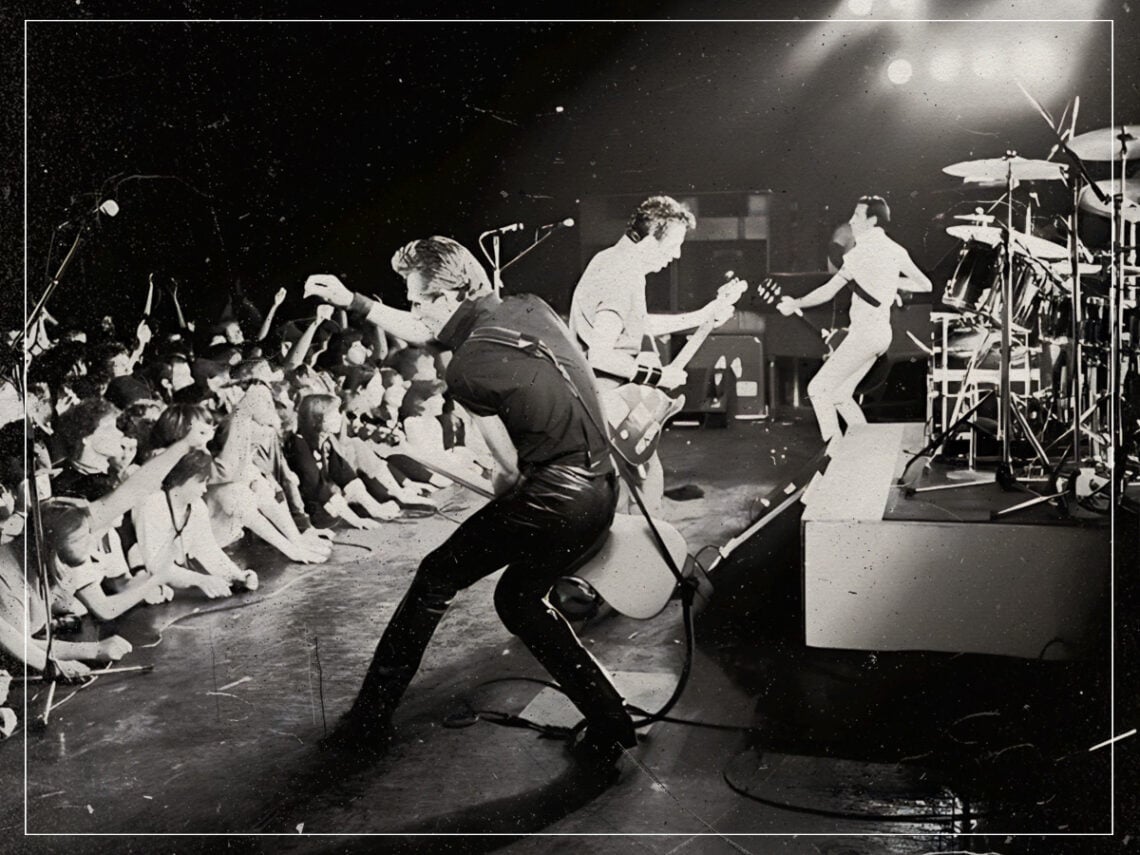
‘Washington Bullets’: The Clash’s most profound political moment

Art doesn’t always need to make an overt political statement to be political, but in an environment as turbulent and disenfranchised as 1970s Britain, The Clash were an essential voice in calling out the injustices of establishment and authority.
Once the dust had cleared from the punk explosion of the mid-1970s, a lot of the material that typified that age could be seen for what it was: substanceless rock dressed up in safety pins and bondage trousers. There were, of course, exceptions to that rule, and one of the only bands that continued to stand head and shoulders above the rest of the London scene were The Clash, who always maintained a staunch message of unity and political resistance at the heart of their output.
From the staunch anti-authoritarian stance of their stunning 1977 debut, with punk anthems like ‘White Riot’ and ‘Career Opportunities’ connecting with the swathes of youths with no prospects and no hope for the future. As the band, and Joe Strummer as a songwriter, progressed, their political motivations never wavered, but the ways in which they tackled those topics became much more nuanced and profound, while still retaining that confrontational attitude that typified the first age of punk.
If you compare the sounds of that 1977 debut album, for instance, with 1980’s Sandinista!, you would be forgiven for thinking that you were listening to two different bands. In three short years, the Clash’s inherent sound and breadth of influences expanded tenfold, and the result was the expansive, exceeding experimental masterpiece, Sandinista!.
Among the hip-hop stylings of ‘The Magnificent Seven’, and the Apocalypse Now-influenced ‘Charlie Don’t Surf’ included on the album, the track ‘Washington Bullets’ stands out as, arguably, the band’s most politically-charged offering.
On their first album, The Clash rallied against American influences in Britain on ‘I’m So Bored With The USA’, but on ‘Washington Bullets’, that criticism of the United States revolved around the historic imperialist actions of the nation’s government over the decades. Taking aim, specifically, at the actions of the US in Latin America, with regard to events like the Bay of Pigs Invasion and the occupation of Nicaragua, Strummer was at his most driven and nuanced, politically.
The importance of the song lies, not just in the fact that The Clash were calling out the continued oppression of Latin America by the United States, but in the lengths that the band went to to expose those actions to mainstream audiences.
After all, that kind of history wasn’t being taught in schools, either in the US or the UK, so for many audiences, listening to ‘Washington Bullets’ was akin to a reggae-marimba-coated history lesson as well as a reminder not to blindly trust the actions of one’s government.
What’s more, the fact that Strummer criticised the US in addition to the actions of the Soviet Union in Afghanistan, or the Chinese state during the period of Cultural Revolution, was political in and of itself. The Cold War was rapidly reaching boiling point back in 1980, and instead of picking a side, as people and governments were so often instructed to do, The Clash were fearless in calling out both sides of the conflict; they were anti-authoritarian and anti-imperialist to their last breath, regardless of whether the oppressors were wearing stars and stripes or hammers and sickles.
Given that ‘Washington Bullets’ appeared on side four of Sandinista’s exhaustive tracklisting, it was never one of The Clash’s fan favourite tracks, lacking the anthemic chant-ability of something like ‘White Riot’ or ‘Career Opportunities’. Nevertheless, the song stands out within the band’s discography as being one of their most important, groundbreaking compositions, both in terms of its experimental sound and the defiant political content of its lyrics.
