


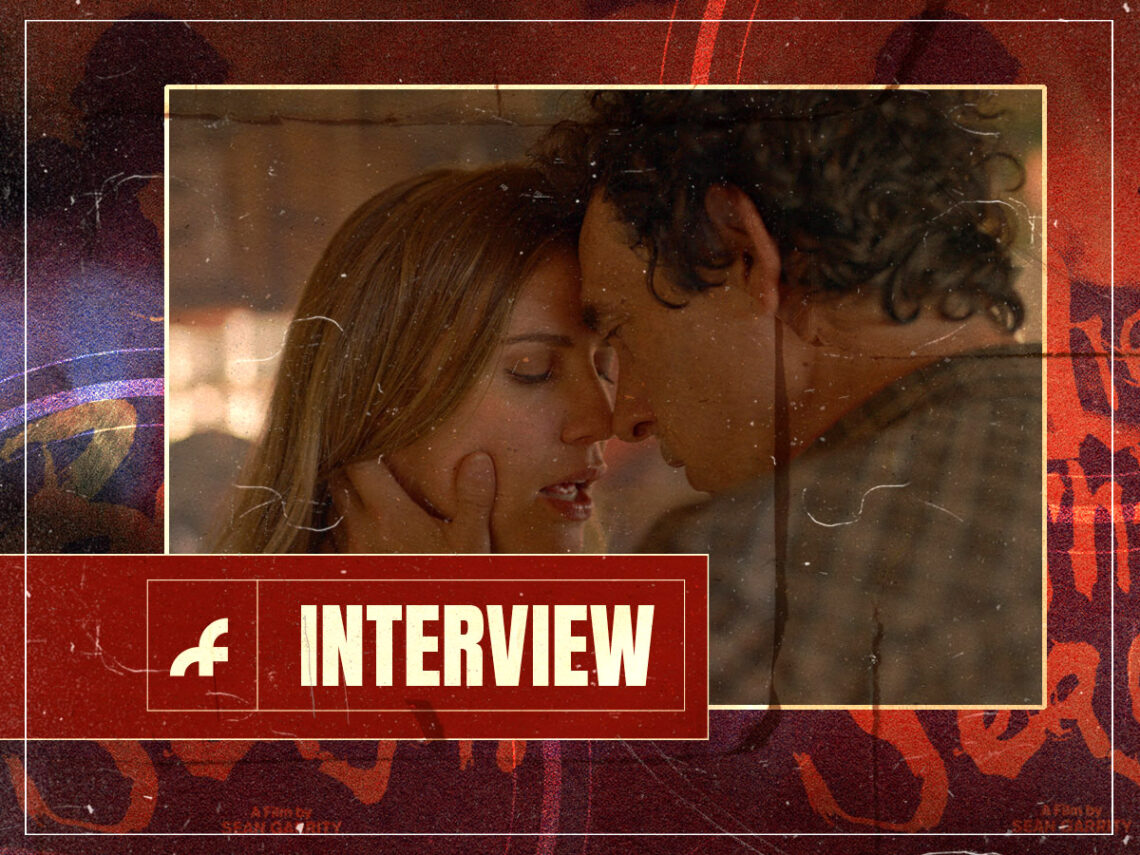
‘The Burning Season’ team break down a reverse-chronological love story

Director Sean Garrity and actor, writer, and producer Jonas Chernick have worked together on seven features, and one of the biggest recurring themes throughout them all has been love. This is something that applies again to their most recent collaboration, The Burning Season.
The story begins with its ending and then works backwards from there to tell the story of the long-running love affair between Chernick’s JB and Sara Canning’s Alena in reverse chronological order. Asking the audience to stick along for the ride, The Burning Season opens with the two trying to maintain their distance before explaining why they initially got together and why they can’t seem to stay away from each other across seven chapters and a prologue.
From their first film in 2001’s Inertia, focusing on a ‘love rhombus’ to 2022’s exploration of a stagnating marriage in The End of Sex by way of 2012’s My Awkward Sexual Adventure and Blood Pressure, it’s become a key motif of Garrity and Chernick’s creative partnership, but why?
“Are you suggesting that love is the very thing that brings us back together?” Garrity asks before answering his own question. “Jonas and I connected over the fact that as significantly younger men, both our hearts had been smashed and broken in recent long-term relationships that each one of us had had.”
“With each other,” Chernick mischievously interjects before Garrity explains how that informed their first movie. “It was something that we connected over and kind of gave birth to the first feature that we were going to make, that I was directing, and that he was acting in and kind of had a hand in writing in.”
For the filmmaker, that seed was born from “some conversations that we had about the significant effect those affairs had on each of us and how we wanted to explore that more”. For Chernick, though, virtually every movie ever made is a love story in one way or another, which has constantly informed his approach as a writer.
“I actually think we also kind of came to the realisation that most films – even if they’re not a love story or they’re not a romantic comedy – are about love in some way,” he mused. “So I don’t know if I’m consciously returning to that subject matter, but I think it’s sort of inherent in most stories.”
There’s also the issue of relatability, with Garrity pulling out a unique point of comparison to find the easiest way to hook the viewer. “It’s a nice shortcut for audiences because everyone’s been there, and everyone can fall in love vicariously in the darkness of cinema with somebody over the course of a film, which is different than saying, ‘My main character is a construction worker, and he can’t get the pylon to fit. You guys know what that’s like, right?’ No! people don’t know what that’s like!”

Even though The Burning Season unfolds in reverse chronological order, the production shot linearly, which Garrity admits some people weren’t entirely thrilled about. “It was always part of my plan. And I had to let my producer, my AD in on it once we started planning to shoot it. And they were like, ‘What? That’s madness!’ but I thought it was really important.” Having the star of the film also be the co-writer and producer aided immeasurably in this instance, with Chernick fully supportive of the director’s vision.
“Jonas is a great producer to a great degree because he’s also an actor and understands. A lot of producers, if you sort of say it’s important for actor process, a lot of producers are like, ‘What are you talking about? Who cares?’ But Jonas also being an actor, it was able to go, ‘OK, yeah, I get that, and I get the importance of that.'”
Having two protagonists engaging in the taboo of an extramarital affair within dangerously close proximity to their respective partners doesn’t make them instantly sympathetic, but as The Burning Season unfolds, it’s gradually revealed why JB and Sara can’t stay away from each other. It’s a hard balance to strike, but Garrity leaned into that sentiment to allow the story to do the talking.
“There’s a kind of traditional rule of screenwriting called ‘Save the Cat’, where the concept is you have your protagonist save a cat in the first scene, or do something similar to that, so that the audience goes, ‘Oh, we love that guy. We’re on board with that guy.'” That being said, JB is not that guy.
“And it seems that a lot of the films that Jonas and I have collaborated on, we do the opposite of that, and we have our main character kick a cat or something at the beginning and then try to get the audience on board with redeeming him over the course of the film by bringing them inside and bringing them on board and having them journey with him through the choices that he makes.”
In this case, “the backward structure really works in our favour,” with Chernick weighing in with his own two cents on how to turn a lack of context into context, as oxymoronic as it may sound. “By beginning the story, showing the audience the behaviour of these characters without context, you watch these characters behaving, and it opens up a lot of questions. Who are these people? Why are they treating each other like this? Why are they? How did they get here?”
Of course, those are all mysteries that will be revealed eventually. “So then, the journey of this particular movie is that we’re eventually going to answer all those questions,” Chernick expounds. “And it felt like the seven-chapter structure with the prologue was the most interesting, compelling way to investigate how secrets affect us and destroy us, and you’re seeing the aftermath, the ramifications. And so the secret itself is the secret at the end of the movie that we’re leading to.”

Garrity, meanwhile, decides to get straight to the point. “If the central question the audience asks at the beginning is, ‘Why is this guy such an asshole?’ We’re gonna tell you.” That’s exactly what happens as The Burning Season works its way back to the start, and as Chernick says, “He wasn’t always.”
The film begins with two characters standing in front of a roaring fire, with the cold open dropping the audience right into the literal heat of the action, posing the biggest question of all that doesn’t get answered until the very end. As it turns out, that wasn’t part of the original script, with Garrity deciding to add it in post-production.
“I’ll tell you as the writer, it was not in the script; the opening shot of the movie was not supposed to be the young versions of these characters,” Chernick clarifies before conceding it was an inspired call. “But for me, it was just a tantalizing hint at what was to come and a really intriguing way to start a movie. And then by opening with that without context, and then jumping to the wedding, knowing that we’re eventually going to return to these younger characters in this massive event that’s happening in the first scene.”
There are repeated references to JB’s addiction issues, and the relationship he has with Alena is addictive in itself. Referring to how extramarital affairs are frowned upon, Canning wanted to use that reference point as a way to make sure she was doing justice to the script and the character by realising the complexities of their years-long entanglement.
“It can be tricky with these characters that are doing something that is largely judged, a thing that’s wrong to be doing, and it provided a base of conviction and of just going, ‘But this is the way our lives have unfolded.'” By the conventions of society, JB and Alena shouldn’t be doing what they’re doing, but The Burning Season drip-feeds the information to outline just how dependent they are on each other.
“It creates this. It’s weird because it’s a non-negotiable thing that they negotiate constantly. But it’s like, ‘The thing is going to be here, we are just going to manoeuvre the parameters around it’. That’s what it felt like to me,” with Canning leaning on the themes of addiction to explore how JB and Alena can’t even adhere to the rules of their own affair.
Chernick notes that although the characters “struggled with their magnetic draw to one another” from the genesis of the project, the ending was a “very late addition” that furthered the addictive nature of JB and Alena’s romance. “I was able to have more compassion for the character and for the choices he was making, and hopefully, we’re taking the audience along that journey and letting them make their own decisions about that.”

Christian Meer plays a young version of JB in the flashbacks that bookend The Burning Season, but he wasn’t beholden to Chernick’s performance to inform his own. “I think any similarities between the film, that has to do with the writing,” he said. “All the time, it gave me all the answers.”
Chernick clarifies that the roles of a young JB and Alena were cast more on merit than resemblance, but the production lucked out either way. “I’m very grateful that we got lucky because these two actors not only are brilliant actors and give amazing performances, but they embody something about the energy that I think Sarah and I bring to these characters as adults,” the star/writer/producer explained. “And I would say that was all very similar to alchemy. For many months, it really was just an energetic kind of happenstance that worked out really well, and give them a lot of credit for that.”
In Garrity’s view, “It was really important that these guys play these characters slightly differently than what they’re playing because they’re making these reckless, selfish choices as this kind of fiery teenage love, that’s gonna lead them to the inciting incident, the break that determines the trajectory of these two characters for the rest of their lives.”
One of the most memorable moments of The Burning Season revolves around the merits of boxed mac and cheese, so the cast and director obviously had to be asked for their real-life opinions on the quick-fix meal. For Meer, it’s a no-brainer: “I love it.” Chernick, meanwhile, occupies the opposite end of the spectrum. “I find it utterly repulsive,” he stated in no uncertain terms. “I’ve eaten it a lot as a kid, but at some point, I came to my senses and realised it was pure garbage.”
Canning is somewhat on the fence, although her association with boxed macaroni does hold a certain nostalgia. “My mom has the funniest strong opinion. She does a bit about it where she like, gags,” the actor reminisced. “We call it ‘Kraft Dinner’ in Canada, and my dad loves it. I don’t know. I could eat it once a year.”
Taking things to an entirely different level, Garrity offered a surprisingly lyrical interpretation of what mac and cheese in a box really means. “I think it’s like the beginning of gastronomy because when you’re a teenage kid, you eat what’s in the fridge, right? You’re a forager, a gorilla. Like, ‘Here’s a banana.'” An unusual comparison, sure, but one that doesn’t go unexplained.
“But then you move it to university, and it’s the first time you ever take this ingredient and that ingredient. And then you very quickly go, like, ‘This is gross. What if I put garlic salt in it?’ And it begins a journey. Crack some pepper on it. Yeah, maybe instead of this gross cheese, I’ll put parmesan. And that’s the beginning of a journey.” Remarkably philosophical from the filmmaker, especially as it pertains to boxed pasta and powdered cheese.
