


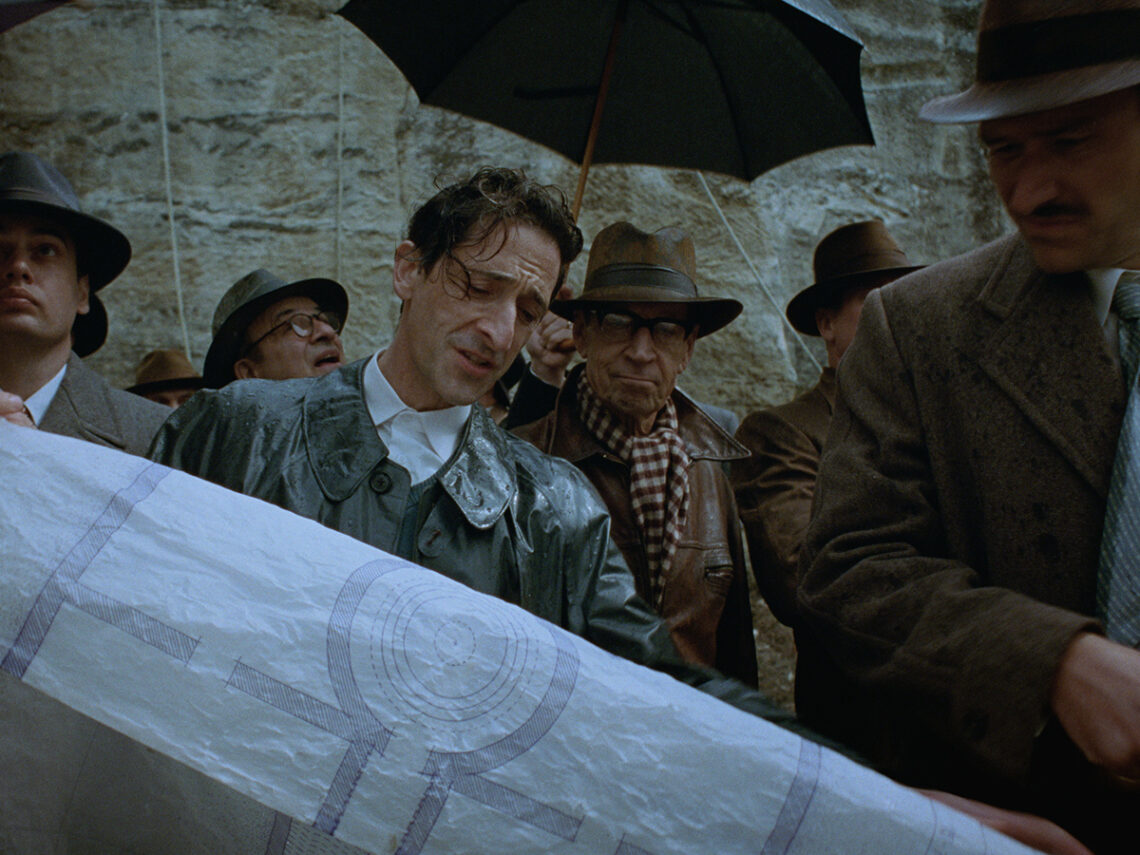
‘The Brutalist’ editor confirms use of AI to help with Hungarian accents

When thinking about movies that are most likely to be using artificial intelligence, one might think of big Hollywood blockbusters with lots of CGI. In the most recent wake-up call about how widespread this new technology already is, the editor of Brady Corbet’s critically acclaimed Oscar hopeful The Brutalist has confirmed that the film contains multiple instances of AI.
The three-and-a-half-hour film stars Adrien Brody as Hungarian-born Jewish architect Laszló Tóth, whose uncompromising approach to his craft is the overriding theme of the story. Although Brody’s mother was Hungarian, the actor’s accent was apparently not up to the standards of editor Dávid Jancsó, who said that he fed his own voice into Respeecher, a Ukrainian editing software, to finesse the actor’s pronunciation. He did the same for Felicity Jones, who plays Tóth’s wife.
Speaking to RedShark News, Jancsó explained that it isn’t just a syllable or two either. “Most of their Hungarian dialogue has a part of me talking in there,” he said, hastening to add that he was “careful about keeping [the actors’] performances” by “mainly just replacing letters here and there.”
Whether or not this will affect Brody’s chances at the Oscars is an open question. He is heavily tipped to be the frontrunner for the ‘Best Actor’ award, but if the editor of his film is on record saying that he couldn’t do a Hungarian accent, it might change how the voters feel about his performance.
Jancsó’s reliance on AI wasn’t limited to overriding the actors’ voices. He also admitted to using it in the epilogue of the movie, which takes place at the Venice Biennale. GenAI, a software that can generate images and text, among other things, was used to spawn architectural drawings and buildings in the style of the fictional Tóth.
“It is controversial in the industry to talk about AI, but it shouldn’t be,” Jansco argued. “We should be having a very open discussion about what tools AI can provide us with.”
He maintains that AI was a necessity and that he and Corbet didn’t do anything with it that hasn’t been done elsewhere already. “It just makes the process a lot faster,” he said. “We use AI to create these tiny little details that we didn’t have the money or the time to shoot.”

Never Miss A Scene
The Far Out Film Newsletter
All the latest film news from the independent voice of culture.
Straight to your inbox.