


Under the Spotlight: Examining the brilliance of Toni Collette in ‘Hereditary’

Despite prevalent claims that horror filmmaking has weakened across the last few decades, many contemporary horror masters have managed to conjure a selection of attentive, suspenseful and impactful genre releases. One filmmaker who embodies these facets is Ari Aster. The burgeoning talent triumphed with his 2018 feature directorial debut, Hereditary, a supernatural psychological horror film written and directed by the man himself. The film stars Toni Collette, Alex Wolff, Milly Shapiro and Gabriel Byrne as the members of a family haunted by a mysterious presence after the death of their secretive grandmother.
Aster’s film showcases an element that horror audiences suggest that the genre has been lacking in recent contributions: the terror of realism. In essence, an unsettling and powerful fear that resides in something realistic and emotionally harrowing. Collette’s performance as family matriarch Annie Graham anchors Herediary’s exploration of this exact tonal experience.
Collette was reportedly one of the first actors Aster envisioned for the role of Annie. It proved to be a brilliant decision, given that she offers up a portrayal that transcends the script in a magnificent manner. Though Collette was reluctant to work on a horror film at the time, the script’s grounded approach to the genre convinced her to take the project on board. “He [Aster] just really understood the dynamics in the family, has such an understanding of what it is to be human, what it is to experience loss,” she revealed, as reported by The Verge.
This character examination is accentuated in the film’s opening as Annie expresses her experience with loss as her mother passed away shortly before the plot begins. This turmoil is immediately cemented in her entire characterisation due to the narrative structure, coining her presence in the film with one of life’s heaviest burdening challenges. In the funeral sequence that opens Aster’s feature, we see Annie’s surprise and confusion at the number of people attending her mother’s funeral, implying that her mother was an emotionally distant and challenging woman to know. This further situates Annie as a character, accentuating that she is accustomed to struggle and emotional suffering. This psychological touchstone steadily develops alongside the chilling narrative.
Later, Annie attends a bereavement support group, revealing she and her mother had a fraught relationship until her daughter, Charlie, was born. The connection is made when Annie visits a counselling meeting in which people dealing with grief come together and talk about the problems they have been facing, similar to that of an alcoholics anonymous meeting. The notions of grief and addiction start to collide when Annie describes her traumatic family history. Specifically, their struggles with mental illness, which both her mother, father and brother had to either live with.
Hereditary thematically dissects this perception of grief throughout its runtime and through its stylistic choices and plot events, coming under the category of ‘elevated horror’. At times, it almost competes against the cultic and supernatural elements for the spot of the film’s most unsettling concept. The harrowing state of grief isn’t one of the go-to drugs during discussions concerning addiction. Yet, Annie is unapologetic and open in how obsessive and attached she is to constantly grieving or emotional turmoil, making Hereditary an unsettling yet human horror film.
We see just how far into her preferred state of grief the character is after her daughter’s violently tragic death, which jumps into the narrative as a cruel twist. Whilst being driven to the hospital by her brother, Charlie leans out of the car window to breathe through an anaphylactic shock caused by her nut allergy and decapitated by a pole. Annie discovers her headless corpse in the car the following day, much to her horror, and screams in agony on her bedroom floor.
Following an attempt to work through this tragic ordeal, we see Annie’s addiction as she works in her workshop and makes a highly detailed model of the accident. While Annie explains to her husband that the model is purely a neutral view of the accident, it is clear that she is addicted to grieving. She refuses to let trauma go and instead holds onto it as well as recreating it in extremely graphic detail, employing her grief as motivation for her passion and creative outlets, suggesting she wants it to define her.
Annie then screams at her son during an uncomfortable dinner sequence that defines the entire film, admitting that she wishes the family could have at least come together due to the death. They remain divided, and as a result, Charlie’s death is seen as a waste. This implies how familiar her character is with grief. She can immediately detect almost-unnerving upsides.
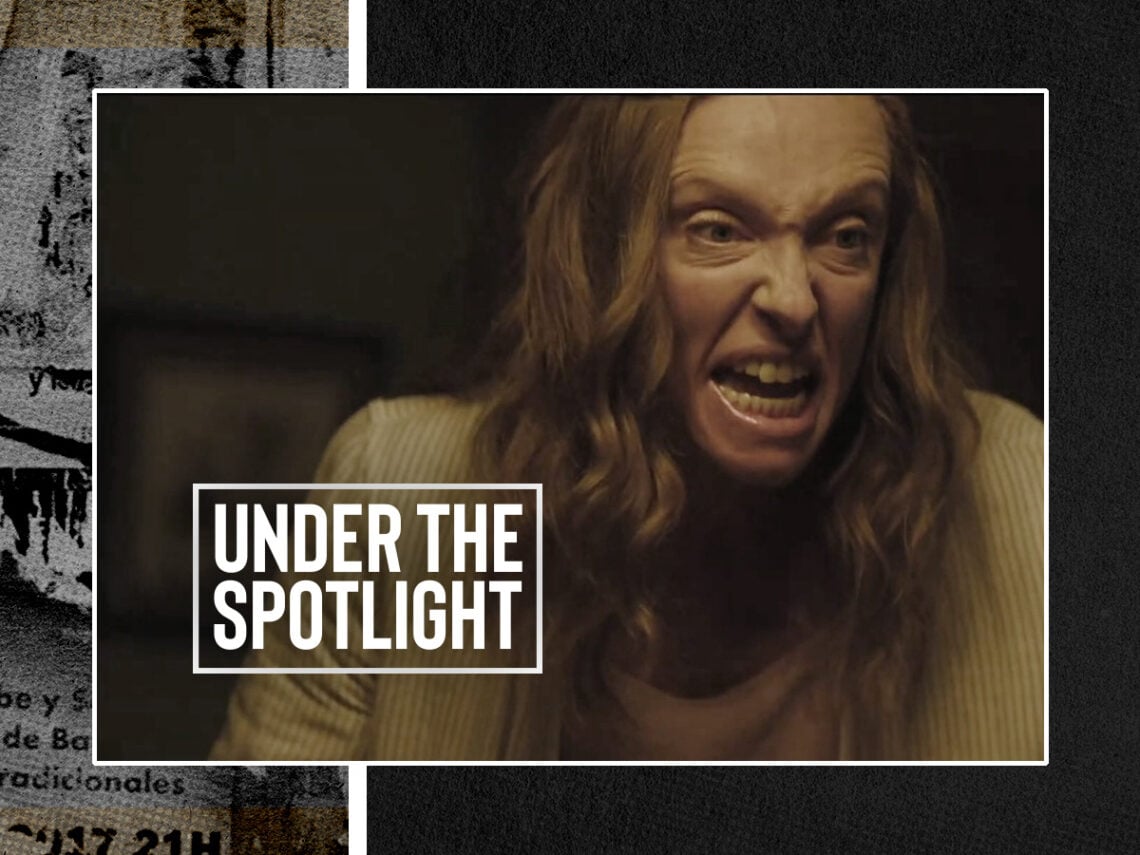
Collette executes this characterisation and thematic concept through her intense and emotionally harrowing acting. The actor employs her body just as much as her facial expressions or vocal work, as her physicality of vigorous arm movement and leaning closer to or further away from her co-stars when needing to display feelings of disgust or intimidation is required. Collette contorts her face into a distressing and unnerving expression of pain, disgust and hatred throughout the scene, setting the sequence alight with a rage-infested flame that engulfs any security or safety for viewers.
The actor then contrasts this with more hysterical and upsetting fits of crying and pleading, shrinking her body through its language and placement within the scene to highlight how she feels lost and vulnerable. In addition, Collette channels the examination of grief in strangled cries of how she longs for her deceased child, with every muscle in her face frozen in a look of striking pain that even the audience feels.
This trait of grieving later serves as the invitation to be possessed by the supernatural entities her mother engaged with, her facial expressions turn empty, cold and harrow as all sense of self is stolen by the entities. In a truly terrifying sequence, Annie terrifies her son as she decapitates herself with a piece of piano wire in front of him, with Collette maintaining an empty ghoulish expression and dead eyes that pierce into her child.
Hereditary is a horror film where human emotions and experiences are the horrors. This examination is supported by how grief exists within the film as a haunting spirit that takes the spotlight against the more conventional genre factors of cults and demons. Collette’s performance as Annie, who drowns in her grief, expresses the rage, agony, loss of self and danger that this emotional state brings, which can terrify the audience more than the possessive spirits or cultic imagery.
