


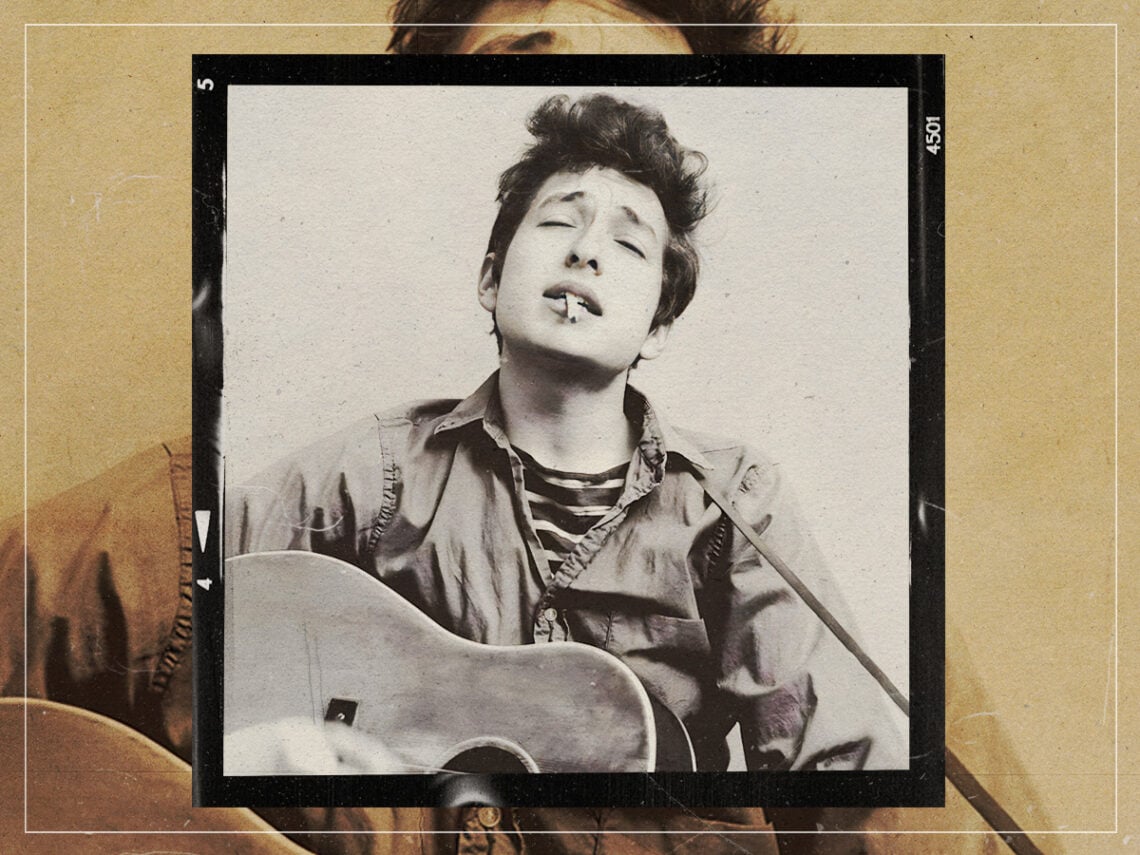
The best guitar player Bob Dylan ever heard: “He could outplay anybody”

Despite being routinely recognised as one of the defining musicians of his generation, a voice for the counter-culture revolution and arguably one of the most gifted lyricists of his day, Bob Dylan has never been seen as the greatest guitarist in the world by a long shot. As a folky in his formative years, he learned the ropes of the six-string to the point that he could get by, but it was always his lyrics that carried the most weight.
It’s strange in the 21st century to imagine such a progression for a young person. To not jump on to the glamour of a guitar or the bouncing rambunctiousness of a drum kit as a way to connect with people. Instead, Dylan was captivated by the notion of songwriting itself, merely understanding the guitar as a tool to help him achieve his aim of speaking to his audience.
Dylan’s fascination with music didn’t seem to focus on an attachment to a specific instrument. He started off as a pianist and often tried to emulate Little Richard’s stood-up playing style during school performances, backed by his earliest band named The Golden Chords. His adolescent motivations were purportedly, as with many young aspiring musicians, a bid for attention from the opposite sex.
As he matured into his late teens and early 20s, Dylan became enamoured with folk music and began to learn the guitar. He swiftly became a dab-hand with the harmonica, and for many of his early gigs in the folk clubs of Minneapolis and New York, he would sit in solely as a harmonica player. As a keen disciple of the folk icon Woody Guthrie, Dylan began making a name for himself by performing Guthrie covers and gradually began to absorb more and more from his folky peers.
What appealed to Dylan about folk music was its focus on lyrics. The style is usually word-dense and conveys poignant and poetic messages. However, these messages would be shrouded if the accompanying music was too involved, and so Dylan, with an intermediate grasp of most chords and an ear for rhythm, felt that he needed little more.
In this sentiment, Dylan was correct; as we all know, he became the most important protest singer of the 1960s and has since been regarded as the greatest songwriter in living memory. To achieve what Dylan did, he needed to be void of envy and have a firm belief in his personal strengths. Dylan’s guitar ability was certainly impressive and improved greatly over the course of his career, but by no means was he up to the level of some of his rock and roll peers who were unbridled virtuosos.
As one of the most celebrated songwriters over the past six decades, naturally, there have been countless guitarists who would have gnawed their own arms off to be able to play alongside Dylan. Among the many lucky candidates have been gifted guitarists such as Mark Knopfler and Mick Taylor, who both collaborated with Dylan – most notably during the creation of Infidels in 1983 and Empire Burlesque the following year in 1984. This goes without acknowledging Dylan’s appreciation for other special guitarists in his orbit. Of course, Jimi Hendrix’s covers of his tracks would open Dylan up to a brand new audience. He would routinely share his appreciation for George Harrison’s style and would label Rory Gallagher one of the best in the business.
Despite collaborating with guitarists of this calibre, Dylan still asserted that of all the guitarists that he worked with throughout his career, Mike Bloomfield was the one that had him most in awe.
Bloomfield may not be the household name as some of the others mentioned above. However, the skilled six-string hero was one of the most lauded guitarists of the 1960s. After Dylan’s seismic rise to prominence early in the decade, he had no question about who he wanted to play alongside when recording his classic 1965 album, Highway 61 Revisited.
Reflecting on his time working with Bloomfield on the 2005 documentary No Direction Home, Dylan said: “Mike Bloomfield said he’d heard my first record, and he said he wanted to show me how the blues were played. And I didn’t feel much competitive with him. He could outplay anybody, even at that point. When it was time to bring in a guitar player on my record, I couldn’t think of anybody but him. I mean, he just was the best guitar player I’d ever heard.”
Bloomfield’s role as a session musician for Dylan may not have garnered him all the fame and fortune that Hendrix and Harrison gathered, but he certainly grabbed a fair slice of appreciation from one of the greatest musicians of all time.

Never Miss A Tale
The Far Out Bob Dylan Newsletter
All the latest stories about Bob Dylan from the independent voice of culture.
Straight to your inbox.