


The 10 best concert scenes in movie history

One strength cinema has through its properties is the ability to tell stories about other artistic mediums to cross boundaries and build alliances with the arts. A film can use its camerawork, editing and performances to narrate stories from the painting, dance and music industries. Any movie that presents the music industry needs to get the musical components down to highlight the medium to its full potential.
This factor means the film’s score and the composition of musical scenes become focal points, leading the director to embody the artist’s energy and the atmosphere of a live performance using filmic properties. The way in which a director lights a scene, moves the camera around the performance, and edits sound together are all crucial components to orchestrating a powerful concert moment to define a musical film.
These concert scenes can come at any point in a narrative, such as an upcoming artist’s first breakthrough performance or a group’s final one before splitting. The audience needs to connect with the artist and become immersed in the feeling of being at a concert. Effective camera use, terrific performance and engaging editing must combine with a thorough story exposition to bring this vision to fruition.
Ranging from mockumentaries, original stories and emotional biopics, here are ten scenes which present a brilliant and atmospheric concert.
The 10 best concert scenes in cinema:
‘F the Police’ (Straight Outta Compton, F. Gary Gray, 2015)
An upcoming talented hip-hop group from Compton, California, are met with several controversies because of their explicit lyrics and revolutionary content reflecting societal issues, starting a culture war.
F. Gary Gray’s dramatic biopic encapsulates N.W.A’s style and artistry effortlessly, such as the infamous ‘Fuck the Police’ performance. After corrupt police officers racially target the group, they perform an anti-police brutality song in front of adoring fans and the police. The scene is powerful and emotional, given the societal context and the performance in front of the police. It also showcases some of hip hop’s finest contributions with a brilliant performance by founder Ice Cube’s son.
Stillwater (Almost Famous, Cameron Crowe, 2000)
Director Cameron Crowe sheds insight on his experience as a music journalist in this comedy-drama about a young writer who accompanies a band on tour. He finds himself infatuated with a girl called Penny, who is involved with the guitarist.
Almost Famous exhibits the musical stylings and aesthetics of its presented decade in what reads as a love letter to that era. The concert sequence embodies the atmosphere, passion for music and the community the medium creates. Crowe employs the camera to conjoin the performers and crowd, equally exchanging shots between the two to emphasise the dynamic of giving and receiving entertainment. The soundtrack is also brilliant, effortlessly capturing the era of classic rock.
Curtain Call (Whiplash, Damien Chazelle, 2014)
An aspiring drummer enrols in a music conservatory in this eccentric and hyperbolic drama. There, he comes under the mentorship of a harsh yet passionate mentor who has some unorthodox methods of achieving greatness.
Whiplash’s goal is to explore how extreme ambition and the fear that comes with it can be, as Miles Teller’s character goes to drastic lengths to prove to his teacher that he is worthy of success in the jazz industry. During the final climactic performance, Andrew uses the chance to prove himself; the editing works with the music to construct the scene’s meaning. The visuals will slow down as the music fades out to emphasise the loss of character, and then both return to normal to reflect the final jump into hysteria. The ending is also ambiguous, both triumphant given the musical success but tragic considering the cost.
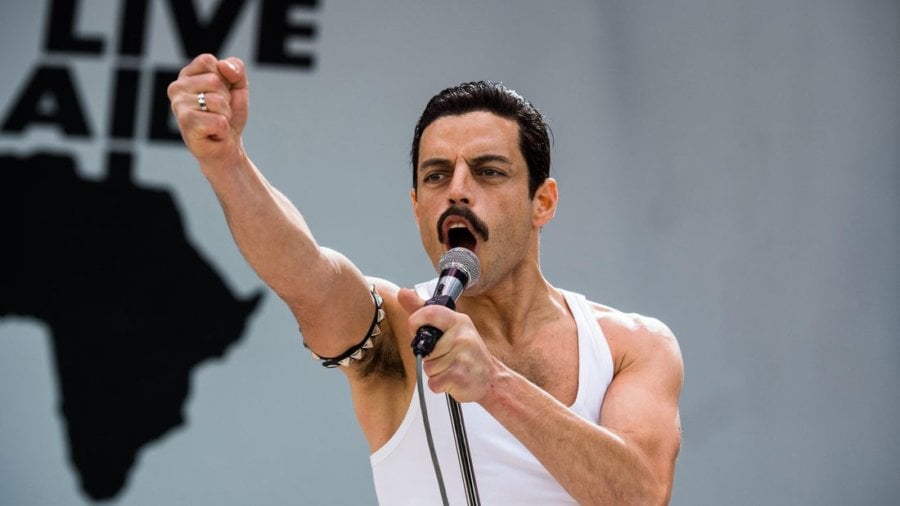
Live Aid (Bohemian Rhapsody, Bryan Singer and Dexter Fletcher, 2018)
This film documents the rise of one of music’s most treasured acts, Queen. The group are led by the immensely talented Freddie Mercury, whose personal life clashes against his one as an entertainer.
Bohemian Rhapsody presents a dramatic vision of one of music’s greatest moments-when Queen performed at Live Aid in 1985. The camerawork situates audiences by showing the colossal crowd, followed by close-up shots of each band member, highlighting the landscape, atmosphere and emotional weight of the band’s experience. The music composition and execution feel raw and authentic, with an attentive performance by Rami Malek as Mercury.
Everybody Needs Somebody to Love (The Blues Brothers, John Landis, 1980)
In this ’80s classic, two brothers band together to save the orphanage that raised them from destruction. They find that music is the way to go, reuniting their old R&B group and setting up a fundraiser.
The big show scene in Blues Brothers highlights a concert’s upbeat, engaging and thrilling nature. The brothers set the place alight with their magnetic energy and terrific talent, performing brilliant dance moves and vocals to ‘Everybody Needs Somebody to Love’ to keep the crowd entertained. The various camera shots are framed to present both performers and the crowd, showcasing the powerful dynamic between the two and fully encompassing the atmosphere of a concert.
Elvis causes trouble (Elvis, Baz Luhrman, 2022)
Baz Luhrman brings his auteurship to one of music’s most iconic stories as a young Elvis Presley is mentored by Colonel Tom Parker to become one of America’s icons. However, tensions rise when Presley begins to rebel.
As an extension of the film’s cinematic power, the Russwood park scene where Presley shocks his manager and the world with a racy performance of ‘Trouble’ exemplifies the icon in all of his glory. Luhrman’s camera work and editing display Presley’s power on stage, exchanging shots between his performance and the crowd’s reaction to emphasise the cultural revolution the musician brought. These elements are elevated by Austin Butler’s brilliant performance, and he late told Indiewire that he “had an existential crisis” after filming.
Taking the stage (Little Voice, Mark Herman, 1998)
Following the tragic passing of her father, Little Voice becomes a recluse, locked up with her father’s collection of old records to hide her pain. However, her hidden singing talent is soon discovered by her selfish, greedy mother, who cares little for her child’s well-being.
The scene where Little Voice first takes to the stage captures the breakthrough a talented performer can create when they exert their skill to a crowd. Little Voice gives a dazzling show under illuminating lights and a calm decorative background, allowing her beautiful voice and passionate energy to take centre stage. The camera movement celebrates her by framing her against rounds of applause from the audience, elevating the hold her talent has over those around her.
Friday (Woodstock, Michael Wadleigh, 1970)
This documentary showcases the time when 500,000 people descended on a small patch of field in a little-known town in upstate New York called Woodstock in 1969. The film presents electric performances, interviews with the artists and candid footage of the fans in a defining portrait of the 1960s hippie America
The Woodstock documentary celebrates an iconic music festival in all its power, artistic merit and joy, specifically in the Friday sequence. This part sees the brilliant performances of Richie Havens, Bert Sommer, Ravi Shankar and Melanie, powerful talents that brought crowds together through their music. The sequence reads as a time capsule, showing a carefree, joyful and thrilling time in music, art and culture.
Stonehenge (This is Spinal Tap, Rob Reiner, 1984)
A filmmaker expresses his love for a heavy metal band called Spinal Tap by documenting their comeback tour. This comedy satirises heavy metal culture and personas through interviews with the band members.
Through its hilarious and informative satirisation of heavy metal culture, This is Spinal Tap presents a comical yet artistic parody performance scene of the band’s song ‘Stonehenge’. The piece is a spoken word recital against some eerie guitar notes to build the atmosphere. It then spirals into a dramatic and powerful composition of electric guitar and sensual vocals, accompanied by some eccentric and peculiar lyrics that work as unorthodox poetry. What follows is a hilarious argument backstage dispute about the stage’s decoration, claiming a huge setpiece was nearly crushed by a little person.
The Under the Sea Dance (Back to the Future, Robert Zemericks, 1985)
A teenager from the ’80s accidentally travels back to 1955 and changes his own timeline by preventing his parents from meeting. Accompanied by his scientist friend, the teen does whatever it takes to fix the colossal damage he has caused and tries to keep his true identity a secret from the young version of his mother.
A pivotal event in the timeline that Marty McFly has to get right is the high school dance, where his parents first fell in love. The band performing at the dance is told to keep up by Marty McFly as he performs ‘Johnny B. Goode’ as he stands in for Marvin Berry following an accident with a car trunk. He nails the performance with his impressive rock guitar skills, but the people of 1955 were not ready for it. The scene is terrific in musical energy and comedic writing, with a brilliant joke about Berry finding the sound his cousin Chuck was looking for.
