


The beginning of ‘Bollywood’: Looking back at India’s first-ever feature film

Every saga has a beginning, and in the colourful narrative of the world’s most prolific film industry, a single tale stands tall as the genesis. Imagine a time when ‘cut’ was something you did with scissors, and ‘action’ was best suited for superhero comics. A time when books, dances, or a good old game of chess defined entertainment. Now, in the middle of all that simplicity, a remarkable milestone in Indian cinematic history took shape that would forever change the face of Indian entertainment.
Long before the term ‘Bollywood’ was coined, before the industry was churning out an average of 1800 films per year, and decades before the grandeur of the Kapoors, the Bachchans, or the Khans was even a glimmer in the cinematic universe, the magic of moving pictures made its debut on Indian soil. In an era devoid of modern cinematic technology, where CGI was a term of science fiction, the seeds were sown for a journey that would evolve into a global phenomenon.
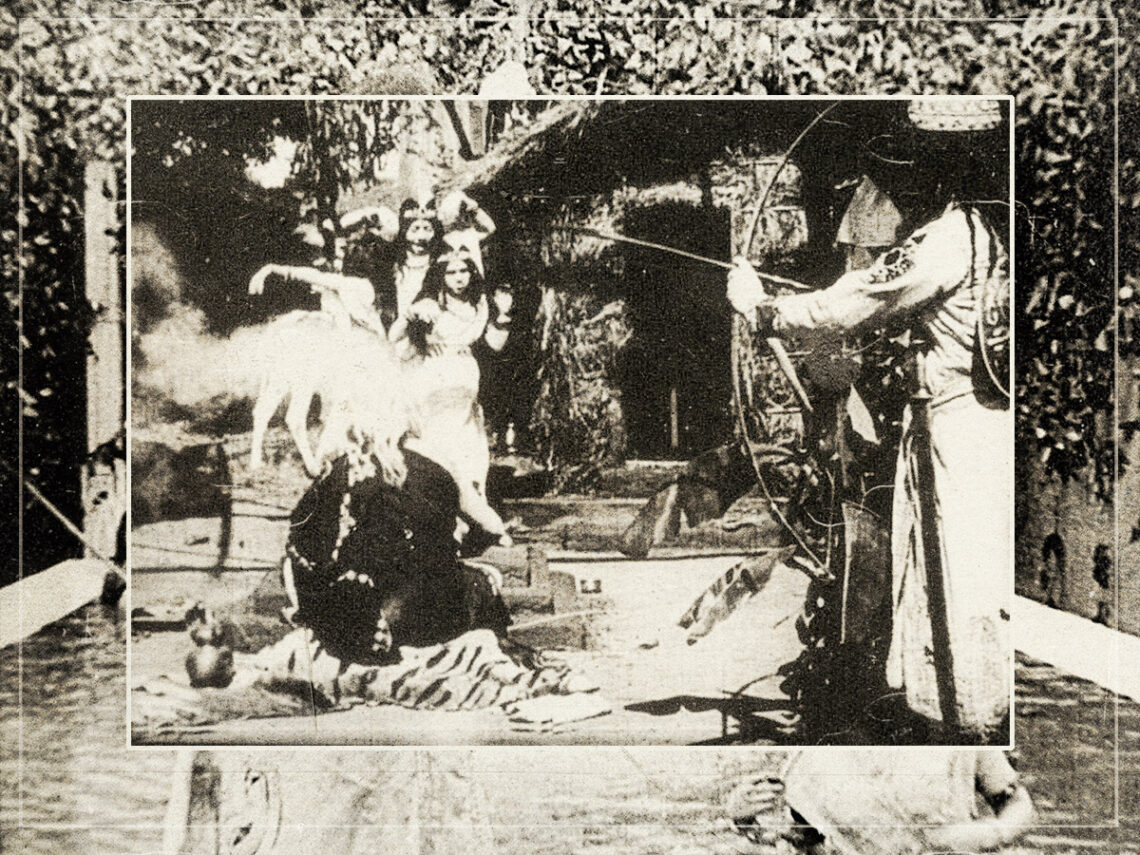
This pioneering achievement was none other than Raja Harishchandra. As the first full-length Indian feature film, it was a spectacular feat of innovation and determination. Released in 1913, this silent picture was helmed by Dadasaheb Phalke, a visionary director often hailed as the father of Indian cinema, and remains a golden chapter in the annals of Bollywood’s history.
Adapted from the great Indian epic ‘Mahabharata’, Raja Harishchandra focuses on the noble and truthful king Harishchandra – who never uttered a lie in his life. A staple for Indian drama and morality, the film was a gamble for Phalke, who plunged headfirst into uncharted waters, drawing from ancient mythology while introducing it to the then-modern medium of film.
The film featured an all-male cast, owing to the cultural norms of the time that did not allow women to perform on stage or screen. Men were thus tasked with playing the female roles, adding layers of complexity and, admittedly, a fair dash of humour to the process. A shout-out must go to Anna Salunke, who played Queen Taramati – bravely facing the challenges of early drag performance.
Phalke’s journey wasn’t all smooth sailing. He sold his personal possessions to finance the film and went as far as to learn the techniques of filmmaking in London before embarking on this ambitious project. This dedication would not only result in the creation of Raja Harishchandra but also in setting the foundation for the future growth of the Indian film industry – a country that can boast a film featuring 12 roles portrayed by one actor.
Today, over a century later, the tale of Raja Harishchandra still echoes through Bollywood. From humble, silent beginnings, the industry has exploded into a vibrant world of sound, colour, and, of course, a good deal of song and dance. Yet, the spirit of storytelling that guided Phalke and the first Indian film remains at the heart of Bollywood, a testament to the lasting legacy of those first flickering frames.
