


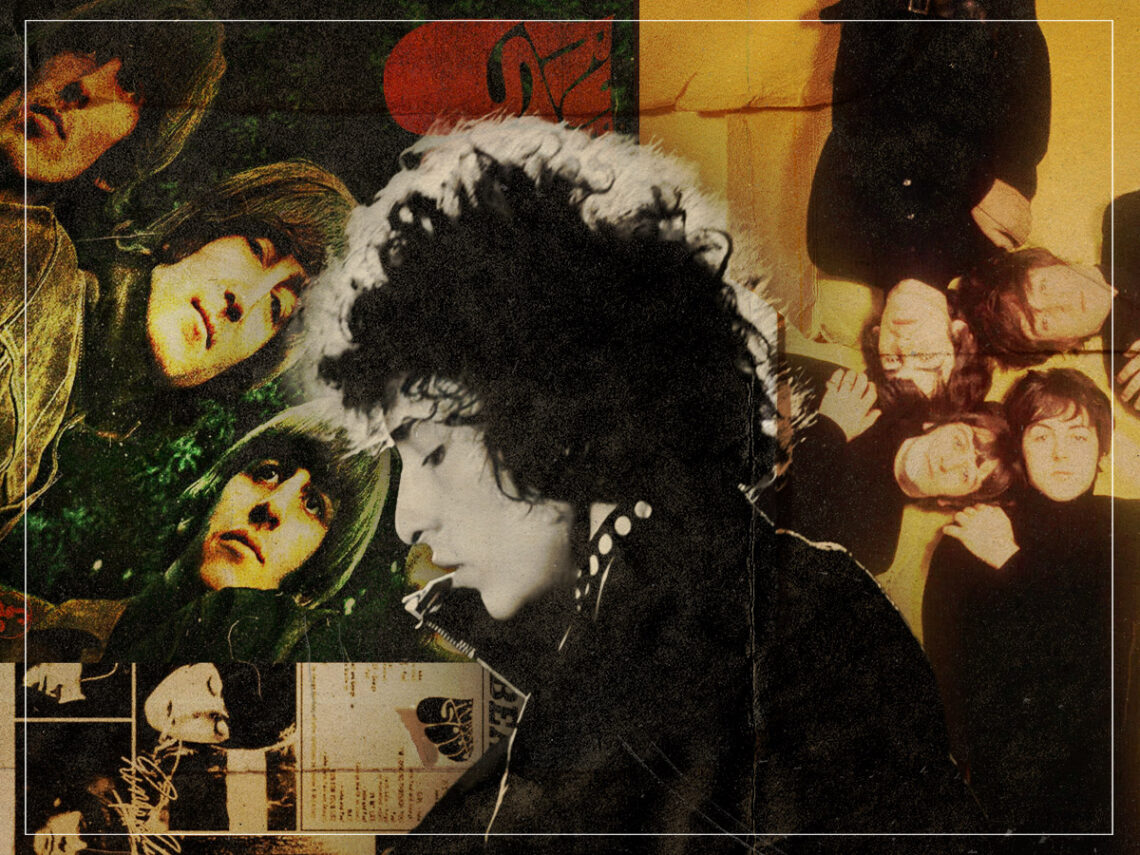
The Beatles songs Bob Dylan hated: “Fucking hell, I invented it”

The Beatles and Bob Dylan enjoyed a fruitful but complicated relationship after first meeting in a hotel room in 1964. Although they had their fair share of musical and personal differences, they were the two acts that defined an entire decade and altered the fabric of popular culture forever.
Bob Dylan’s influence on The Beatles extended far beyond introducing them to marijuana. His introspective songwriting and lyrical depth significantly impacted their musical evolution, steering the Fab Four towards more mature and experimental themes. Conversely, Dylan was also inspired by The Beatles’ innovative approach to pop music, incorporating some of their techniques into his own work. Despite this mutual admiration and exchange of ideas, Dylan and The Beatles didn’t always agree on everything, leading to occasional creative differences and varying perspectives on music and artistry.
Bizarrely, both acts looked at one another with a hint of jealousy despite their respective career riches. Dylan was a critical darling who had been hailed the musical messiah and seemingly dropped from the heavens to advance the art form, but The Beatles had achieved a level of mainstream success that he could only dream of having. Meanwhile, John Lennon would likely have happily swapped positions to have Dylan’s reputation.
In truth, when they first encountered each other, the two factions operated on different ends of the spectrum. Dylan was a highly regarded songwriter who had begun to assume the role of the ‘voice of his generation’ with a vinegary disdain. Revered among his peers, Dylan had struggled to earn the commercial success of Lennon, Paul McCartney, George Harrison and Ringo Starr. Paradoxically, The Beatles may have achieved pop fame, but their desire to be seen as bonafide artists was often whitewashed by their cavalier commercial career. It meant that as the two acts grew into their respective roles, they flitted between friendship and competition.
Their audiences may have overlapped, but they weren’t in direct competition with one another. Nevertheless, there was a sense of tension between Dylan and The Beatles. While both have always shared their admiration of the other, sometimes they would allow a snide barb and shot to slip out across the boughs of the music world. The opportunity to send out such a taunt was available with every new song they released, and by 1966, tensions between Dylan and the Fab Four were growing.
In 1966, Dylan couldn’t resist sharing his unflattering opinion on two Beatles songs. Those tracks in question were ‘Michelle’ from Rubber Soul and the triumphant ‘Yesterday’ from Help!, which Dylan referred to as “cop-outs”.

The freewheelin’ Dylan started his tirade against the Liverpool band by remarking: “I’m not gonna be accepted, but I would like to be accepted by the Hogtown Dispatch literary crowd who wear violets in their crotch and make sure they get all the movie and TV reviews and also write about all the ladies’ auxiliary meetings and the PTA gatherings, you know all in the same column. I would like to be accepted by them people. But I don’t think I’m ever going to be, whereas The Beatles have been.”
The interviewer, seizing his opportunity to put two of the decade’s biggest stars in the same story, then probed Dylan on his comments about The Beatles, to which he replied: “I’m just saying The Beatles have arrived, right? In all music forms, whether Stravinsky or Leopold Jake the Second, who plays in the Five Spot, the Black Muslim Twins, or whatever.”
The singer-songwriter elaborated in a sneery fashion: “The Beatles are accepted, and you’ve got to accept them for what they do. They play songs like ‘Michelle’ and ‘Yesterday’, a lot of smoothness there.”
Perhaps he knew the band’s potential or was eating sour grapes, but Dylan didn’t hold back when confronted with the idea of Joan Baez performing a Beatles number. “Yeah, it’s the thing to do, to tell all the teeny boppers ‘I dig The Beatles’, and you sing a song like ‘Yesterday’ or ‘Michelle’. Hey God knows, it’s such a cop-out, man, both of those songs.”
Although referring to the two tracks mentioned above as “a cop-out” is harsh enough, it looked polite compared to his opinion of ‘Norwegian Wood’. A classic Lennon number, Dylan viciously viewed the song as almost a direct copy of his own style. While Lennon was always happy to admit that he enjoyed a “Dylan period” during his songwriting career, ‘Norwegian Wood’ pushed the American so far that he wrote a song in retaliation titled ‘Fourth Time Around’.
Listening to Rubber Soul, Dylan replied: “What is this? It’s me, Bob. [John’s] doing me! Even Sonny and Cher are doing me, but, fucking hell, I invented it.”
While Dylan had only been a prominent figure for a few years, countless artists had already adapted his style. Of course, once a musician becomes revered, this is part of the job description, and few artists know the feeling of being imitated more than The Beatles. Nevertheless, it was still a difficult pill to swallow for Dylan to have the Fab Four impersonate him.

The comparison is hard to ignore, too. Before their infamous meeting in New York, The Beatles’ lyrics were never at the forefront of their songs. By the band’s own admission, the group were happy to include “nonsense” lyrics if they sounded correct and bolstered the melody. The art of storytelling was never their forte until Dylan changed their way of thinking. John Lennon was especially inspired by the singer-songwriter’s style, a factor which led him to write in more of a storytelling tongue than he previously had done.
Of course, there is a degree of pettiness to Dylan’s remarks. However, the fact he chose to back up his comments with a song that essentially saw him write a more eloquent version of ‘Norwegian Wood’ is hard not to admire. Dylan even left Lennon a not-so-subtle message at the end of the track, knowing his number one fan would undoubtedly study the composition. The last two lines see him sing, “I never asked for your crutch, Now don’t ask for mine”, which makes his thoughts on Lennon hero-worshipping him evidently clear.
Naturally, Dylan’s viewpoint on The Beatles softened over time, and his influence over them as a band became a badge of merit rather than an unwanted albatross. He even worked extensively with George Harrison to bolster his creative output during the final days of the Fab Four, and they later became bandmates in the Traveling Wilburys.
The Beatles undoubtedly revered Bob Dylan throughout their career, frequently referring to him as their “idol”. However, like any friendship, theirs had its moments of disagreement, primarily centred around their music. The rivalry, though largely one-sided, served as a catalyst for both acts, pushing their artistry to new heights. For The Beatles, Dylan’s influence encouraged deeper, more introspective songwriting, while for Dylan, the association with the Fab Four expanded his reach to a broader audience. This dynamic, while occasionally tense, proved mutually beneficial, enhancing the legacy and impact of both legendary figures in pop culture.

Never Miss A Beat
The Far Out Beatles Newsletter
All the latest stories about The Beatles from the independent voice of culture.
Straight to your inbox.