


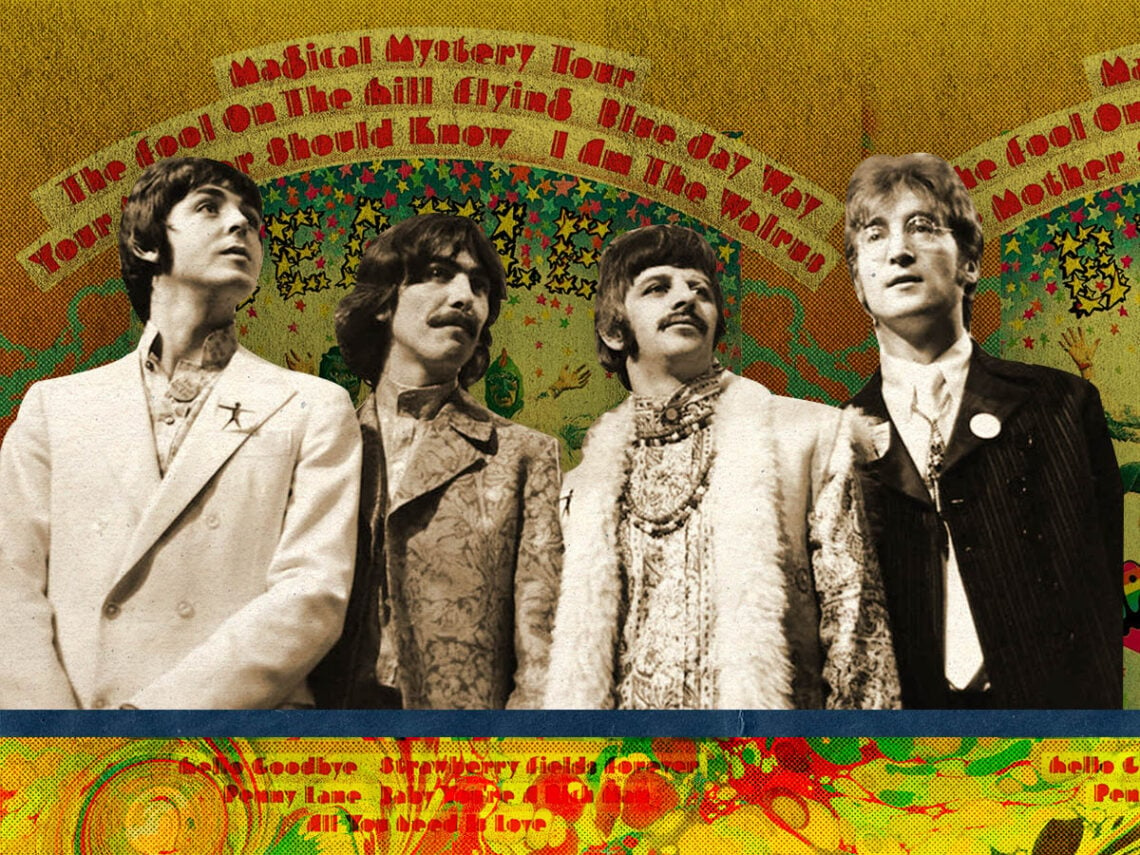
The Beatles – ‘Magical Mystery Tour’

There is still nothing like putting on an album and getting whisked away to another time and place. The best LPs are the ones that act as sonic transportation, instantly hauling you to sets and settings far beyond the droll and drab everyday life most of us live. Just as Dorothy steps into the technicolour world of Oz in The Wizard of Oz, so too did The Beatles step out into the vibrant multi-coloured explosion of psychedelia and wonder with their 1967 LP, Sgt. Pepper’s Lonely Hearts Club Band.
A massive critical and commercial success, Sgt. Pepper’s almost instantly obtained the title of ‘greatest album of all time’, kickstarting a legitimate cultural revolution that most people tend to recognise as the start of the 1960s in earnest. But the immediate after-effects of Sgt. Pepper’s would become its own fascinating period in The Beatles’ career, one that saw a fight for artistic control, a major leap into the future of recorded music, and the first cracks that would eventually fracture the band completely in 1970.
Magical Mystery Tour represented a number of firsts for the band. It was their first album since they completed their transition into the pre-eminent psychedelic act of the time. It was their first album since changing the world with Sgt. Pepper’s Lonely Hearts Club Band. It was also their first album to be released after the death of their manager, Brian Epstein. The loss of Epstein’s guidance would force the four Beatles to take on more responsibilities outside of music than any of them would have liked, and the resulting animosity slowly but surely began to creep into their working process.
When Epstein died, Paul McCartney began to exert a more prominent influence over the group. After having previously pitched the idea of a far-out coach bus tour that paralleled the psychedelic bus trips that Ken Kesey and The Merry Pranksters were taking in the US, McCartney doubled down on his fervour once Epstein had passed. The band was to write, direct, and star in their own movie, along with creating the accompanying soundtrack.
“We’ve been waiting for a couple of years now to make another feature film. And we’ve been asking people to write stories and write plots. But nobody’s come up with one, you know,” McCartney said after the film came out in 1967. “So we thought, ‘We’ll do something which isn’t like that,’ which isn’t like a real film in as much as it’s got a story and a beginning, and we’ll just do a selection of, you know… We’d put together a lot of things that we like the look of and see what happens. I liked it.”
Lennon was less convinced of the idea and was specifically put off by McCartney’s leadership. “I was still under a false impression,” Lennon claimed in 1972. “I still felt every now and then that Brian would come in and say, ‘It’s time to record,’ or, ‘Time to do this.’ And Paul started doing that: ‘Now we’re going to make a movie. Now we’re going to make a record.’ And he assumed that if he didn’t call us, nobody would ever make a record. Paul would say, well, now he felt like it – and suddenly, I’d have to whip out twenty songs. He’d come in with about twenty good songs and say, ‘We’re recording.’ And I suddenly had to write a fucking stack of songs.”
Inspired by the experimentation and randomness that helped fill in the spaces on Sgt. Pepper’s, McCartney decided that the film would be shot without a traditional script. Instead, scenes and vignettes would be filmed on the fly. “Magical Mystery Tour was Paul’s idea. It was a good way to work,” Ringo Starr said in Anthology. “Paul had a great piece of paper – just a blank piece of white paper with a circle on it. The plan was: ‘We start here – and we’ve got to do something here…’ We filled it in as we went along.”
Parallel to the film being shot, The Beatles returned to EMI Studios to cut the soundtrack. At the same time, the group was working on another soundtrack: Yellow Submarine, the animated film that the band didn’t actually star in. During this period, the group were also attempting to kickstart their own company, Apple, and were getting deeper into Transcendental Meditation. There were multiple different projects going on at any given time in 1967, but Epstein’s death caused McCartney to focus the group on the Magical Mystery Tour concept.
Instead of a full-length album, The Beatles decided to make Magical Mystery Tour a double EP. While the group had enough songs to turn the films A Hard Day’s Night and Help! into full albums, those films also had accompanying EPs that were more specific to the music in the movie. With a large number of other commitments, the soundtrack to Magical Mystery Tour featured three McCartney songs, one track each from John Lennon and George Harrison, and a brief bit of incidental music featuring all four members on wordless vocals. Six songs were too much for a traditional EP, so EMI decided to release the soundtrack as Britain’s first double EP.
The soundtrack side kicks off with the film’s theme song, ‘Magical Mystery Tour’. Featuring blaring horns and some not-so-subtle references to “rolling up”, ‘Magical Mystery Tour’ also features tempo changes, a spacey coda, and traded lead vocals between McCartney and Lennon. As a stage setter for both the film and the album, ‘Magical Mystery Tour’ features The Beatles at their most effortlessly cinematic. In fact, the song arguably featured more plot than the actual film.
McCartney then takes centre stage with the hazy ‘Fool on the Hill’. Rooted in McCartney’s love of music hall piano tunes, the insistent D6 chord at the heart of the composition creates a sense of tension and languidness, always wanting to resolve but never finding the right time. Just as it seems like he’s about to do it, McCartney takes a sudden turn into the parallel minor (D minor) for the song’s chorus, adding a bit of darkness to the otherwise bright and poppy LP. As the group tootles on harmonicas and recorders, McCartney muses on solitude and knowledge in ways that feel both serene and surprisingly deep.
After that, a bit of a breather comes in the form of the mostly instrumental ‘Flying’. Meant as bumper music to accompany a sequence in the film featuring clouds and footage discarded from Stanley Kubrick’s Dr. Strangelove, ‘Flying’ is mostly reliant on 12-bar blues. Lennon’s Mellotron skills are also on full display, as is the goofy group dynamic that comes out whenever all four members sing with each other. Although it has its charms, ‘Flying’ is mostly just a passing diversion, in and out, before you even remember much of it.

Harrison takes his turn in the spotlight with the album’s most transgressive track, ‘Blue Jay Way’. Complete with a melody that hinges on a tritone, ‘Blue Jay Way’ is dense with keyboards, atmosphere, and a palpable sense of dread. With verses that march forward with a disconcerting pulse, the song then lifts with Harrison’s “please don’t be long” choruses. ‘Blue Jay Way’ was written during the period when Harrison had largely stopped playing guitar, instead choosing to compose on either the sitar or the keyboard. While it’s not one of his more beloved tracks, ‘Blue Jay Way’ represents one of Harrison’s most successful forays into the world of trippy otherworldliness.
McCartney steps up once again with another music hall-inspired number, ‘Your Mother Should Know’. Although it fits right into the style that Lennon would later characterise as “granny music”, ‘Your Mother Should Know’ does have a highly memorable melody attached to its more chintzy elements. Unfathomably, McCartney wanted ‘Your Mother Should Know’ to represent The Beatles during their segment in the Our World broadcast. Thankfully, wiser heads prevailed, and Lennon’s ‘All You Need is Love’ was selected for its universal message instead.
Lennon closes out the soundtrack with one of his greatest songs, ‘I Am The Walrus’. Taking a hard turn into surrealism, Lennon crafts one of his most indelible pop songs out of nonsense, Lewis Carroll, randomness, and heady psychedelia. With an orchestra and choir there to back him up with some of the most insane music ever put to tape, Lennon pushes the envelope of what pop music can be as far as it can go without ever losing track of hooks and genuine fun.
While the group were recording the soundtrack, McCartney brought in another song, ‘Hello, Goodbye’. Earmarked as a single, the track was the tipping point for the band’s American label to turn Magical Mystery Tour into a full-length album. Along with ‘Hello, Goodbye’, Capitol Records collected the rest of the band’s most recent singles to fill outside two of a traditional LP. ‘Hello, Goodbye’, ‘Strawberry Fields Forever’, ‘Penny Lane’, ‘Baby, You’re a Rich Man’, and ‘All You Need Is Love’ were sequenced to make up the second side of Magical Mystery Tour in the US.
Despite being five of the band’s most indelible and influential songs of all time, The Beatles were initially unhappy with the inclusion of their singles. Since EPs sold significantly fewer copies in the US, Capitol rearranged Magical Mystery Tour into a full album. “It’s not an album, you see,” Lennon told American journalists in 1968. “It turned into an album over here, but it was just [meant to be] the music from the film”. Eventually, the full-length album featuring the singles on side two became the most recognisable version of Magical Mystery Tour, with Parlophone reissuing the album in that format for UK audiences in 1976.
With McCartney’s overbearing leadership coming into conflict with the desires of the other band members, Magical Mystery Tour represented the first real crack in the working relationship of The Beatles. Even worse, the television film received highly negative reviews, representing the first time that the Fab Four received criticism at that level in their entire career. Premiering on primarily black and white televisions on Boxing Day, 1967, the colourful editing and trippy aesthetics of the film weren’t fully grasped, while the aimless plot was targeted in harsh reviews.
Despite the critical lambasting that the film received, the accompanying album was more warmly welcomed by their fans. In retrospect, John Lennon didn’t seem too put out by the full-length album that was half soundtrack and half singles. “Magical Mystery Tour is one of my favourite albums because it was so weird,” he said in 1972. “‘I Am The Walrus’ is also one of my favourite tracks – because I did it, of course, but also because it’s one of those that has enough little bitties going to keep you interested even a hundred years later.”
The legacy of Magical Mystery Tour is that of a messy, piecemeal final product that represented the first real failure in The Beatles’ career. But when viewed apart from the film and away from the background that led to its creation, the Magical Mystery Tour album contains some of the most engrossing music that The Beatles ever put out. While it might have been seen as a cheap cash-in at the time, putting some of the band’s best singles on the flip side has greatly helped the standing of Magical Mystery Tour as it got added to the core of The Beatles’ discography.
While it’s certainly chaotic, Magical Mystery Tour also represents The Beatles’ peak of psychedelia. As the 1960s produced more conflict and turmoil for the band, Magical Mystery Tour looks like the first sign of acrimonious things to come. But it’s also filled with so much whimsy, goofiness, and real innovation that it’s impossible to cast off. Magical Mystery Tour may not be The Beatles at their best, but it’s still a deeply engrossing and delightful journey nonetheless. The Beatles on an off day is still better than most bands at their best, so feel free to roll up with Magical Mystery Tour any time.

Never Miss A Beat
The Far Out Beatles Newsletter
All the latest stories about The Beatles from the independent voice of culture.
Straight to your inbox.