


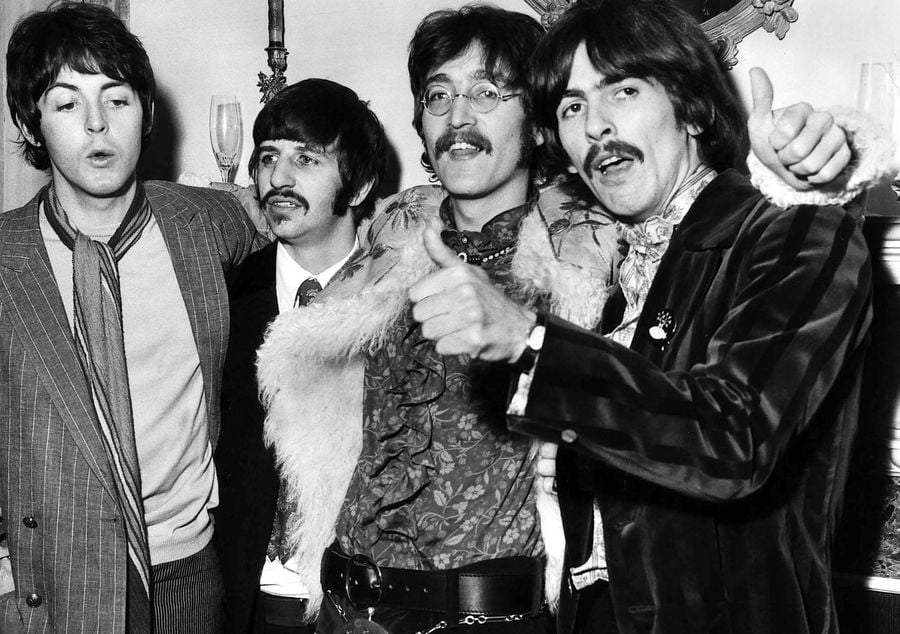
The 8 Beatles B-sides that were better than the A-sides

The single is a curious thing for us in the 21st century. With streaming services now our primary way of discovering new music, the idea of picking up your favourite band’s new single from your local record store is the stuff of nostalgia-hued dreams. What’s perhaps even more alien is that those single releases always came with a B-side, an essential component to the vinyl releases that have since become a treasured piece of musical history.
B-sides have taken on an almost mythical role in music. Despite there being little to no need for any B-side in 2021, the very notion of a rare song attached to a presumed more popular release is still captivating. Music lovers are a curious bunch and, as soon as song or artist is confirmed as having widespread appeal, the chances are that diehard musos will decry it unworthy of such attention. It’s a curse that can befall any band, event The Beatles.
John Lennon, Paul McCartney, George Harrison and Ringo Starr are some of the greatest pop music songwriters to have ever graced the planet. The original superstar band, The Beatles, turned the world on its head during the sixties and made its cultural impact felt across the globe. While notoriously famed for their predisposition for making albums, something that would become heightened as their career progressed, the group also released some stellar singles in their day too.
More often than not, those singles would operate in a unique position. Not given a spot on the band’s album of that year, the single would, instead, perform as either an introduction to the record or an appetite suppressor for the next one — but that doesn’t mean they were throwaway pieces. Certainly, at the beginning of the band’s career, their singles were just as important as their albums, meaning that everything had to be perfect for every release.
Such a high demand for quality meant that, unlike the horrendous nineties, singles couldn’t be backed with a remix of the original or an alternative take. No, singles would need to be backed by a proper B-side. Unfortunately, it’s meant that some of the band’s very best songs were given the unwarranted secondary letter of the alphabet.
Below, we’ve picked out eight songs that featured as Beatles B-sides that go one better and actually trump the A-side.
The Beatles B-sides that were better than the A-sides
‘P.S. I Love You’
Shared with ‘Love Me Do’ as the A-side, it is a tough call to give ‘P.S. I love You’ the nod as the best song of the release. But, according to Richards, the song was only kept as B-side because he “was originally a music publishing man, a plugger, so I knew that someone had already done a record with that title,” he said, referring to Gordon Jenkins and Johnny Mercer’s song of the same name.
With its sentimental lyrics and obvious Motown influence, the track became a hit within The Beatles community and featured in many of their live sets, even if it did come from their early days. “That’s Paul’s song,” recalled Lennon of the track. “He was trying to write a ‘Soldier Boy’ like the Shirelles. He wrote that in Germany or when we were going to and from Hamburg. I might have contributed something. I can’t remember anything in particular. It was mainly his song.”
It’s a charming piece of pop music that feels so unbelievably “of the moment” that it’s hard not to get swept up in the majestic nostalgia of it all.
‘This Boy’
Released as the B-side to ‘I Want to Hold Your Hand’, the song ‘This Boy’ may not make it into everybody’s list as one of the band’s best B-sides. Certainly, the A-side is one of the band’s most treasured singles and is rightly revered, but there is something delicately balanced and highly personal about ‘This Boy’. Perhaps the finest comment on the song is that it typifies the band at this moment.
Not only did John Lennon and Paul McCartney write the song as an exercise in three-part harmony, but they wrote it “eyeball to eyeball” while on tour. “‘This Boy’ was another hotel-bedroom song, twin beds, one afternoon somewhere; we had arrived around one o’clock,” recalled McCartney of the song’s composition.
“We had a couple of hours to kill, so we thought, Well, let’s write one. Rather like the hotel where we wrote ‘She Loves You’. It’s funny; I remember the room and the position of the beds: John and I sitting on twin beds, the G-Plan furniture, the British hotel with olive green and orange everywhere, that marvellous combination, the colours of vomit.”
‘Rain’
The release of ‘Paperback Writer’ and ‘Rain’ is about as close as we can get to being a double A-side release without the fact. Both songs on the record are simply sublime, showcasing the vast amount of talent the band possessed at this time. But, we think that ‘Rain’ is the better number largely because of one man: Ringo Starr.
The song is arguably his finest work for the Fab Four, something he himself suspects too: “I feel as though that was someone else playing,” he said. “I was possessed!”
He then went on to detail what exactly he loved about the song to Barry Miles: “I was into the snare and hi-hat. I think it was the first time I used this trick of starting a break by hitting the hi-hat first instead of going directly to a drum off the hi-hat,” Ringo said. “I think it’s the best out of all the records I’ve ever made.”
‘You Can’t Do That’
OK, so it’s about this time that we must admit to being some of the aforementioned diehard music lovers who devalue a song because of its popularity. Going on the people’s will alone, and you’d be hard-pressed to find a strong majority for going against ‘Can’t Buy Me Love’ in this battle versus ‘You Can’t Do That’. But, taken away from the magic of the band’s legacy and things become painstakingly obvious.
“That’s me doing Wilson Pickett,” recalled John Lennon of the song. “You know, a cowbell going four in the bar, and the chord going chatoong!” The song was meant to be the band’s sixth single release but Lennon’s composition was topped for the A-side by McCartney, a moment which would spur the bespectacled Beatle into writing most of the A Hard Day’s Night LP.
It’s a joyful piece of pure rock and roll revelry.
‘Don’t Let Me Down’
Another case of Lennon versus McCartney came when the band were looking to release singles in their final years with ‘Get Back’ facing off against ‘Don’t Let Me Down’. The B-side from John Lennon was a rallying plea to Yoko Ono and its impassioned performance puts it leagues ahead of the Macca-penned ‘Get Back’.
The song was composed about Yoko and saw Lennon take his lyrics into the territory of pleading with Yoko to stay with him, prove him right and live out their love together. It was a plea that all the extra worries and troubles he was now dealing with were worth it. As Paul McCartney remembered in 1994, “So ‘Don’t Let Me Down’ was a genuine plea, ‘Don’t let me down, please, whatever you do. I’m out on this limb.’
“It was saying to Yoko, ‘I’m really stepping out of line on this one. I’m really letting my vulnerability be seen, so you must not let me down.’ I think it was a genuine cry for help. It was a good song. We recorded it in the basement of Apple for ‘Let It Be’ and later did it up on the roof for the film.
‘Baby You’re A Rich Man’
‘All You Need Is Love‘ is exactly the kind of anthemic moment of pure connection and global outreach that The Beatles would soon make a key piece of their iconography. A huge chorus and a captivating performance mean the song will forever remain a gem in the band’s crown. Unfortunately, however, musically, it isn’t incredibly interesting.
The B-side, however, is about as rich in music as it gets, operating as the double cream on top of the ‘All You Need Is Love’ saccharine dessert. ‘Baby, You’re A Rich Man’ was a composite of two songs and recorded in a single day. The unusual conception and construction mean it stands out amid the pack of pop ditties.
“That’s a combination of two separate pieces, Paul’s and mine,” Lennon told David Sheff, “Put together and forced into one song. One half was all mine. [Sings] ‘How does it feel to be one of the beautiful people, now that you know who you are, da da da da.’ Then Paul comes in with [sings] ‘Baby, you’re a rich man,’ which was a lick he had around.” It’s the combining of these two landmark songwriters that make this a similarly shining jewel.
‘I Am The Walrus’
Perhaps the most famous battle of the B-sides came with ‘Hello, Goodbye’ and ‘I Am The Walrus’ squaring off against each other. Though ‘I Am The Walrus’ isn’t necessarily one of the band’s best songs, no matter what people say, it certainly has more artistic merit than Paul McCartney’s ‘Hello, Goodbye’ a song written at a schmoozy dinner party that essentially just rattles through a host of opposing forces.
‘I Am The Walrus’, in this regard, is far its superior. Though Lennon’s tripped-out track is keenly connected to LSD and the mind-altering propositions it provided, the song uses these themes to provide an insightful view of its creator, Lennon, namely his adoration for Lewis Carroll.
Depending on what you believe, the song was either inspired by Carroll or a ludicrous sex act, neither of which feels far from the truth. Given the fact the song has sparked countless covers and a myriad of conceptual theories, there’s no doubt it deserved to be the A-side.
‘Old Brown Shoe’
‘The Ballad of John and Yoko‘ was always a strange choice for a Beatles single. Not only had Yoko Ono implemented herself within the very fabric of the Fab Four, but she was now being serenaded with songs about her own wedding day. It left a puzzling look on most fans faces, especially considering just how rich in musical muscle ‘Old Brown Shoe’, the single’s B-side, was.
Similar in style to McCartney’s aforementioned ‘Hello, Goodbye’, George Harrison turned to the duality of life for inspiration for ‘Old Brown Shoe’. Writing in his autobiography I, Me, Mine, Harrison said: “I started the chord sequences on the piano, which I don’t really play, and then began writing ideas for the words from various opposites… Again, it’s the duality of things – yes no, up down, left right, right wrong, etcetera.”
The song is now rightly seen as one of the band’s most underrated gems and deserves re-listening whenever you can.

Never Miss A Beat
The Far Out Beatles Newsletter
All the latest stories about The Beatles from the independent voice of culture.
Straight to your inbox.