


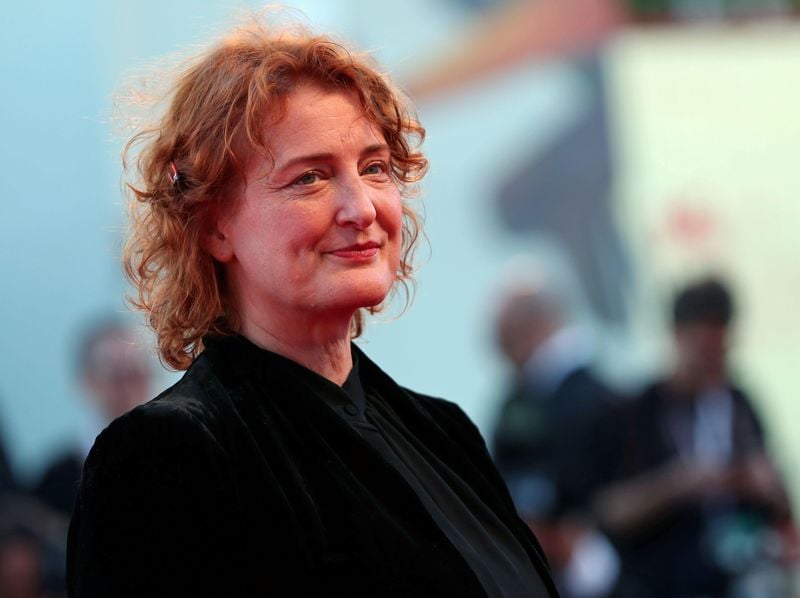
‘The Babadook’ director Jennifer Kent names her 10 favourite horror films

Australian filmmaker Jennifer Kent ditched acting after she saw Lars von Trier‘s Dancer in the Dark, a movie that inspired her to become a director. Disgusted by the idea of film school, Kent wrote to Von Trier, asking if she could study under him. Magnificently, he replied, and in 2002, she began working on his film Dogville as a production assistant.
However, it wasn’t until 2014 that Kent recieved widespread critical acclaim when she adapted her short film, Monster, into a feature called The Babadook. The film follows a single mother and her son as they must confront the possibility of a monster lurking in their home. Financed by government grants and crowdfunding, Kent’s film grossed $10.3 million, compared to its $2 million budget.
Reflecting on her efforts, Kent said of the film: “I’m not saying we all want to go and kill our kids, but a lot of women struggle. And it is a very taboo subject, to say that motherhood is anything but a perfect experience for women.” She also said that she “was always quite fascinated by people who could suppress really dark, deep, painful experiences and [she] wanted to explore the idea that perhaps pushing down on those terrible experiences is harder than facing them.”
In 2018, the director released her second film, The Nightingale, and is currently working on several upcoming projects. However, Kent wouldn’t be the filmmaker she is today without the influence of specific films. Here, she creates a list via Shutterstock, detailing ten horror films vital to her development as a director, particularly inspirational to the creation of The Babadook.
10 horror films that inspired Jennifer Kent:
La Maison Ensorcelée (Segundo de Chomón, 1906) / Georges Méliès Shorts
Kent shared her love for Georges Méliès, saying: “I had a binge where I sat down and watched the whole collected works over a period of weeks, because there’s hundreds of them. It really struck me what a genius he was and how he really was the grandfather of special effects.” The director stated that his work inspired the special effects in The Babadook, adding: “People may say, ‘Oh, the special effects aren’t very good,’ but it’s intentional that they’re of a similar quality to the Méliès style. It’s what resonated for me.”
Clips from Segundo de Chomón’s La Maison Ensorcelée appear in the film. “Chomón is a lesser-known genius. All his films are around the same time as Méliès and they have a similar quality. They’re very childlike, because now they’re naïve — we know how those tricks are done, but there’s a brutality to them.”
Black Sabbath (Mario Bava, 1963)
A clip of Mario Bava’s film Black Sabbath can be seen on the TV in The Babadook. Kent shared that she “had to pay an arm and a leg for it, I must say! Paid for it myself. That stuff in the TV is like a character speaking to her”.
Detailing further, the director added: “It was very important what was on there. It couldn’t be random stuff. I saw that clip again and thought, ‘This is perfect.’ She’s haunted by what she’s done. You see that image and it’s a premonition of what she’s about to do.”
The Tenant (Roman Polanksi, 1976)
Forming the third part of Roman Polanksi’s Apartment Trilogy, which also includes Rosemary’s Baby and Repulsion, The Tenant stars Polanski as a man that loses himself down a spiral of paranoia.
Kent said: “Any filmmaker that has dealt with the mind in a more abstract way has been inspired by The Shining and Repulsion. Also, The Tenant is another film that goes deeply into someone’s mental state. It also has a bizarre humour to it, which really tickles my fancy, whereas Repulsion is a much more straight film in that way.”
Lost Highway (David Lynch, 1997)
Surrealist genius David Lynch released his neo-noir thriller Lost Highway to critical praise in 1997. Kent has cited the filmmaker as one of her biggest inspirations: “I have a very broad view of what I call horror — much more broad than most people. I find a film like Lost Highway to be a horror masterpiece, because he’s going straight into the mind of someone who’s not coping with what they’ve done. It’s terrifying!”
She continued: “I find that much more terrifying than more straightforward horror films. Maybe younger horror audiences — and I’m not ruling out everybody across the board — would look at a film like Lost Highway and think it was boring, but for me, it’s gripping to watch the descent of that person.”
The Amityville Horror (Stuart Rosenberg, 1979)
Based on the real occurrences of a supposed haunting reported by the Lutz family, who moved into a house that had been the site of mass murder, The Amityville Horror became one of the highest-grossing independent films of all time upon its release in 1979.
“When I was about 13, I watched it and it freaked me right out. There’s the repeating thing of 3:15am, and I would always wake up around this time in my bed just filled with dread, expecting something terrible to happen,” Kent said. “For me, that’s what horror can be: it’s not what actually happens, it’s this dread of what could happen. It’s an environment that should be safe and it’s not. If you can’t trust your home, where are you safe?”
Halloween (John Carpenter, 1978)
A horror classic, Halloween is one of the most iconic slashers ever made. Kent calls it a “masterpiece,” explaining in more detail: “It wasn’t crowded out with lots of sound; it was very economically made. The same with [Carpenter’s] version of The Thing“.
She added: “The characters in Halloween, we look at now and maybe think it’s hilarious, but they are very well drawn and it still works. It’s still frightening to me, that film.”
The Texas Chainsaw Massacre (Tobe Hooper, 1974)
Another cult favourite, The Texas Chainsaw Massacre, shocked audiences due to its extreme violence and grotesque nature. Kent also called the film a “masterpiece.”
Discussing the movie’s impact, Kent explained: “It’s saying something deeper about humanity. For me, it’s like how an animal must feel at the slaughter. There’s something so rough and coarse in a really great way running through that film. It’s a genius film. It’s still shocking. There’s an energy to it.”
Vampyr (Carl Theodor Dreyer, 1932)
German Expressionism greatly inspired The Babadook, particularly Vampyr, a lush and atmospheric horror about a student placed under the curse of a vampire. Kent called it a “beautifully surreal, frightening film”.
She explained in more detail: “The whole point of using German Expressionism is that it’s about bringing the inside out, and that felt perfect for Amelia [the film’s protagonist]. You can’t deal with a psychological story like this in a kitchen-sink drama kind of way. I think it would be boring.”
The Innocents (Jack Clayton, 1961)
Based on Henry James’ novella The Turn of the Screw and adapted by Truman Capote, the film follows a governess who must care for children possessed by ghosts. Kent stated: “I’m just amazed at how many layers there are in that film. The Innocents is so beautifully ambiguous, though. It demands that the viewer work to find out what’s going on. It doesn’t take us for idiots, and that makes it incredibly creepy.”
Black Swan (Darren Aronofsky, 2010)
The most recent film on this list, Darren Aronofsky’s Black Swan tells the tale of a ballerina who drives herself to a state of insanity in order to perform the coveted starring role. Natalie Portman won an Oscar for her mesmerising portrayal of dancer Nina.
Kent said: “It was a film that dealt with psychology in a beautiful, surreal way. That was something that inspired me to keep going. I do find modern horror has degenerated a bit, but it’s not across the board. There are beautiful films like Let the Right One In and The Orphanage, but it’s the earlier ones that I went back to for greatest inspiration.”
