


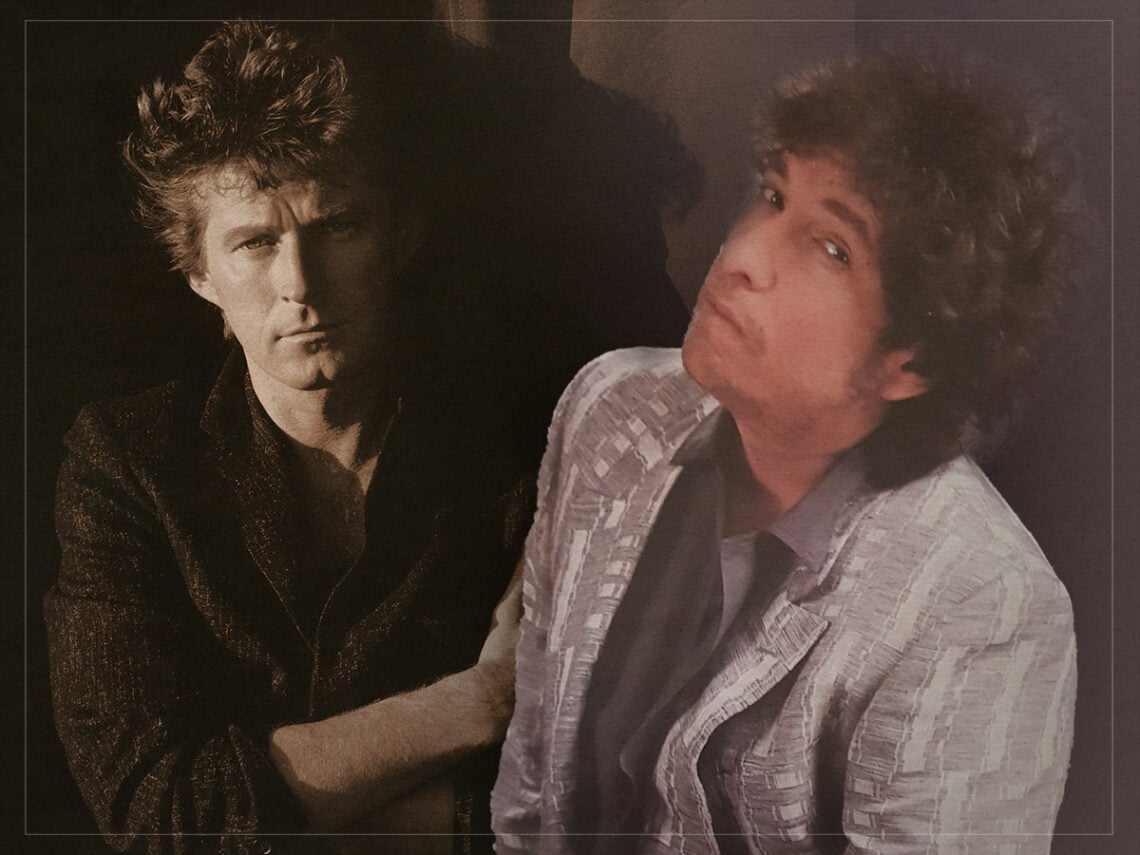
The artist Bob Dylan and Don Henley called an American “national treasure”

Perhaps the pinnacle of Bob Dylan’s majesty lies with all the songs he didn’t write.
Armed with little more than four chords, the truth, and – as David Bowie put it – a voice of sand and glue, he transformed the direction of American music. “I have an enormous respect for what he’s brought to popular music, particularly as I get older,” Don Henley said about his great ‘Blowin’ in the Wind’ contemporary from Duluth, Minnesota.
There’s no doubting the way he brought a newly minted intelligence and bite to pop. His approach was so radical, in fact, that he happily belongs on the Mount Rushmore of great American artists, period, let alone songwriters. Without him, Henley, who many might argue deserves to be a neighbouring face on the fictional Rushmore, might not have ditched his literature studies to apply what he had learned to song.
But there is also one often overlooked icon who took songwriting in yet another direction who both men admire to the extent that they would call him a “national treasure”. That’s high praise indeed from fellows who have always seemed to embody the patriotic James Baldwin quote: “I love America more than any other country in the world and, exactly for this reason, I insist on the right to criticize her perpetually.”
Nobody has ever done that with quite so much unwavering wit as Randy Newman. Newman must have been delighted when Dylan came along. With a Los Angeles family all attached to the Hollywood music business in some way, it long seemed fated that he would become a songwriter himself. But even still, venturing into the profession at 17 was an early start.
He was hired by Metric Music and January Music at a young age to work as a songwriter for hire. It seemed foregone that this would likely be the role he would one day retire from when his pension days beckoned. He wasn’t much of a flamboyant performer, and his voice was never going to compete with some airbrushed young songbird.

But when Dylan came along, none of that seemed to matter any more. The meaning and depth of songwriting were now a rising currency. So, Newman leapt out of his window on Tin Pan Alley, squireled away on his own, and quickly began writing songs that earned him the title: The Dean of Satire.
While he might’ve ventured back into songwriting for hire when he became the soundtrack master for Pixar – ironically, the mode that most people now know him for – his peers revered him most of all for his daring political songs about slave traders trying to convince Africans to come to the Land of the Free (‘Sail Away’), the pollution of the Cuyahoga River (‘Burn On’), and how Karl Marx would be laughed out of modern America (‘The World Isn’t Fair’).
It wasn’t just the poise, intent, and humour of the songs that left his peers awed, either. He was skilled enough to make his melodies part of the narrative. Newman never just picks pretty chords; they have to interplay with the lyrics in some clever post-modernist way. In fact, I’m going to say it… Randy Newman is – that dreaded overused word – a bloody genius.
Thankfully, you don’t just have to take my word for it, or even Dylan’s and Henley’s for that matter, everyone from Brian Wilson, who called him a “genius”, to Linda Ronstadt who said each of his songs make you “laugh or cry”, has heaped praise on him. And this makes it all the more peculiar that he claims he has perpetually sustained around 200,000 fans throughout his career.
That’s not for lack of campaigning from his old pal Henley, though. “Randy Newman is a national treasure,” Henley told the Los Angeles Times. “He’s a songwriter’s songwriter; a musician’s musician. He’s also probably the most misunderstood and underappreciated recording artist alive.”
The extent of that underappreciation is elucidated when you consider how Henley concluded his appraisal, “He’s one of the only living songwriters who can get ridicule and empathy into the same song. Sometimes, he works in the realm of irony; other times, he’s a heart-on-his-sleeve romantic. The combination of his lyrical genius and his deep ability as an orchestrator and composer is powerful stuff. There’s nobody quite like him.”
You can’t say that about, well, anyone bar maybe Dylan. And speaking of Dylan, while he might usually stay enigmatically schtum about his peers, he felt the urge to say, “To me, someone who writes really good songs is Randy Newman,” Dylan told Paul Zollo in 1991.
Adding: “There’s a lot of people who write good songs. As songs. Now Randy might not go out on stage and knock you out, or knock your socks off. And he’s not going to get people thrilled in the front row. He ain’t gonna do that.”
He’s going to do something a little more timeless, as Dylan concludes, “But he’s gonna write a better song than most people who can do it. You know, he’s got that down to an art. Now Randy knows music. He knows music. But it doesn’t get any better than ‘Louisiana’ or [‘Sail Away’]. It doesn’t get any better than that. It’s like a classically heroic anthem theme. He did it.”
Indeed, he did – and there are a few revered folks who think he hasn’t gotten enough credit in his native States for doing so.

Never Miss A Tale
The Far Out Bob Dylan Newsletter
All the latest stories about Bob Dylan from the independent voice of culture.
Straight to your inbox.