


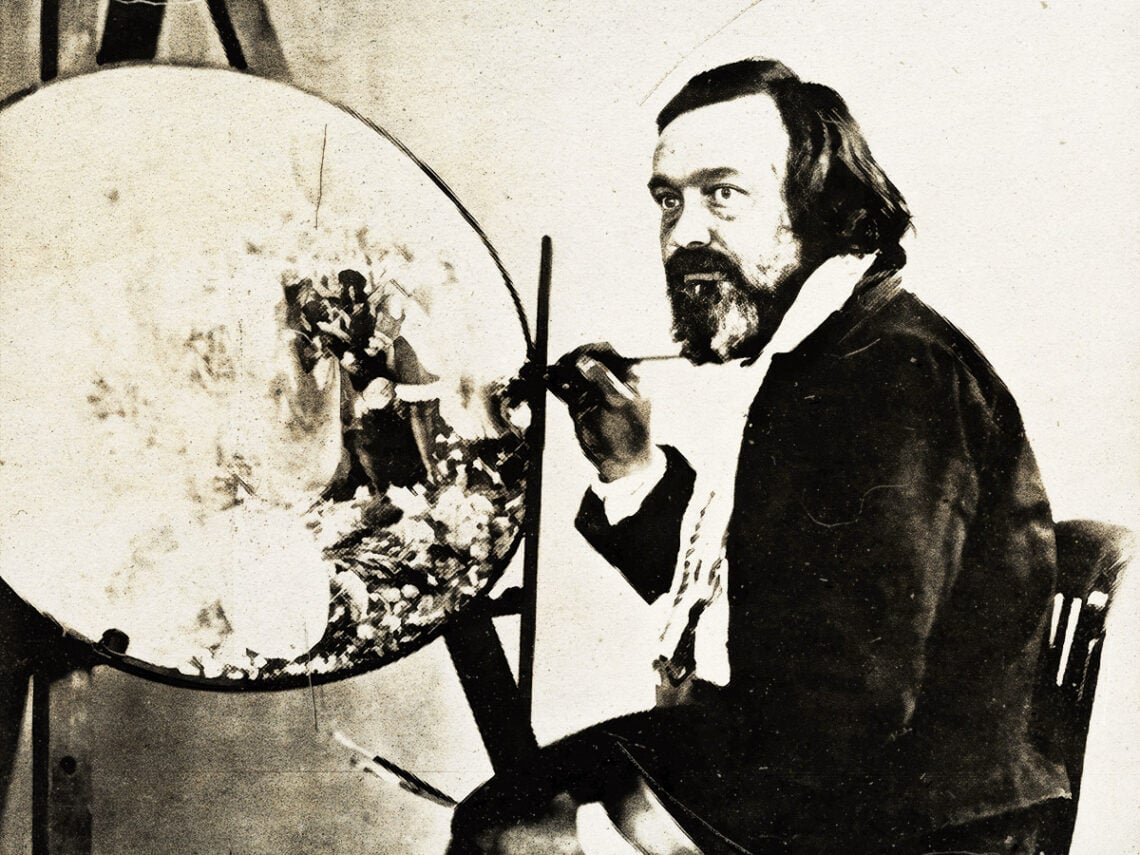
The art of murder: Richard Dadd’s paintings from prison

The prolific and fantastical imagination of Richard Dadd demanded a ransom: his sanity.
The attempted escapism through his visionary paintings and drawings fabled him as another victim of the ‘tortured genius artist’ trope. Unfortunately for Dadd, if you murdered your father once in 1843, suddenly, everyone puts it at the centre of your biographies — and you get life in an asylum. But luckily for him, being in the midst of a psychotic absolves you from reality – so you don’t really have to worry about the guilt, the shame, or how Victorians completely misunderstand your schizophrenia.
Although Dadd’s travels in the Middle East marked the beginning of his decline, their religious and cultural influence would linger until his last painting. He was expected to draw Sir Thomas Philip, a lawyer and former Mayor of Newport, in exchange for the trip. When they arrived in Cairo, the architecture, atmosphere and amber hues would never leave his painterly language. He became fascinated by the Egyptian Gods, namely Osiris, who later convinced Dadd to sacrifice his father. When arriving in Italy, he expressed some paranoiac episodes where he felt compelled to attack the Pope.
Dadd was later confined to mental institutions such as Bedlam and Broadmoor for the rest of his life, being admitted at just 27 years old. During this time, doctors encouraged his hobbies: giving him a studio and paint. Retrospectively, the imaginative freedom of his paintings could only be the result of his imprisonment. This seclusion and shelter from the figurative and punctilious Victorian tendency in painting differentiated him from his contemporaries. Despite the stigma that followed him, Dadd was liberated from any movement or the need for profit. This let him cater to his fantasies (or delusions), allowing him to develop his legendary style.
Without his monastic lifestyle, Dadd might not have reached the notoriety that he has today. Reportedly, the artist was nonsensical and could not carry out normal conversation. His fervent need to communicate meant he replaced his tongue with a paintbrush and conversations with canvases upon canvases.
His most celebrated painting, ‘The Fairy Feller’s Master-Stroke’, is a visual fairytale. It was incomplete, as he was moved between asylums at the time. The intricacy of the painting led him to compose a long poem about it instead of its visual finish. The poem is called ‘Elimination of a Picture & its subject – called The Feller’s Master Stroke’, and opposes the assumption that Dadd’s paintings are irrational and meaningless hallucinations. All the characters in the painting have a purpose and are deliberate.
An authentic glimpse into his occasional lucidity, Dadd’s plethora of meaning in each of his paintings has a narrative, though some are vaguer than others. In this case, it is an ode to Shakespeare with characters such as Queen Mab from Romeo and Juliet. The theatrical nature of this painting means that it is in a state of permanent suspense – paralleling Dadd’s life between institutions and removal from reality. The scene’s participants are waiting for the Feller, in the lower quarter of the painting, to throw his axe down onto the chestnut to split it for Queen Mab’s Carriage. This is explained in Dadd’s poem:
“fay woodman holds aloft the axe
Whose double-edge virtue now the tax
To do it singly & make single double
Featly & neatly–equal without trouble.”
Titania and Oberon from A Midsummer Night’s Dream are also included in this coalescence of literature and art. Complementing them stands ‘The Patriarch’ in the centre of the painting. Some muse that the Pope inspires it, and Dadd’s animosity towards him had dissipated. He is adorned with a large hat and a white beard as he anxiously watches the Feller and the chestnut.
This whimsical fairy lore composition creates a whirlwind of romanticism, caught in the grass tendrils and the yellow hearts of the daisies cascading down towards the Feller. When the painting was given to the Tate in 1960, Dadd’s painting rose to popularity for its delicacy, detail and tension. Inspired by these motives, Queen released ‘The Fairy Feller’s Master Stroke’ in 1974. It has also been used in a novel by Terry Pratchett, ‘The Wee Free Men’ As seen by its transcendence from literature to art and from art to music, the painting is an endless source of inspiration for current and past creatives.
The mythical lines traced by Dadd coloured his daily life of isolation. In his imprisonment, he reached greater artistic freedom and imagination than his peers, free from direct public judgement.
