


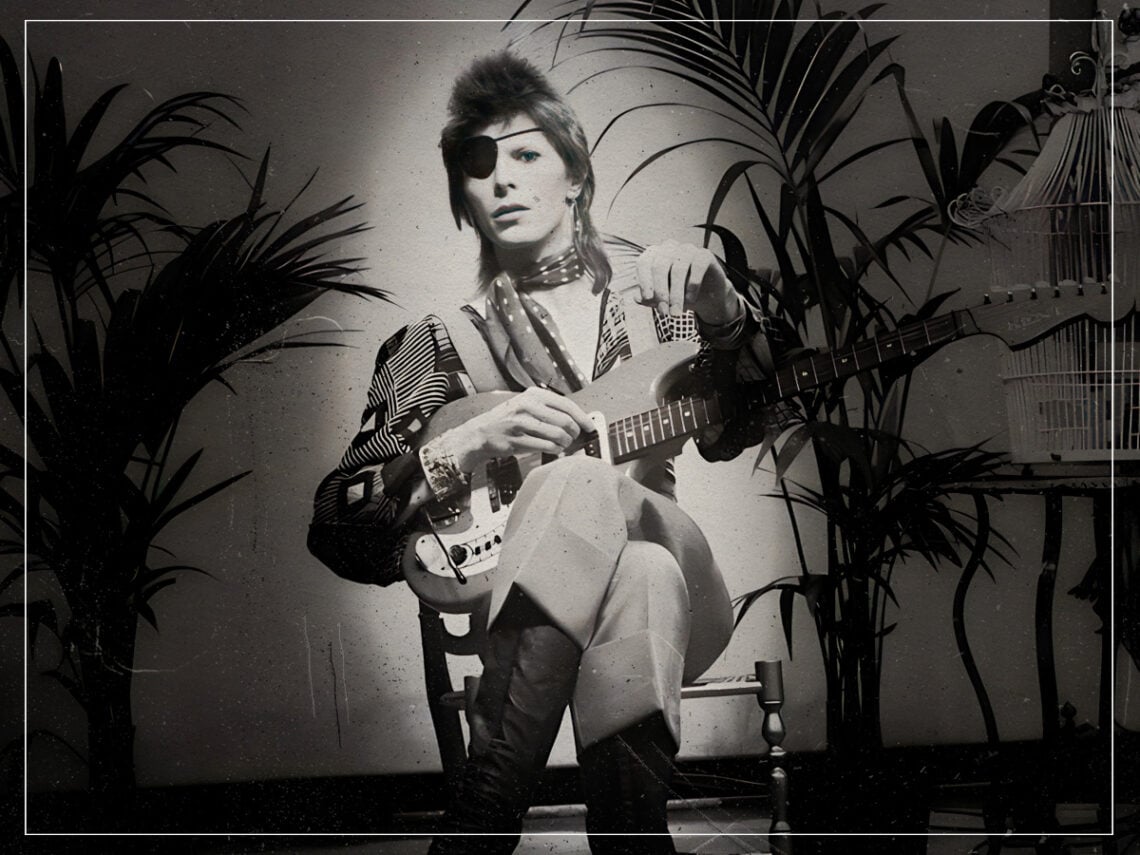
“A certain degree of optimism”: Why David Bowie wanted to be remembered for ‘Scary Monsters’

We always imagine that all art is as the artist intended it. A critic can never concern themselves with whether a splitting headache caused the bass drum to be dulled or a broken boiler in a studio prompted a painter to rush a few brushstrokes and head home for warmth. This perception is amplified further when it comes to a fellow like David Bowie. The late Starman was so profuse with ideas that you imagine them as such: bottled-up moments of divine inspiration. You barely reconcile the tiresome work behind them.
But from the lightning bolt across Aladdin Sane’s face to the searing solo in ‘Moonage Daydream’, behind each moment of inspiration was blood, sweat and tears. From ‘Heroes’ to ‘The Laughing Gnome’, every song was lauded over by fate, a finite pool of effort, and capricious circumstance. Whether it was management demanding demos in a hurry, hangovers from hell upending would-be classics, or an unruly toddler whittling away at precious rest, art is inextricably tied to the same drudgery that it looks to offer exultation from.
This was, in fact, always evident in Bowie’s work as a notable boon. No matter how otherworldly the surface may have appeared, his art was always humanised in a way that helped it resonate. Perhaps that comes down to how relatable he was as a person. People simply loved David Jones, the man, as much as they loved David Bowie, the performer. But that didn’t always come over quite so effortlessly.
Bowie’s rise could be defined as failing to succeed. The notion that Bowie arrived from nowhere and bestrode the 1970s like a kaleidoscopic colossus is a falsehood cooked up after the fact. Ostensibly, the single that smashed the hinges off of the door to world dominance and thrust him into the spotlight was ‘Space Oddity’. In reality, it charted at a hardly earth-shattering number five in the UK. It was kept off the top spot by Thunderclap Newman’s ‘Something in the Air’, which, in retrospect, is like Muhammad Ali being fended off by a light spring breeze.
Likewise, The Rise and Fall of Ziggy Stardust and the Spiders from Mars reached number five in the UK charts and a mind-bending 75th in the US. Bowie only had one record in the 50 best-selling albums of the ’70s, and it was Spiders from Mars, lingering down in 42nd place alongside Leo Sayer. His career up until that release had, likewise, been a stuttering mess of failed multi-media mime acts, attempts to copy Simon and Garfunkel, novelty songs, and strange dance troupes.

So, he was never quite settled nor successful enough to ever rest on his laurels and lavish his ideas with oodles of time and painstaking attention. Everything was done in a flurry, governed by factors beyond his control. Moreover, he had a monkey on his back to boot, and this frequently meant that chaotic cocaine would ruffle the hair of his most pristine ideas. So, by the time he did find a measure of success and comfort as an artist, he was always irked by the fact that nothing to that point had ever been quite as he had intended it.
Tony Visconti, the producer with whom Bowie made 12 in the studio and two live albums, felt much the same. Nothing had ever been as smooth sailing in the studio as he had hoped. Before every record that the duo would make together, they would proclaim, “Let’s make this our Sgt Pepper’s! We’re going to take nine months, and we’re going to do everything we want to do.”
But for one reason or another, the pair never quite found the time. Visconti explained to Ameoba Records that Heroes was recorded in “just four weeks”. Obviously, that stands as a glowing testimony that Bowie barely needed time on his side to achieve brilliance, but there was still the nagging doubt that they could potentially unearth more with a few months to play with. After all, The Beatles spent well over 700 hours stretching the limits of Sgt Pepper between November 1966 and April 1967, and while some might argue that this actually resulted in a record that was over-indulged and overcooked, Bowie also thought it represented the best of what rock ‘n’ roll could do.
The record defined the facet that Bowie loved most about John Lennon in that ”he would rifle the avant-garde and look for ideas that were so on the outside of, on the periphery of what was the mainstream and then apply them in a functional manner to something that was considered popularist and make it work.” 13 years on from Sgt Pepper’s, the Starman was finally handed an opportunity to see whether he could do the same in the most studious way yet.
With Scary Monster (And Super Creeps), they managed to catch a break in the calendar, an upturn in sobriety, and, thanks to the relative success Bowie enjoyed in the late ’70s, the resources were there to finally make their own painstaking epic, “This was our Sgt Pepper’s,” Visconti proudly proclaims. With Bowie in a sweet spot, many of the melodies were already in place, and he cut them with a band rather effortlessly over the course of a relaxed and refined period in The Power Station in New York City before being polished off in London.
Being stationed at the iconic studio for an extended period of time offered the chance for pals like Roy Bittan of Bruce Springsteen’s E Street Band to drop in to lend a piano riff to the classic ‘Ashes to Ashes’. Robert Fripp, Pete Townshend and a few other guests were also welcomed. The place was a heaving hub of creativity, and Bowie’s sense of freedom was emblematic of his confidence at the time. “There was a certain degree of optimism making [Scary Monsters] because I’d worked through some of my problems,“ he recalled. “I felt very positive about the future, and I think I just got down to writing a really comprehensive and well-crafted album.“
From top to bottom, the record captures what Bowie was all about: a presider over a menagerie of weird and wonderful influences coming together to produce a blistering cacophony of unrivalled creativity. It’s an album that only he could’ve made, yet he could never have made it alone. It is, without doubt, one of his greatest attributes as an artist that he wasn’t unhinged by his own sense of individualism and was happy to celebrate the artistic vision of others. So, as the band played around with his abstract ideas, buoyed by the sense of freedom abounding from his position behind the mixing desk, Visconti began to hear “magic taking place“.
In many ways, it was a culmination of what Bowie was angling for throughout his career. It was the last album that he made with the dream team of Visconti, guitarist Carlos Alomar, bassist George Murray, and drummer Dennis Davis, who had been a pivotal part of his revolutionary sound in the ’70s. And it is with no small degree of irony that their farewell undoubtedly shaped the sound of the decade to come, as Bowie himself put it, “By the time of Scary Monsters, the kind of music that I was doing was becoming very acceptable,“ he said, “it was definitely the sound of the early 80s.“
For a man who once said, “Tomorrow belongs to those who can hear it coming“, that was a great sense of pride. As was the fact that he had somehow coded profoundly postmodern and fiendishly Freudian ideas into something that became a huge success. As the title suggests, rather than pit villains and heroes against each other, Bowie delved into the psychology of perturbed perpetrators, explaining that the song is about “a criminal with a conscience who talks about how he corrupted a fine young mind.” In the process, he offered up some of his greatest-ever songs in the form of ‘Teenage Wildlife’ and ‘Ashes to Ashes’.
It is a defining album—and what it defines remains joyously hard to elucidate. That’s the magic of Bowie. As Visconti concluded in A New Career In a New Town, ”When we finished mixing, we knew we had done something very special. Scary Monsters was so incredibly satisfying to make; fans and critics alike validated us. This was one of our finest hours.”
