


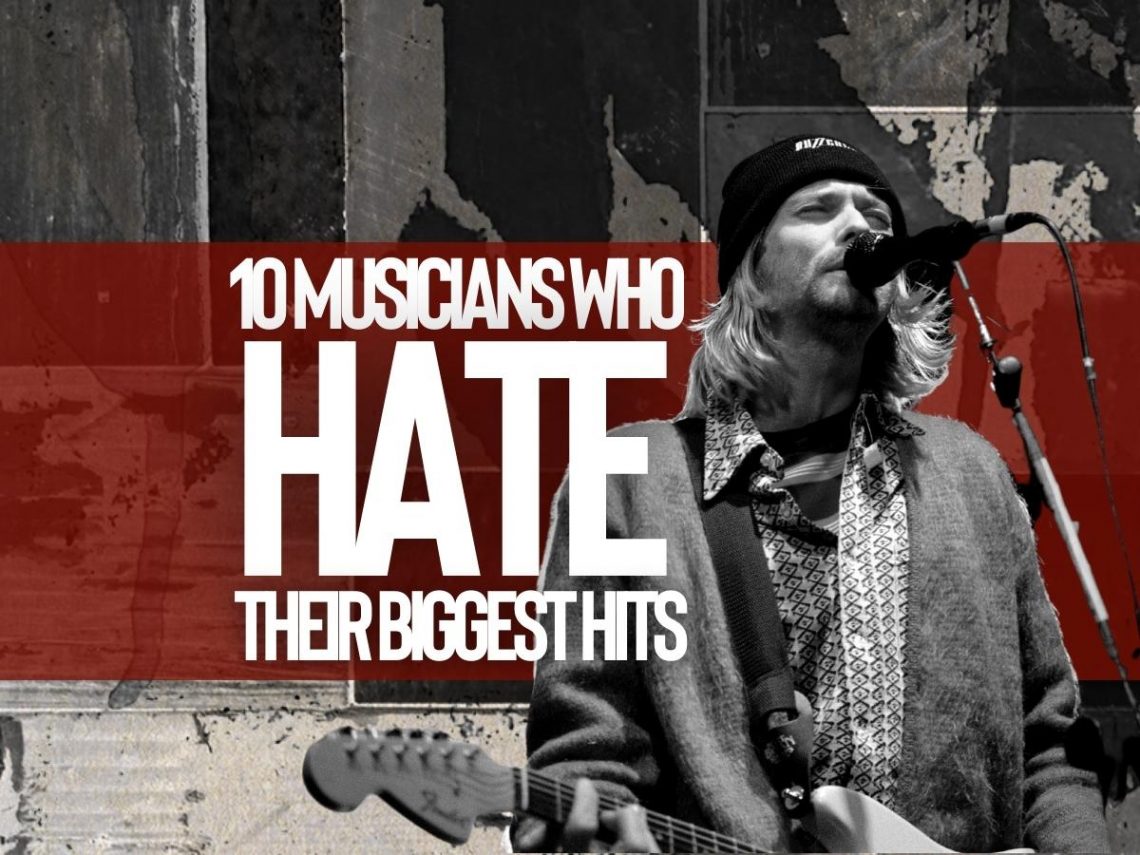
10 musicians who hate their biggest hits

A surprisingly common trope within the music industry is that artists of international fame grow to hate the very song that helped give them the major platform they required. A combination of factors likely leads to the mounting disdain those artists have for their most widely adored songs. There is the need for artistic evolution, the dislike for market saturation and the general annoyance one must feel to have a large body of work be reduced to a single three-minute entry.
It’s a widespread preference too. Artists, including the likes of Nirvana and Radiohead, have been vocal about their disdain for a specific song that most people associate them with, a piece of material which, most commonly, doesn’t rank anywhere near the top of their best work yet but still acts as their headline hit.
Having an anthem that gathers a life of its own, going to become bigger than the artist who created it, is the definition of a double-edged sword. On the one hand, the song has reached a vast amount of people who previously wouldn’t have come into contact with their work, a contributing factor of success which usually results in larger concerts and an opportunity to take your band to the next level.
On the other hand, however, those increased shows start to become filled with the type of person who would purchase tickets in the hope of hearing that one song and, ultimately, spend the whole evening disengaged, struggling to get involved with proceedings and thus damaging the atmosphere.
Here, we have compiled a list of ten artists who grew to hate their biggest hit.
10 musicians who hate their biggest hits:
Oasis – ‘Wonderwall’
Oasis classic ‘Wonderwall’, which featured on the band’s faultless 1995 album (What’s the Story) Morning Glory?, is widely regarded as being a turning point in the history of indie music. The record achieved unparalleled commercial success and outlined a new direction for bands of that ilk to explore. Although it made the Mancunians undoubtedly the biggest band in Britain, in the years since its release, the single has become one of the most overly performed tracks of all time, and even Liam Gallagher has grown sick of it.
“At least there’s no ‘Wonderwall’ on there. I can’t fucking stand that fucking song! Every time I have to sing it I want to gag,” Gallagher said to WENN in 2008. “Problem is, it was a big, big tune for us. You go to America and they’re like: ‘Are you, Mr Wonderwall?’ You want to chin someone,” he added in a way that only he could.
R.E.M. – ‘Shiny Happy People’
On first listen, the song comes across as a light-hearted big pop track. In truth, that statement is a stark contrast to the type of song that the general public would associate with being of the R.E.M. mould, referencing the darker ‘Everybody Hurts’ or ‘Losing My Religion’ as prime examples yet ‘Shiny Happy People’ became a monster hit.
The song was released in 1991, two years after the Tiananmen Square uprising when the Chinese government clamped down on student demonstrators, killing hundreds of people in the process in an event which has left a scar on humanity ever since. With the song using the phrase ‘Shiny Happy People‘, which they took from Chinese propaganda posters, there began an attempt to con the world into believing into a very different image of what was going on under the regime in the early 1990s.
Michael Stipe called this “a really fruity, kind of bubblegum song,” in an interview with The Quietus. He later admitted that he was slightly embarrassed when it became a big hit because of its light-hearted sound on the surface, one which was not in line with the kind of artist he wanted to become. The song was even once considered to be the theme tune for hit television sitcom Friends which would have put the material on an even wilder trajectory.
“Many people’s idea of R.E.M, and me in particular, is very serious, with me being a very serious kind of poet,” Stipe maintained. “But I’m also actually quite funny—hey, my bandmates think so, my family thinks so, my boyfriend thinks so, so I must be. But that doesn’t always come through in the music. People have this idea of who I am probably because when I talk on camera, I’m working so hard to articulate my thoughts that I come across as very intense.”
Beastie Boys – ‘Fight For Your Right (To Party)’
The Beastie Boys helped establish hip-hop as the dominant force we know today with their emphatic 1986 debut release, Licensed To Ill. The album was a breath of fresh air, a hybrid of the underground New York hip-hop scene and the punk movement, with the Beastie Boys channelling an attitude reminiscent of Joe Strummer, among many others.
As their first release, many people didn’t understand that a large chunk of everything Beastie Boys related was drenched in irony and poking fun at areas of society. Then when they released the visceral, ‘(You Gotta) Fight for Your Right (To Party!)’, most people took the song at face value, much to the irritation of Mike D, MCA and Ad-Rock.
‘Fight For Your Right’ was a parody of the frat culture of the day. Rather than being treated with the desired effect they intended, the track instead became an anthem celebrating the very thing it was poking fun at. Because it was their first hit single, this meant that it was a lot of people’s first introduction into The Beastie Boys’ world. They understandably took the group at face value and assumed they stood for standing for everything they detested.
“It was summer 1986. We wrote it in about five minutes,” Mike D recalled in 1987. “We were in the Palladium with Rick Rubin, drinking vodka and grapefruit juice, and ‘Fight for Your Right’ was written in the Michael Todd Room on napkins on top of those shitty lacy tables. I remember we made a point there of like, ‘Look, we gotta get shit done,’ and we sat at one table, really determined to accomplish something.”
Although, Mike D has fond memories of creating the track — how people interpreted the song was an entirely different story, “The only thing that upsets me is that we might have reinforced certain values of some people in our audience when our own values were actually totally different,” he lamented. “There were tons of guys singing along to [Fight for Your Right] who were oblivious to the fact it was a total goof on them. Irony is often missed.”
Lorde – ‘Royals’
Lorde, the New Zealander, who burst onto the scene seemingly out of nowhere aged just 16 with the release of ‘Royals’ in 2013, immediately rose to fame, and the track made her one of the biggest pop stars in the world — but she’s not a fan of the song that made her a star.
Lorde went as far as describing her debut hit as “disastrous”, before adding: “I listen to people covering the song and putting their own spin on it,” she explained to Scotland’s Daily Record. “I listen to it in every single form except the original one I put out—and I realise that actually, it sounds horrible.”
She then poured more scorn on ‘Royals’ by adding: “It sounds like a ringtone from a 2006 Nokia. None of the melodies are cool or good. It’s disastrous. Awful… but for the same reason, in the context of the way I released it, it just worked out.”
The Who – ‘Pinball Wizard’
‘Pinball Wizard’ is one of The Who’s finest efforts, one which was a high point on their masterful concept album Tommy and was also a commercial success on both sides of the Atlantic. Most fans The Who will have ‘Pinball Wizard’ in their top five tracks by the seminal group, but the song’s writer Pete Townshend thinks otherwise about the bonafide classic.
When describing the writing of the song, Townshend said: “I knocked it off. I thought, ‘Oh, my God this is awful, the most clumsy piece of writing I’ve ever done. Oh my God, I’m embarrassed. This sounds like a Music Hall song. I scribbled it out and all the verses were the same length and there was no kind of middle eight. It was going to be a complete dud, but I carried on.”
He continued: “I attempted the same mock baroque guitar beginning that’s on ‘I’m a Boy’ and then a bit of vigorous kind of flamenco guitar. I was just grabbing at ideas, I knocked a demo together and took it to the studio and everyone loved it.
“Damon Lyon-Shaw (the engineer on Tommy) said ‘Pete, that’s a hit.’ Everybody was really excited and I suddenly thought ‘Have I written a hit?’ It was just because the only person that we knew would give us a good review, was a pinball fanatic.”
Radiohead – ‘Creep’
Radiohead anthem ‘Creep’, a song which is unquestionably the band’s biggest hit, remains a repeated source of anguish for the group. Given their overabundance of masterpieces created over a 35-year career, the fact that this one song is often the focus of people’s attention is a repeated frustration for its creator Thom Yorke.
‘Creep’ became an underground hit for the band in the United States, one which can be traced back to one Californian college that added the song to a radio playlist in San Francisco. A censored version of the number was then released to radio stations, and gradually, it became an American alt-rock anthem.
Over the next couple of years of touring, the band began to lose patience with the track and the sort of clientele it attracted to their concerts. “We seemed to be living out the same four and a half minutes of our lives over and over again. It was incredibly stultifying,” Johnny Greenwood said on those early tours, even recalling how audience members would scream for ‘Creep’ and then leave immediately after it was performed.
During those string of live dates for Radiohead’s third album OK Computer, Yorke became hostile when ‘Creep’ was mentioned in interviews and then, in the weeks after, began to refuse requests to play it live. One night in Montreal, things escalated when Yorke shouted at the audience, “Fuck off, we’re tired of it.”
The lead singer even dismissed fans demanding to hear it as “anally retarded”, and they have played it on less than half a dozen occasions since.
Nirvana – ‘Smells Like Teen Spirit’
Nirvana was jet-propelled into stardom thanks to the video for ‘Smells Like Teen Spirit’ being on constant rotation during pretty much all the years MTV actually showed music videos. The clip was the distillation of America’s growing grunge movement and it left Nirvana paddling in the mainstream, which was waters they didn’t feel comfortable swimming in.
“Everyone has focused on that song so much,” Cobain once remarked to Rolling Stone. “The reason it gets a big reaction is people have seen it on MTV a million times. It’s been pounded into their brains.”
The iconic frontman then continued his denouncement of the track, “I can barely, especially on a bad night like tonight, get through ‘Teen Spirit.’ I literally want to throw my guitar down and walk away. I can’t pretend to have a good time playing it.”
Led Zeppelin – ‘Stairway To Heaven’
The track, released in late 1971, was created by Plant and his bandmate Jimmy Page for Led Zeppelin’s untitled fourth studio album and is considered by many as one of the greatest rock songs of all time. One of the people who doesn’t consider it as one of the high points of rock ‘n’ roll though is frontman Robert Plant who feels nothingness towards the lyrics.
While sitting down with UCR as part of their Nights radio show in 2019, Plant said: “The construction of the song, the actual musical construction, is very good. It’s one of those moments that really can stand without a vocal and, in fact, it will stand again without a vocal, I’m sure, because it’s a fine piece of music.”
“Lyrically, now, I can’t relate to it, because it was so long ago. I would have no intention ever to write along those abstract lines anymore. I’d break out in hives if I had to sing that song in every show,” he added.
Guns ‘N’ Roses – ‘Sweet Child O’ Mine’
Few songs are as widely known as Guns ‘N’ Roses hit ‘Sweet Child O’ Mine’. The song has been a mainstay on rock radio ever since its release in 1987 and has perforated eardrums for every minute it has been given airtime. If you’ve ever reached for the dial when the screeching tones of Axl Rose and his nasal vocal hit the speakers, then you aren’t alone.
Despite being one of the biggest songs in rock history, proliferating pop culture as we know it, the track is widely disliked by the band, with guitarist Slash having a particularly dim view of the song. However, over time, the lead axeman’s hate for the track has waned: “I hated it for years, But it would cause such a reaction, so I’ve finally gotten to appreciate it.”
With 1.5 billion streams of the song on YouTube alone, its fair to say that if the band dislike the track, they are part of a small minority.
Queen – ‘Don’t Stop Me Now’
While we can’t necessarily claim that every member of Queen dislikes their break-neck bruiser, ‘Don’t Stop Me Now’, the Queen guitarist Brian May probably has enough disdain for all of them. May once explained that, initially, he didn’t like the song as he thought that Freddie Mercury’s lyrics underplayed the dangers of HIV/AIDS, with May saying that he found it “flippant”. However, May was eventually won over after he realised that it “gave people great joy”.
“I didn’t really take to it in the beginning. I didn’t feel totally comfortable with what Freddie was singing at the time,” May told the publication. “I found it a little bit too flippant in view of the dangers of AIDS and stuff. But as time went on, I began to realise that it gave people great joy.”
“I had to give in. It’s a great song – there’s no way around it,” he continued. “I think that’s what Freddie had an amazing knack of doing: he could put his button on things that make people feel a bit more alive.”
The surprising popularity of the track has always slightly puzzled May, with him calling it a “phenomenon”. Detailing further, he said: “I’ve seen it played at all sorts of functions. It’s become the most requested song at hen parties and stag parties and marriages and weddings and funerals – just because it brings joy.”
“I don’t have any quarrel with it now – I enjoy playing it onstage,” the guitarist concluded. “It’s wonderful that everyone wants to sing it. In singing with us, they express their own joy and their own determination to make the best out of their lives, and to keep on and not get knocked down by things.”

Never Miss A Beat
The Far Out Led Zeppelin Newsletter
All the latest stories about Led Zeppelin from the independent voice of culture.
Straight to your inbox.