


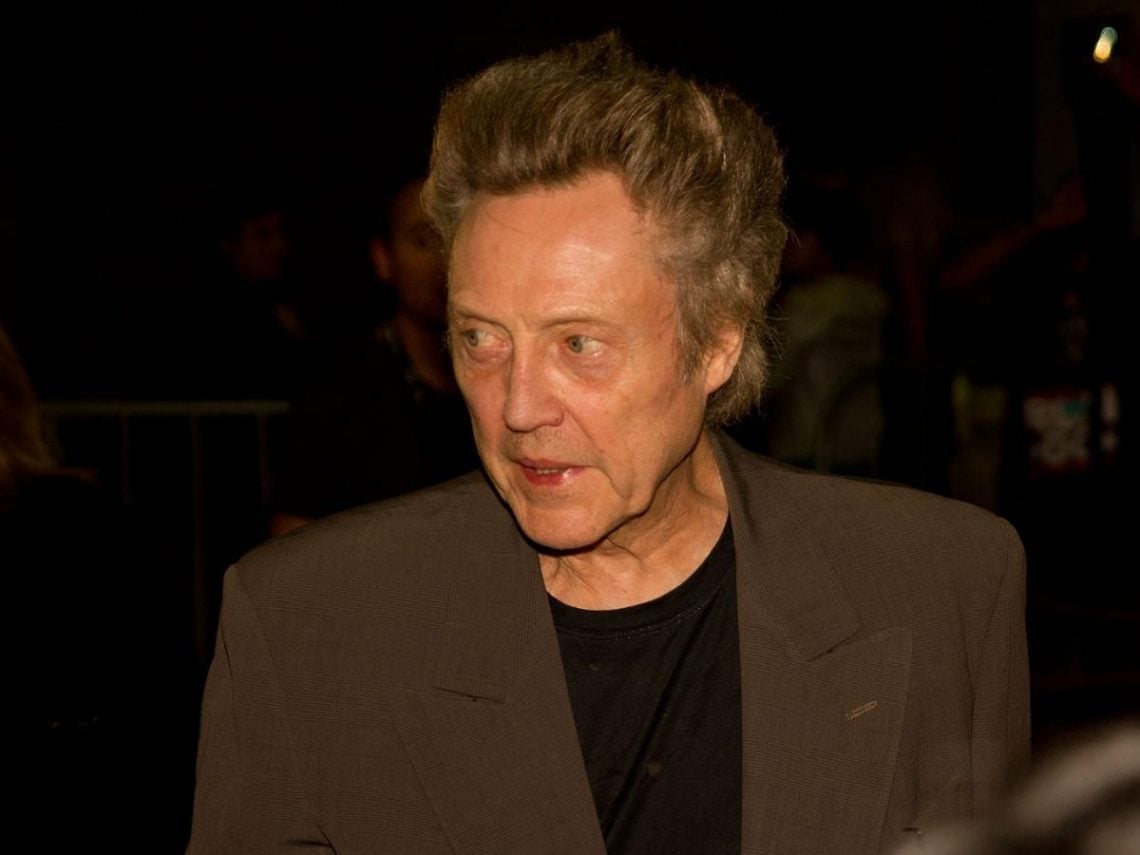
The 2012 movie Christopher Walken wanted to change his career: “I hope it opens the door for me”

During his peak years, Christopher Walken earned a stellar reputation playing very similar characters.
He cut his teeth playing damaged, multi-layered personalities, often occupying the ‘anti-hero’ slot in a movie. He could switch between hilariously charming and chillingly vile in an instant and won over a lot of fans who now consider him something of a demi-god.
Since becoming a gentleman of a certain age (I’ll let you decide when that was), Walken has entered an entirely new phase of his career. He happily poked fun at himself when he appeared opposite a cross-dressing John Travolta in Hairspray, though it would have been difficult not to. He even played Zeus in the comedy Gods Behaving Badly, which, ironically, was so poorly received that it never got an official release. Walken has clearly embraced this chapter of his career as a funny old man, even if critics haven’t always been quite as enthusiastic.
Adjusting to getting older is hard for everyone, but especially actors. Their stock and trade is their body, their voice, their physicality. Anything that changes has got to be terrifying. Speaking to Awards Daily in 2012, Walken revealed that a recent film had put his mind to rest about playing older men. That film was A Last Quartet, the debut feature of Israeli-born director Yaron Zilberman.
“I never used to get the parts of fathers and grandfathers and uncles,” he confessed. “In A Late Quartet, this guy is kind of Papa in the movie. He’s the patriarch… I hope it opens the door for me to be able to do more of that. I spend so much time playing troubled people, disturbed people. And that’s fine. It’s been a good living. But sometimes it’s a little monotonous. I’d like to be able to do something else once in a while.”
Released in 2012, A Late Quartet stars Walken as a famous cello player who has recently been diagnosed with Parkinson’s. This brings him into conflict with the second violin player (Philip Seymour Hoffman) as the group considers their future without their star attraction. It received positive reviews from the press, who particularly appreciated the level of musical detail shown on screen.
Walken described his character, Peter Mitchell, as the closest he’s ever come to playing himself. He identified with Mitchell’s dedication to performing, even when his body and physical health don’t make it easy. He identified Mitchell as a fellow actor, albeit one who channels his work through a cello rather than his own body. To study the effects of Parkinson’s, Walken spent time with the Brooklyn Parkinson’s Group, whose members appear in a scene from the film.
In an ideal world, A Late Quartet would have been a sleeper hit that made hundreds of millions of dollars. Instead, it barely made a splash at the office. However, that’s not what these sorts of films are for. They’re for letting acclaimed actors discover new things about themselves and unlock entirely new phases of their illustrious careers. Money simply can’t buy that.
