


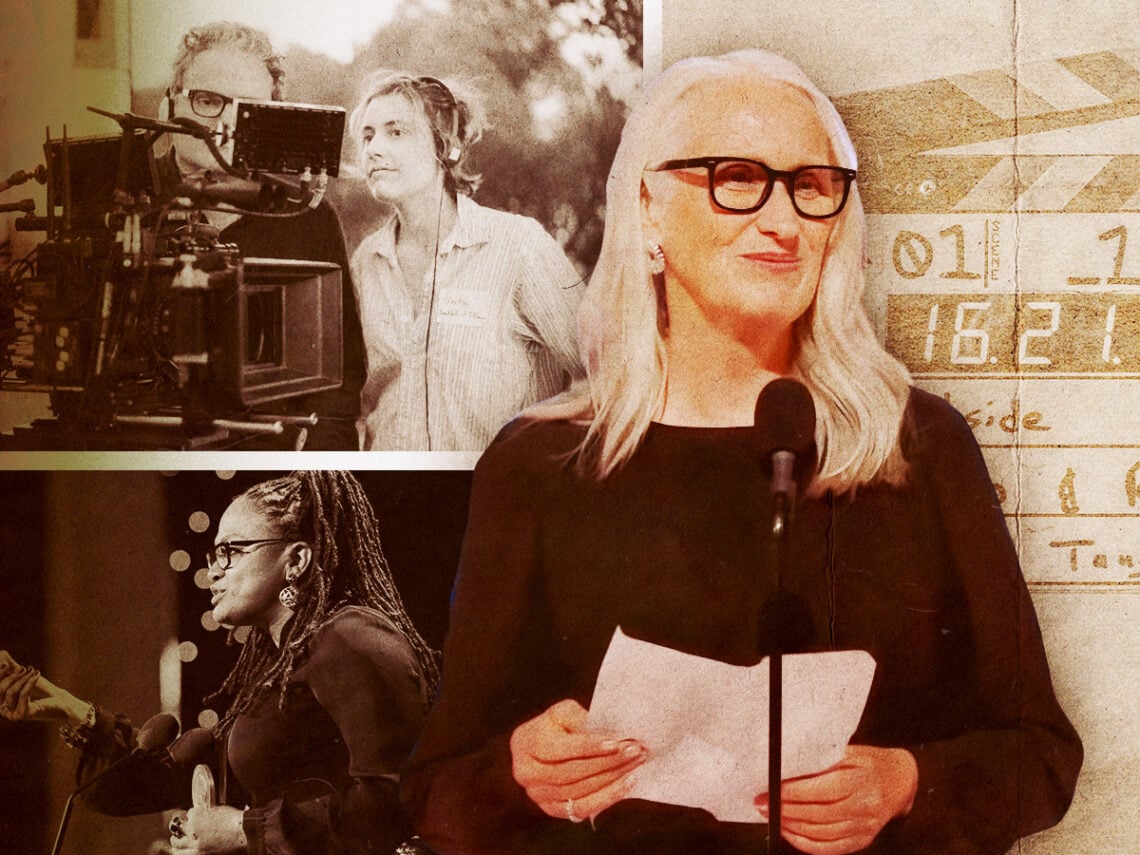
The 25 best working female filmmakers

With a drive for better representation in the arts, female filmmakers have been given the necessary platform to thrive in recent years after generations of inequity in the movie industry. This has led the likes of some of the greatest directors of the contemporary art form to thrive, with Greta Gerwig, Julia Ducournau, Chloé Zhao and Céline Sciamma each achieving great success in the previous decade.
“Women kicked serious ass this year,” the Palme d’Or winner of Titane, Julia Ducournau, told The Guardian in 2021, pointing to significant wins at the Oscars for Chloé Zhao, among many other successful female filmmakers. Commenting that her win at the Cannes Film Festival was “was incredibly powerful to me,” she adds, “Through this prize, a lot was happening. It took 28 years [since Campion’s win], and I believe it’s not going to take 28 years again”.
Helping to lead the industry onto bigger and better successes, Ducournau is among the finest filmmakers working today, making her name known in the realm of horror cinema, a genre long dominated by male creatives. Though she, of course, is not the only one shaking up the film industry for female directors.
Let’s take a look at 25 of the finest female filmmakers working today.
The 25 best working female filmmakers:
25. Emerald Fennell
Though Emerald Fennell may have been an actor for many years before her big directorial break, appearing in movies such as Albert Nobbs, Anna Karenina, and The Danish Girl, the British creative is now better known as a filmmaker thanks to her 2020 Oscar-winner Promising Young Woman. Taking home an esteemed statuette for ‘Best Original Screenplay’, the writer and director stamped her name into contemporary culture.
With the success of Promising Young Woman still swirling to this day, Fennell also has a forthcoming feature film to look forward to in the shape of Saltburn, a thriller following an aristocratic English family with a cast that includes Barry Keoghan, Rosamund Pike and Carey Mulligan.
24. Rose Glass
Contemporary horror has been refreshed by a number of exciting female voices, with British filmmaker Rose Glass being one of these innovators. Her 2019 film Saint Maud was a work of innovative modern horror, framing a haunting tale of loneliness in a remote Welsh town where a pious nurse (Morfydd Clark) becomes obsessed with saving the soul of a terminally ill elderly woman.
Creating one of the finest horrors of modern cinema, Glass has since been working on her step-up to Hollywood in the form of Love Lies Bleeding, an analysis of the American dream starring Kristen Stewart, Dave Franco and Ed Harris.
23. Charlotte Wells
Creating a trio of celebrated short films before her latest feature film triumph, Charlotte Wells has slowly risen the ranks of the industry, only to arrive with real creative impact with Aftersun under her arm. A magnetising meditation on nostalgia, loss and men’s mental health, her devastatingly emotional debut won her a BAFTA for ‘Outstanding Debut by a British Writer, Director, or Producer’.
There’s been no mention at all of any future projects as of yet from Wells, but after the true cinematic mastery of Aftersun, we await her next film with bated breath.
22. Sarah Polley
An esteemed actor, and a celebrated filmmaker, American director Sarah Polley, helmed the drama Away from Her in 2006, the underrated rom-com Take This Waltz in 2011 and the fascinating documentary Stories We Tell in 2012. Most recently, Polley has seen great success with the release of Women Talking, a complex drama about an isolated religious community that must tussle with their morals and faith.
Nominated for two Academy Awards, including ‘Best Picture’ and ‘Best Adapted Screenplay’, Women Talking proves that Polley is one of the most innovative filmmakers currently working in the industry.
21. Laura Poitras
Over in the documentary space, American filmmaker Laura Poitras has been making waves for years, creating My Country, My Country in 2006, The Oath in 2010 and the urgent political study Citizenfour in 2014, for which she won an Oscar for ‘Best Documentary, Feature’. Her latest movie, All the Beauty and the Bloodshed, which tells the life story of the artist Nan Goldin and the downfall of the powerful Sackler family, may just be her very best.
Up for yet another Oscar in the same category, Poitras has quickly proven herself as one of the finest documentarians of modern cinema, bringing an unparalleled level of background research to each of her projects.
20. Ildikó Enyedi
The Hungarian filmmaker Ildikó Enyedi has been working in the film industry since 1979, making short films before she moved on to feature film work in 1987 with her debut, Mole. Showing off a unique, experimental style, her films flirt with ethereal imaginings and idiosyncratic creative flourishes, with her early career peaking in 1989 with the critically acclaimed film My Twentieth Century.
More recently, it was On Body and Soul in 2017 that elevated Enyedi to international acclaim, whilst her Cannes contender The Story of My Wife, starring Léa Seydoux, acted as a worthy follow-up.
19. Lucrecia Martel
Focusing on hard-hitting South American drama, the Argentinian director Lucrecia Martel made her directorial debut in 1996 with Historias Breves 1, before making La Ciénaga and The Holy Girl in 2001 and 2004, respectively. It was with 2008s The Headless Woman, however, where her career would make considerable progress, with her 2017 follow-up Zama, winning at several film festivals.
Creating important works of national cinema and dramas that explore the Argentine identity, her next film is the documentary Chocobar, following the murder of the indigenous activist Javier Chocobar.
18. Mira Nair
Better known for her previous contributions to the film industry with Salaam Bombay! and Mississippi Masala starring Denzel Washington in the 1990s, the Indian filmmaker has developed a consistently impressive body of work. This filmography peaked in 2001 with the celebrated comedy Monsoon Wedding starring Tillotama Shome, before impressing five years later with The Namesake in 2006 with Kal Penn.
Slowing down her rate of feature films, Nair’s influence on modern female filmmakers is indelible, and her work is not yet done as she is currently filming an episode of National Treasure with the likes of Catherine Zeta-Jones.
17. Kathryn Bigelow
Possibly one of the most well-known female filmmakers of all time, the influence of Kathryn Bigelow is truly remarkable, normalising the role of female directors for significant blockbuster films. This started in 1991 when she helmed Point Break with Keanu Reeves and Patrick Swayze before she became the first female director ever to win ‘Best Picture’ for her dramatic war thriller The Hurt Locker.
Making the Oscar-nominated Zero Dark Thirty in 2013 and the pertinent critically-acclaimed drama Detroit in 2017, Bigelow most recently completed an advert for Apple, though looks to soon return to feature filmmaking.
16. Sofia Coppola
If Kathryn Bigelow is the most well-known female filmmaker in the commercial space, then Sofia Coppola claims the crown for the most critically celebrated, with her 2003 film Lost in Translation often referred to as one of the greatest films of modern cinema. Far from a one-hit-wonder, however, Coppola also helmed the fantastic Virgin Suicides in 1999 and continues to influence the industry, most recently with her 2020 film On the Rocks starring Bill Murray.
Adapting the novel by Edith Wharton, Coppola is currently working on the TV movie, The Custom of the Country, following a cunning woman living in New York at the start of the 20th century who works her way up to the top of the social class.
15. Lynne Ramsay
Though Lynne Ramsay has not made a feature film since 2017, her track record is nothing short of stupendous, making the classic coming-of-age Ratcatcher in 1999, followed by the compelling drama Morvern Callar in 2002. It wasn’t until the release of We Need to Talk About Kevin in 2011 that Ramsay truly started to get noticed. However, going on to work with Joaquin Phoenix in You Were Never Really Here in 2017.
With unique, hard-hitting visual creativity and a distinct emotional density, we await Ramsay’s upcoming project, Polaris, with bated breath.
14. Nora Twomey
Much like the horror genre, animation is also a medium of filmmaking that has long been dominated by men, though the Irish filmmaker Nora Twomey is certainly trying to put an end to this. Showing off a truly impressive track record that includes co-directing The Secret of Kells in 2009 and helming The Breadwinner in 2017, two dense Oscar-nominated animated classics, Twomey also produced 2020s Wolfwalkers that was too loaded with praise.
With a well-established visual style, we can’t wait for her upcoming project My Father’s Dragon, a comedy that follows a search for a captive dragon and the wild adventure that ensues.
13. Mia Hansen-Løve
There’s simply no ignoring the strong filmography of the French filmmaker Mia Hansen-Løve, a director who has grown from strength to strength with every film she puts out. Her debut project, All Is Forgiven, in 2007, was her first major win, followed by Father of My Children in 2009, Goodbye First Love in 2011 and the music drama Eden in 2014. Her later films, Things to Come and Bergman Island, stand as her greatest projects to date, winning several awards across the board.
Her upcoming movie, One Fine Morning, is currently in post-production and she will no doubt continue her fine form behind the camera.
12. Clio Barnard
Bringing British social realism back to national filmmaking, the work of Clio Barnard is distinctive, tender and beautiful. After creating several short films at the start of the 21st century, Barnard turned heads in 2010 with the BAFTA-nominated documentary, The Arbor, followed by the critical and commercial success of The Selfish Giant in 2013, starring Ralph Ineson and Shaun Thomas.
More recently, Barnard has been showered with praise for her 2022 film, Ali & Ava, a warm modern love story that paints the North of England in a brand new cinematic light.
11. Joanna Hogg
Much like Clio Barnard, Joanna Hogg has helped to revive the social realism movement in British cinema, starting with her 2010 film Archipelago, featuring the likes of Tom Hiddleston, Kate Fahy and Lydia Leonard. This was followed up by the most unlikely independent film series, with her 2019 drama The Souvenir and its sequel in 2021 creating much critical furore.
Hogg’s upcoming project, The Eternal Daughter, looks to be diverting from the current series, telling a modern ghost story featuring Tilda Swinton and Joseph Mydell.
10. Ava DuVernay
A powerful filmmaker and influential advocate for civil rights, the films and TV projects of Ava DuVernay are known for casting light and rousing discussion on previously under-publicised events. This includes her compelling Netflix documentary about the mistreatment of black people in modern prisons in 13th, to the retelling of the shocking true story of ‘The Central Park Five’ in When They See Us.
This has led Ava DuVernay to take on several exciting projects, such as 2018’s Wrinkle in Time, whilst she now sets her sights on the TV drama Battle of Versailles about the 1973 Palace of Versailles fashion show.
9. Claire Denis
As one of France’s most influential filmmakers, Claire Denis has been working in the movie industry since the 1990s and is best known for her 1999 masterpiece Beau travail. She has since reinvigorated her career with 2018’s abstract science fiction, High Life, starring Robert Pattinson, as well as the 2022 romantic drama Fire with Juliette Binoche and Vincent Lindon.
“I’m not so sure films should be made to soothe people’s pain. I don’t want to be a social worker. I want to share something that is a vision, or a feeling,” Denis told cléo magazine, an apt description of the director’s own hard-hitting style.
8. Kelly Reichardt
A pioneer of American independent cinema, the quiet and subtle power of Kelly Reichardt’s filmography starts with 1994’s River of Grass and continues to this very day with the release of First Cow in 2020. Tackling pertinent issues of contemporary life, each of Night Moves, Meek’s Cutoff and Old Joy concern themselves with addressing urgent social and political questions with grace and purpose.
Collaborating with Michelle Williams and André 3000, her latest project, Showing Up, follows an artist on the verge of a career-changing exhibition that could change her life forever.
7. Jennifer Kent
Australian filmmaker Jennifer Kent has to be uttered in the same breath as other horror innovators Ai Aster and Robert Eggers, with her 2014 film The Babadook stunning audiences and critics upon its release for its stunning design and terrifying scares. Kent followed this up in 2018 with the rape-revenge horror The Nightingale, which was brutal in its delivery and truly memorable as a result.
Next, she’s due to collaborate with Guillermo del Toro for the anthology series Cabinet of Curiosities, where she’ll once again dabble in the horror genre.
6. Jane Campion
In line for considerable success at the 2022 Oscars, director Jane Campion’s revisionist western, The Power of the Dog, is deserving of its praise thanks to the deft creative touch of the director herself. Having already won an Academy Award for her work on The Piano in 1993, Campion could make history with further success at the latest awards show, with her leading actor Benedict Cumberbatch already the frontrunner for ‘Best Actor’.
Campion’s impact on female filmmaking throughout the 21st century has been immeasurable, with her success with The Power of the Dog, emblematic of this long-running achievement.
5. Andrea Arnold
Among the greatest working British filmmakers, Andrea Arnold has helped to contribute to several areas of cinema, often working within the realms of social realism. This started in 2006 with the release of Red Road, followed by the BAFTA award-winning Fish Tank in 2009 and her move to America with the critically acclaimed American Honey in 2016. Since then, Arnold has lent her talents to a handful of lorded TV series, including Transparent and Big Little Lies.
Her most recent film, the documentary Cow, may be her most impressive, translating the lived experience of a cow living its daily life on a farm. It’s a remarkable piece of cinema.
4. Greta Gerwig
A multi-faceted American filmmaking talent, Greta Gerwig found success with screenplays for Frances Ha in 2012 and Mistress America in 2015, though it wasn’t until 2017’s fantastic Lady Bird that she was recognised as a pertinent modern director. Such a sensitive film would allow Gerwig to go on to adapt the classic American novel Little Women in 2019, which was met with overwhelming critical acclaim.
Moving away from quiet drama and onto unexpected Hollywood filmmaking, Gerwig’s latest project is the upcoming film, Barbie, inspired by the classic Mattel doll, which is sure to subvert initial expectations.
3. Julia Ducournau
Winning the Palme d’Or for her explosive and furious Cronenberg-esque sci-fi terror, Titane, Julia Ducournau transitioned from being a promising French filmmaker to one of the most urgent directors working today. Ducournau’s Titane joins 2016’s gruesome coming-of-age tale Raw, which changed the thinking behind the usually emotionally charged sub-genre, bringing a punk style and aesthetic to each of her films.
With no news yet as to what Julia Ducournau will take on next, her stunning track record makes her one of the most important voices in the contemporary industry.
2. Chloé Zhao
Bringing the modern masterpiece Nomadland to audiences in 2020, painting a picture of both the landscape of contemporary periphery America and a portrait of those that inhabit its space, Zhao made herself known after years of operating in the industry. Crafting her films with a gentle, passionate lyricism, Nomadland joins her previous successes, The Rider from 2017 and Songs My Brothers Taught Me from 2015.
With no upcoming project currently on the horizon, Zhao is taking a breather after helming the mighty Marvel film The Eternals starring Salma Hayek, Angelina Jolie and Kit Harington.
1. Céline Sciamma
One of the most eccentric and enigmatic filmmakers working today, the work of Céline Sciamma is already being considered by many to hold all the value of some of the greatest films of modern cinema. Intellectually stirring and persistently challenging, Sciamma’s films, including Portrait of a Lady on Fire, Girlhood, Tomboy and Water Lilies, each examines modern life and contemporary attitudes to gender with tender love and consideration.
Her latest BAFTA-nominated film Petite Maman, filmed under Covid-19 restrictions, shows just how diverse this French filmmaker can be, crafting a loving modern fairytale through simple characters and intricate dialogue. It’s simply spellbinding.
