


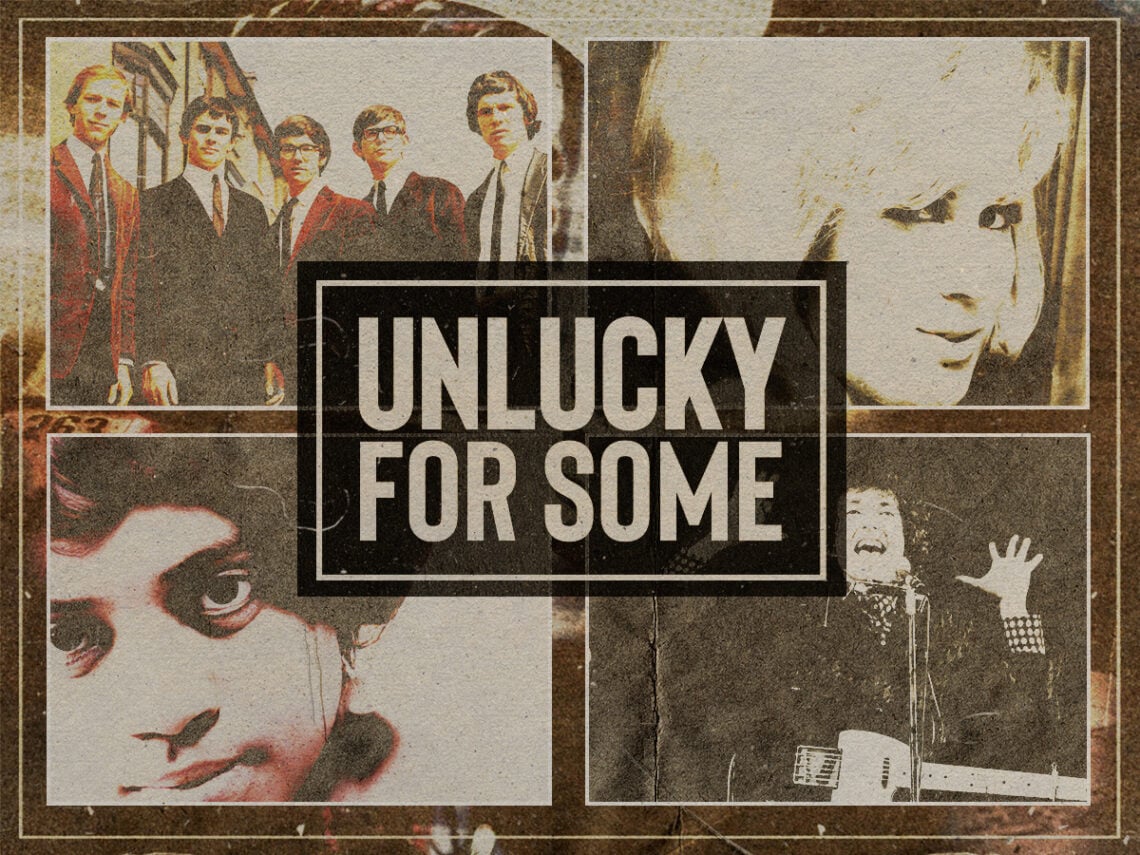
Unlucky For Some: The 13 most underrated songs of 1965

1965: It saw a spacecraft reach Mars, an intensification of the Vietnam War, Che Guevara left Cuba, and a three-year-old was taken to court for $50,000 worth of damages for riding his tricycle with a mentally disturbing degree of recklessness. It was, indeed, the best times, the worst of times, and most certainly, (horrible phrase), ‘the epoch of incredulity’. Alongside all of this, you had the release of Bob Dylan‘s masterpiece, Highway 61 Revisited.
Elsewhere, The Beatles gave us Rubber Soul, John Coltrane graced us with A Love Supreme, Nina Simone sang her Pastel Blues, and Charlie Brown charmed Christmas thanks to Vince Guaraldi. The revolution was getting groovier and intensifying ten-fold, with the war looming in the psyche, music took on a new level of importance, even if it was just the reality-twisting escapism of psychedelia rather than the acerbic viscera of some of the most prominent wordsmiths.
Kurt Vonnegut’s masterful God Bless You Mr Rosewater did the same for literature when it was published, encapsulating things as follows: “Thus did a handful of rapacious citizens come to control all that was worth controlling in America. Thus was the savage and stupid and entirely inappropriate and unnecessary and humorless American class system created. Honest, industrious, peaceful citizens were classed as bloodsuckers, if they asked to be paid a living wage. And they saw that praise was reserved henceforth for those who devised means of getting paid enormously for committing crimes against which no laws had been passed. Thus the American dream turned belly up, turned green, bobbed to the scummy surface of cupidity unlimited, filled with gas, went bang in the noonday sun.”
In essence, the world was in a bit of a frenzy. Culture was holding up one end of the argument, and the powers that be were brandishing the other. This left songs that didn’t shout loud enough floundering, and there are a slew of masterpieces that were just a little too meek for the riot lingering in the unseen welter of the year. We’ve collated these into a playlist of the year’s most underrated songs.
The 13 most underrated songs of 1965:
13. ‘You Were On My Mind’ – We Five
We Five sing of worried shoes and woe in troubled times with the grooving pop hit ‘You Were On My Mind’. It’s rather typical of the times, but that doesn’t stop it from being a gem, especially with its billowing crescendo performed beautifully by Beverly Bivens. Driven by a stripped-down jazz drum rhythm, the song has a joyous simplicity that many musicians would do well to learn from.
The song was originally performed by Ian & Sylvia, however, as is often the case with covers, in a bid to bring something different to the track, We Five take it back to its basics and then litter it with a barrage of flourishes. That dynamic keeps things interesting while you ultimately bask in the beauty of a little ’60s time capsule.
12. ‘Cast Your Fate to the Wind’ – Sounds Orchestral
Not everything was as fraught as the headlines may have made it seem in 1965; some folks were just having a swinging good time, and ‘Cast Your Fate to the Wind’ embodies that notion. The song is the musical equivalent to the line from Pierrot Le Fou, “Life may be sad, but it’s always beautiful”, waltzing to a beat that is by turns melancholic and then instantly jubilant.
This jazz orchestral number has an air of free-form complexity but never becomes difficult or convoluted; it’s more like Schubert taking on ‘Peaches En Regalia’. The British group were assembled by John Schroeder with Johnny Pearson in 1964 and quickly got to work on their version of this Vince Guaraldi original, imbuing the cover with a sense of fresh exploration.
11. ‘The Seventh Son’ – Johnny Rivers
This Willie Dixon epic is part of blues folklore. As Willie Mabon explained regarding the classic tune: “The Seventh Son is kind of a historical idea. In New Orleans and Algiers, Louisiana, they have these people calling themselves born for good luck because they’re the seventh sister or seventh brother or the seventh child. The world has made a pattern out of this seven as a lucky number. Most people think the seventh child has the extra wisdom and knowledge to influence other people.”
Johnny Rivers‘ version would not have been out of place on The Big Lebowski soundtrack, and that’s high praise indeed. Bob Dylan said that Rivers’ cover of ‘Positively 4th Street’ was the best Dylan cover out there, proving that he knew how to treat a classic with due reverence, and that shines through on ‘The Seventh Son’ too. He brings groove to the blues and tops it off with his raspy vocals.
10. ‘Just a Little’ – The Beau Brummels
The San Francisco scene was a renaissance in itself. As Hunter S. Thompson wrote in reflection: “Maybe it meant something. Maybe not, in the long run, but no explanation, no mix of words or music or memories can touch that sense of knowing that you were there and alive in that corner of time and the world. Whatever it meant.”
The psychedelic tail-spin of that age of invention infects ‘Just a Little’ with a brooding weight. Thereafter, there is a refreshing sense of sincerity to the break-up lyrics on display as the band whisk up a strange miasma of sadness that makes your tapping toes seem inappropriate. Above all, it just feels effortlessly cool.
9. ‘People Get Ready’ – The Impressions
The beauty of The Impressions music is undeniable. They sport the sort of vocals that could spread butter on bread with a silky drift of sound. However, you’d be hard-pushed to describe them as rock ‘n’ roll. In fact, if they were any more wholesome and soothing, their album sleeves would have to be knitted to give off the right impression.
Thus, as racial injustices howled around them, a difficult proposition was presented – join the movement and risk alienating a hard-fought fanbase or remain on the apolitical side-lines. With ‘People Get Ready’ Curtis Mayfield wrote a song that showed they could do both without diluting. It is gorgeously sweet and sanguine while offering a profound message, proving that bliss doesn’t have to be ignorant.
8. ‘Some of Your Lovin” – Dusty Springfield
There are two parts of singing: the vocals in an instrumental sense and the interpretation of the song itself – Dusty Springfield was a master of both. So, it was always set to be sumptuous when she decided to tackle this plea for attention penned by Gerry Goffin and Carole King. There is a defined narrative to the performance that proves so very alluring.
Sadly, the singing didn’t go down as one of her more famed efforts. Nevertheless, it typifies her class and naturalistic style. With silken tones and an eye for storytelling, it’s easy to see why Springfield got due backing from the likes of Paul McCartney.
7. ‘Tell Her No’ – The Zombies
There are certain melodies, ones you happen upon very rarely, that whisk up a feeling more singular than being on a balcony at dusk. Something about this wavering reminiscence captures the riviera, twisting it with a bittersweet refrain and a dynamic chorus that stands out more like a middle-eight. Compositionally, there is very little like this cut from The Zombies it in pop history.
Written by Roy Argent, the song teeters on the brink of being baroque, showcasing the developments in pop music that were unfurling at the time. Sadly, this effort peaked at a mere 42 in the charts back in February of 1965. However, it did have The Animals’ classic ‘Don’t Let Me Be Misunderstood’ for company.
6. ‘We’re Gonna Make It’ – Little Milton
“We may not have a cent to pay the rent,” Little Milton sings with spooky prescience, “But we’re gonna make it, I know we will / We may have to eat beans every day, but we’re gonna make it.” It’s a song for the times that prove hardships are a constant part of modern civility. But then, there’s more than enough joy in Milton’s optimism to sing the praises of working-class defiance.
As an artist, Little Milton straddled the boundary of pop, R&B, and blues, but he proudly said, “Any category they want to put me in is fine with me as long as they accept what I do.” That aura of liberated expression is palpable in ‘We’re Gonna Make It’. It might be simple, but exists because of the hard-earned sentiment of the words.
5. ‘I Can Never Go Home Anymore’ – Shangri-Las
Somewhere in the wild welter of punk is a pinch of girl group prowess. The raucous movement that emerged from the silted climate of the back half of the seventies was very much a culmination, spinning out a smorgasbord of pop culture influences in an era-defining snarl. One central tenet came from the unlikely source of harmonising sisters, who, in a short blast, changed the way that kids looked at music.
Despite the wildly kitsch name of ‘The Shangri-Las’, they were a pop band who disavowed the commercial teeny-bopper fodder that often springs to mind when you think of the genre. Of all the female four-pieces that sat outside of the usual status quo and spawned a revolution by doing so, the main protagonists in punks prelude were the 1960s pop phenoms, these four bold females. This gloriously cheesy effort typifies the way they turned pop dark.
4. ‘Baby, I’m Yours’ – Barbara Lewis
Cass Elliot, Cher, Arctic Monkeys and a million others might have had a crack at the track since Barbara Lewis released the Van McCoy-written song into the world, but few come close to the authenticity of the original. Alright, there are a fair few platitudes parading in the lyrics, but there is something so fulfilling about sanguine love songs done right.
Lewis sings it with a smile as though conveying a tangibility that the words are genuinely heartfelt. The irony is that she didn’t want to sing it at first; she was put off by how good McCoy’s singing was on the songwriter’s demo. However, this reluctance and some clever coaxing by the producer, Ollie McLaughlin, resulted in her returning to the take with an emboldened sense of authority over the song, and the final take was sublime.
3. ‘Rescue Me’ – Fontella Bass
A dark backstory to Fontella Bass’ hit ‘Rescue Me’ symbolises the lack of equality in the era. The song came out of a jam session at Chess Records. Carl Smith, Raynard Miner and Billy Davis were the four big hitters present when they got working on the song. Suddenly, this piece of soul-pop perfection started falling into place. The mood was triumphant, but knowing how the situation usually pans out, Bass asked whether she would be getting a justified writing credit for the track; she was assured that her lyrics would be duly noted, but this never happened.
In some ways, Bass’ defiance in the face of such damned inequity is codified in the boldness of her performance in the song. The beautiful juxtaposition at play is that nobody seems to have ever needed rescuing less. With shimmering style she cracks the whip on the up-beat melody and asks it to match her marching bravura.
2. ‘Do You Believe in Magic?’ – The Lovin’ Spoonful
It’s as happy as a dog with a bone, as adrenalised as a half-time team talk from Al Capone, and it feels so human it could make the man on the moon not feel alone. Alright, it might not entirely fall into the category of a forgotten classic. Alas, some folks out there have forgotten how good it is; otherwise, the whole of humanity would begin their Saturdays with a blast of The Lovin’ Spoonful in the showers, like me.
It’s got an autoharp chord sequence inspired by Martha and the Vandellas’ ‘(Love is Like a) Heat Wave’, but thereafter, it seems to layer in an array of influences from the explosion of music at the time. The result is a song that feels like the end of an early 2000s rom-com movie, all confetti swirls, dance numbers, and maybe even a laugh-along outtake as the credits roll.
1. ‘Positively 4th Street’ – Bob Dylan
It’s not often you’ll find Dylan on an ‘underrated’ list, but when it comes to the overlooked majesty of ‘Positively 4th Street’, it seems justified. The beauty of the track is the juxtaposition that Dylan offered, with an unbridled disdain parading on an otherwise sanguine soundscape that gives the impression of pure, hard-earned indifference. The gem in the crown of this piece of folk-rock perfection is the very last verse, perhaps one of the best break-up verses ever penned: “I wish that for just one time you could stand inside my shoes / And just for that one moment I could be you / Yes, I wish that for just one time you could stand inside my shoes / You’d know what a drag it is to see you.”
It would never make the album and, as such, resides as one of the greatest B-sides ever written, although, in fairness, ‘Positively 4th Street’ was intended as an A-Side and only found itself usurped by ‘Can You Please Crawl Out Your Window?’ as an error while printing. But this mishap is a quirk of fate that ensured that song didn’t quite get as much light as it deserved, and now it stands on the podium of Dylan’s most underrated songs as a result.

Never Miss A Tale
The Far Out Bob Dylan Newsletter
All the latest stories about Bob Dylan from the independent voice of culture.
Straight to your inbox.