


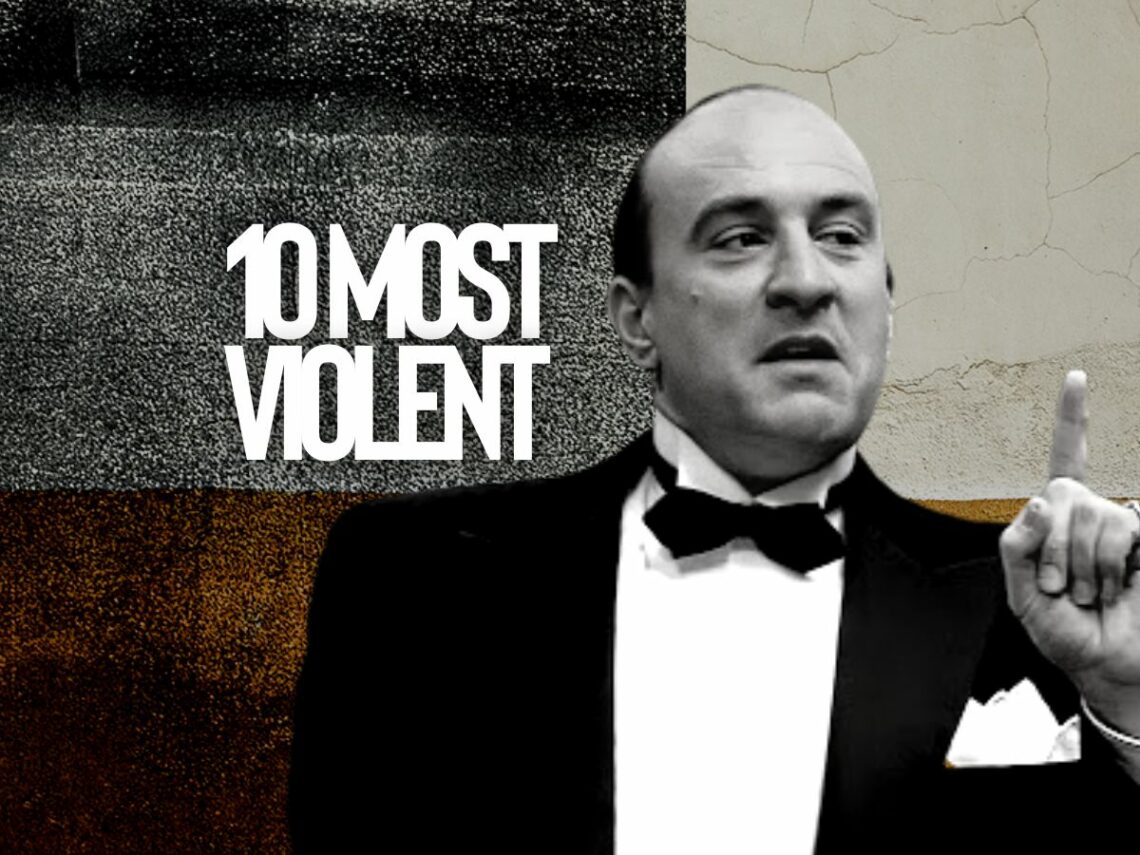
Margaret to Al Capone: The 10 most violent Brian De Palma characters

It is a prerequisite that celebrated auteurs boast a distinctive style, with this demonstrated in the oeuvres of every director from Stanley Kubrick to Jean-Luc Godard. One figure who has also created an instantly recognisable tone is Brian De Palma. Whilst some of his most notable efforts are well-deserving of criticisms, his highlights are infallible, solidified as masterworks of cinematic tension, intrigue, and of course, violence.
De Palma has proven himself adept at producing titles that challenge the audience and their relationship with cinema, analysing the darker side of the human condition. Best known as a master of suspense, his most outstanding works have elevated the realms of the psychological thriller in a starkly post-modern way. Indicative of this, Body Double, Dressed to Kill and Blow Out are three of De Palma’s finest creations, and all are imbued with a profoundly Hitchockian essence. Voyeurism, artificiality, and helplessness are employed throughout his best works. Because of these titles, De Palma has come to be hailed as the spiritual successor to the late Alfred Hitchcock, the original ‘Master of Suspense’.
An open disciple of Hitchcock, De Palma credits the Englishman’s films as having the most significant influence on his work, with special mention going to 1958’s Vertigo. Of the flick, he told NPR in 2016: “A movie I saw in 1958, and it had an incredible impression on me way before I was interested in making movies. And there was something about the way the story was told and the cinematic language used in it that connected to me, even though, at that point, I was studying to be an engineer.”
One of the most outstanding indicators of De Palma’s skill as a filmmaker is the variety of memorable characters he’s delivered, with evil the place he’s really triumphed. From the depiction of real-life gangster Al Capone in The Untouchables to the murderous Commander Kevin Dunne in Snake Eyes, De Palma has excelled at bringing antagonists to life over his career. Often, they are fuelled by a shocking capacity for violence, which is one of the most distinctive aspects of a Brian De Palma film. His villains are just so good.
Duly, we’ve listed Brian De Palma’s ten most violent characters. A spoiler alert must be issued.
The most violent Brian De Palma characters:
10. Jim Phelps – (Mission: Impossible, 1996)
There is no place better to start than with one of the evilest puppeteers cinema has ever seen, Jim Phelps, the villain at the centre of the labyrinthine plot of Mission: Impossible. As ruthless as they come and willing to kill everyone who stands in his way, he’d be right at the top if there was a list of spy-film baddies.
A mole working inside the IMF team for illegal arms dealer Max, Phelps is so brutal that he even murders his wife Clare on his quest for money, aborting the pair’s conspiracy to steal the NOC list. However, hubris and carelessness facilitate his undoing. Given the number of deaths on his hands, the explosion that sees him meet his maker never fails to be satisfying.
9. David Kleinfeld – (Carlito’s Way, 1993)
Whilst there could have been many characters from Carlito’s Way on the list, none were more deserving than Sean Penn’s David Kleinfeld, arguably the most crucial character of the bunch. A pivotal figure in the story of the Nuyorican criminal, his slippery and drug-fuelled disposition not only leads to his death but those of many of the other main characters.
From brazenly pulling a gun on Benny, to his merciless killings of the Taglialuccis, without Kleinfeld’s brazen use of violence, there might have been a way for Carlito to finally quit the game and move away to a warmer clime with the mother of his unborn child, Gail. However, this was not the case, and Kleinfeld’s machinations pull everyone in, with disastrous consequences.
8. Commander Kevin Dunne – (Snake Eyes, 1998)
Snake Eyes is one of the better Nicolas Cage films, and much of this can be attributed to the presence of Brian De Palma and, less so, Ryuichi Sakamoto’s overlooked score. In the movie, Cage plays Rick Santoro, a corrupt Atlantic City policeman who enjoys a comfortable lifestyle. However, his world rapidly unravels when the US Secretary of Defence is murdered during a boxing match he’s at. Before long, Santoro stumbles across a deadly conspiracy.
Eventually, the puppet master of the conspiracy is found to be Santoro’s best friend, US Navy Commander Kevin Dunne, who exhibits the ruthless streak that all De Palma villains of note do. Attempting to kill everyone who knows of his involvement in the plot, Dunne shoots and tortures his way to the climax, where he meets his end by suicide.
7. Margaret – (Carrie, 1976)
In the discussion outside of the work of Brian De Palma, Margaret from Carrie is one of the ultimate cinematic villains. There’s no real surprise that she’s hailed as one of the greatest movie baddies, though. She was originally created by horror author Stephen King and is a highlight of his 1974 epistolary novel of the same name. However, many props have to go to De Palma and actor Piper Laurie for how this demented parent was brought to life.
An abusive mother who constantly chastises Carrie and subjects her to horrible punishments for being herself, Margaret eventually attempts to murder her daughter by stabbing her after the carnage of the prom. A spine-tingling manifestation of unchecked regret and parental abuse, Margaret is the stuff of nightmares.
6. Danielle / Dominique – (Sisters, 1972)
Another one of De Palma’s films with Alfred Hitchcock to thank is 1972’s Sisters. Undoubtedly one of his rawest works, it’s a cult picture that set a precedent for all the shocking thrillers the auteur was to create in the future. Telling the tale of the French Canadian model, Danielle’s formerly conjoined twin, Dominique, who is suspected of committing a barbaric murder, this is another movie that suspends in the memory thanks to its unforeseen twists and turns.
In what would become a familiar weapon in Brian De Palma’s arsenal, the identity of the murderer had been under the audience’s noses all along. It is revealed that Dominique died during the separation surgery and that Danielle now dissociates to a violent “Dominique” personality when sexually aroused. A bloody killer in a fashion that puts those of the classic Italian Gialli to shame, her deadly use of kitchen knives and scalpels is truly abhorrent.
5. Dr. Carter Nix / Cain / Dr. Nix Sr. / Josh / Margo – Raising Cain (1992)
Raising Cain is one of Brian De Palma’s most underrated titles. It tells the story of Dr. Carter Nix, a respected child psychologist suffering from multiple personality disorder, who embarks on a killing spree aided by his various personalities. Although he is clearly already unhinged at the film’s beginning, he cracks after discovering his wife’s affair.
A suspense-filled film with similar themes to Dressed to Kill, it keeps audiences on their toes, primarily because nobody knows what Nix or his personalities will do next. A brutal character raised by an equally cruel father, he, or should I say they, are well deserving of their place on the list.
4. Ramona Linscott – (The Black Dahlia, 2006)
In my mind, Ramona Linscott is the most terrifying individual on the list, let alone one of the most murderous ones. Based on James Ellroy’s 1987 novel of the same name, The Black Dahlia is one of the darkest moments in Brian De Palma’s oeuvre, with the primary antagonist Ramona Linscott searing herself into the memory after the first watch.
Eventually, Ramona is revealed as the killer of wannabe film star Elizabeth Short, ‘The Black Dahlia’, who butchered her and carved the gruesome Glasgow smile into her body. Ultimately a crime of jealousy; when making her confession, Ramona shows almost no remorse before killing herself out of the blue. A wholly unsettling character, the murder she commits stays with you, even if it is a fictional depiction of one of America’s most notorious unsolved cases.
3. Dr. Robert Elliott – (Dressed to Kill, 1980)
Dressed to Kill lodges a solid claim to be the most Hitchcockian title Brian De Palma has produced, to the extent that it even contains a handful of direct references to 1960’s Psycho. The film follows the murder of a housewife in New York City, before switching to the prostitute who witnesses the crime at the hands of a mysterious blonde woman. A deceptive title with a shocking twist at the end, themes of gender and psychological issues are explored in interesting but outdated ways here.
It transpires that the good-willed Dr. Robert Elliott, whom the audience believed to be the film’s moral compass, is the killer. He had always wanted to become a woman, but buried his feelings, with his threatened female alter-ego morphing into the killer that does all the slashing. A truly vicious character, Elliott’s crimes make the skin crawl.
2. Al Capone – (The Untouchables, 1987)
Al Capone from The Untouchables was always going to be high on the list. The finest cinematic take on the storied Chicago gangster, this is thanks to Robert De Niro in his third collaboration De Palma, which is now registered as one of his ultimate performances. A violent criminal who runs the illegal liquor trade and controls nearly all of Chicago, it is up to Kevin Costner’s righteous Bureau of Prohibition agent Eliot Ness to stop him.
Capone causes carnage throughout the film, including the deaths of Ness’s sidekicks, Jim Malone and Oscar Wallace. However, his brutality is best exhibited not long after the movie’s beginning. Here, he wickedly beats a warehouse manager to death with a baseball bat for failing to hide their operations from Ness and his crew.
1. Alejandro Sosa – (Scarface, 1983)
Whilst it was a toss-up between Alejandro Sosa, the primary antagonist of Scarface, and Al Capone, it was Sosa that pipped the Chicagoan gangster. He is a frighteningly authentic embodiment of the inherent brutality of the drug trade and the broader criminal underworld of the 1980s, from which the likes of Pablo Escobar and El Chapo emerged.
In the film, Sosa is a violent Bolivian drug lord and protagonist Tony Montana’s supplier, whose death he eventually orders. Whilst he is behind the all-out invasion of Tony’s mansion at the climax, and causes countless other horrific casualties, the demise of Omar sticks in the memory most vividly. He savagely hangs the alleged police informant from a helicopter in the most unforgettable moment of brutality in De Palma’s filmography. Although there is little to no blood on display here, it is the symbolic nature of it that really causes discomfort.
