


The 10 most controversial movies to win the Palme d’Or

Every year, the Cannes Film Festival has dished up glamour, publicity stunts, awkward press conferences, and breakout stars. It has also, without fail, screened movies that are destined to generate controversy. Unsimulated sex scenes, divisive politics, and meandering art house tone poems have all caused uproar and led to booing and walk-outs.
For the most part, these controversial movies have been in no danger of winning the festival’s top prize, the Palme d’Or. In 2002, Gaspar Noé’s rape drama Irreversible led to a mass exodus from the theatre. Approximately 200 audience members walked out, and there were reports of others passing out. A year later, Vincent Gallo’s notorious entry, The Brown Bunny, was almost as controversial. Featuring an unsimulated sex scene with Chloë Sevigny, it provoked the critic Roger Ebert to call it the worst film to ever screen at the festival.
Several years after he declared himself to be a Nazi during a press conference at the 2011 festival, Lars von Trier came under fire for his serial killer movie The House That Jack Built, which showed a duck’s legs being cut off and the gruesome murder of two children. At least a hundred audience members left that one, and booing accompanied the credits.
You might think that these controversies would make anything surrounding actual Palme d’Or winners look pretty tame, but nothing could be farther from the truth. Some were hailed as masterpieces at Cannes but banned and censored in some countries over their political or explicit content. Others were controversial at the festival and became even more so when they took home the top prize. A few have gone down in history as some of the greatest movies ever made, while others have slid into some form of obscurity.
The 10 most controversial Palme d’Or winners:
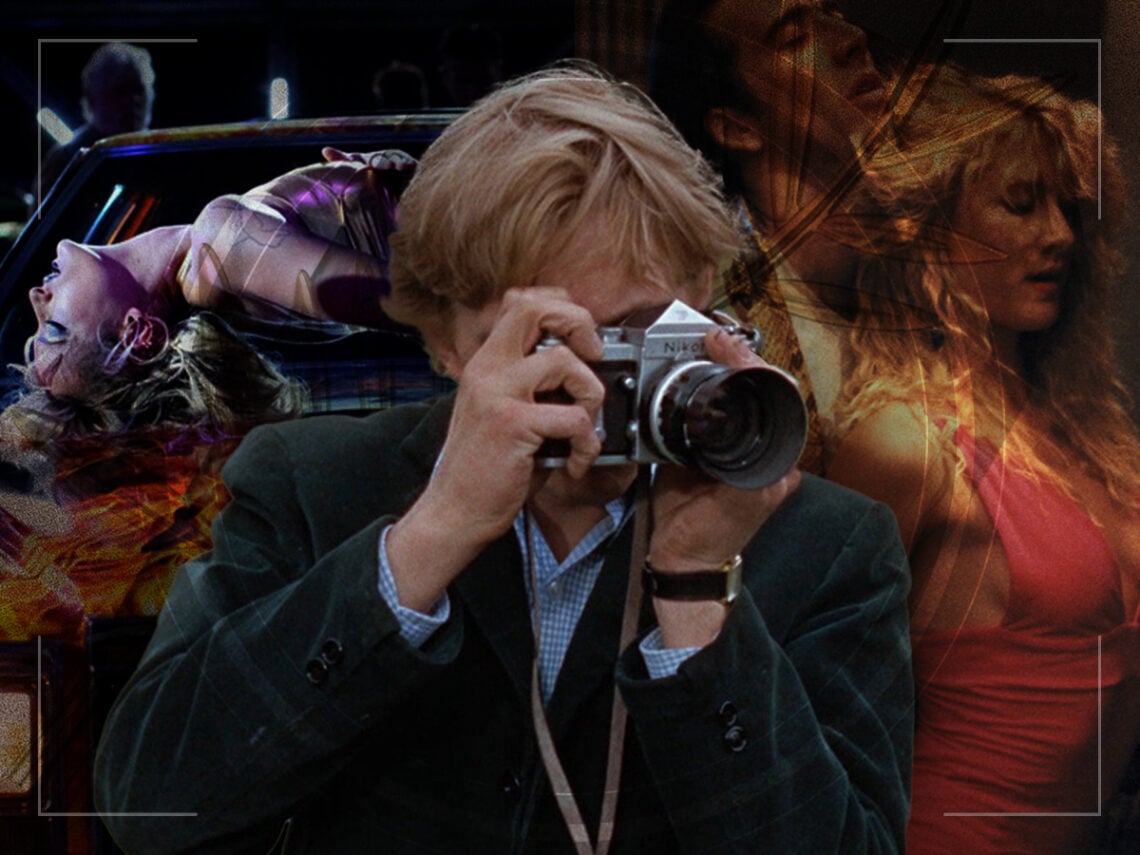
‘Blow Up’ (Michelangelo Antonioni, 1966)

By Cannes standards, Michelangelo Antonioni’s Blow Up is a real crowd-pleaser. Set in the heart of London’s swinging sixties, it stars David Hemmings as a fashion photographer who accidentally captures a murder on film after following a couple in a park. Featuring a score by jazz legend Herbie Hancock, Jane Birkin’s screen debut, and a cameo by The Yardbirds, it perfectly encapsulates mod culture like few other films. It is also a moody, occasionally confounding thriller about voyeurism and memory. It is, quite simply, a masterpiece and a turning point in cinema history, but it was punished for being a trailblazer.
Although met with ecstatic praise at Cannes, Blow-Up proved to be an existential threat to the Hays Code in the United States, which forbade the kind of explicit sexual content it portrayed. Pubic hair and bare nipples were far outside the guidelines, which had been strictly enforced since the 1930s. However, the film proved to be such an internationally successful release that it was the Code, not the film, that lost the battle. Banned from releasing the film in US theatres, MGM rebelled by releasing it under a subsidiary company, a direct challenge that proved to be the final nail in the coffin for the laughably archaic censorship system.
‘If….’ (Lindsay Anderson, 1968)

The trailer for Lindsay Anderson’s satire If…. intones, “It’s a film that will make you take sides. Which side will you be on?” Set in the rarified world of the traditional British Public School, it follows young iconoclast Mick Travis (Malcolm McDowell), who bristles against the casual brutality to which he and his friends are subjected in the name of order and discipline. Things take a surreal turn when he decides to take his petty rebellion to another level, unleashing a bloodbath upon the boarding school that is shockingly violent even by modern standards.
The movie was mostly praised when it was released for its savage takedown of the traditional ‘values’ of the British Public School system, and, in the year 1968, was a perfect illustration of the youthful rage against the establishment that was sweeping the country. It was made even more prescient in the global context. There were mass student protests in Paris, West Germany, and the US, as well as roiling debate over the Vietnam War. Presenting a satirical fantasy in which students resort to mass murder to overthrow tradition hit some critics the wrong way, but it’s safe to say that the film has enjoyed a glowing legacy.
‘Taxi Driver’ (Martin Scorsese, 1976)

Martin Scorsese’s Taxi Driver hardly needs an introduction. These days, it’s considered to be one of the greatest movies of all time. It stars Robert De Niro as a young war veteran in New York who spirals into paranoia and rage against the establishment while driving a taxi through the city streets at night. Although his isolation and turn to violence were the perfect encapsulation of the unsettled era, it still resonates eerily well today.
The film was controversial upon its release, mostly due to its grisly violence and Jodie Foster’s portrayal of a 12-year-old sex worker. When it screened at Cannes, it was met with a torrent of boos from the audience as the credits rolled, but it still went on to win the Palme. When it was set for release in the US, Scorsese had to desaturate the colour from the final shootout sequence to appease the MPAA and avoid an ‘X’ rating, a decision he ultimately felt was to the film’s aesthetic benefit.
‘The Tin Drum’ (Volker Schlöndorff, 1979)

There aren’t many movies that can claim to be part of a contentious court battle, but The Tin Drum can. Based on Günter Grass’s groundbreaking novel of the same name, it follows a young boy in Germany who possesses several superhuman abilities (including the power to shatter glass with his high-pitched screaming), who goes around maniacally banging a toy drum. At age three, he decides to delay his ageing process to avoid becoming like the Nazi-fied adults around him. It’s a dark, satirical, and intensely creepy allegory steeped in Germany’s gruesome past.
When it screened at the Cannes Film Festival, it was met with rapturous praise and shared the Palme d’Or with Francis Ford Coppola’s Apocalypse Now (which, incidentally, was booed at its premiere). When it came time for its release in the US and Canada, however, The Tin Drum faced severe backlash. The problem was two scenes in which the 11-year-old lead actor engages in sexually suggestive activity while playing a stunted teenager. In one scene, he licks powder from a girl’s naval, and in another, he appears to have sex with her.
It was banned in Canada and the state of Oklahoma over claims of child pornography, even as it became one of Germany’s most financially successful international releases. It also went on to win ‘Best Foreign Language Film’ at the Oscars.
‘Wild at Heart’ (David Lynch, 1990)

Like fellow self-proclaimed weirdo John Waters, David Lynch was, by all accounts, an absolutely lovely man who enjoyed making profoundly disturbing movies. He made Wild at Heart directly after Blue Velvet, a film that was utterly shocking and polarising. By comparison, Wild at Heart was almost tame, but it still upset many critics.
It starred Laura Dern and Nicolas Cage as a couple on the run from his parole and her psychotic mother. Like all of Lynch’s films, it is profoundly weird, featuring preoccupations with Elvis Presley and The Wizard of Oz and treading the line between romantic caper and brutally violent exploitation flick.
When it was released, the cult of Lynch was at a fever pitch. During Cannes, there were screens playing episodes of Twin Peaks that drew hordes of fans, but American critics were unimpressed. They condemned the film for being a shallow pastiche of Lynch’s earlier work and asserted that it was rife with superfluous sex and violence. These days, the film is viewed more favourably, but it continues to be overshadowed by Blue Velvet and Mulholland Drive.
‘Elephant’ (Gus Van Sant, 2003)

Gus Van Sant is one of the most consistently surprising directors of the past half-century. From that edgy Nicole Kidman masterpiece To Die For and Good Will Hunting to that mystifying shot-for-shot remake of Psycho starring Vince Vaughan, he refuses to be categorised. In 2003, he pivoted again, making a meandering, almost dreamlike tale of suburban high schoolers based on the Columbine Massacre.
Elephant defies the usual conventions of movies based on real tragedies. Van Sant used non-actors and opted for long takes and improvisation, heightening the sense of low-key realism. The camera follows various teenagers going about their daily lives, two of whom turn out to be the eventual killers. Revisiting a country-shaking tragedy so soon (Columbine happened in 1999) was controversial enough, but doing so in such an unsensationalised, almost banal way was considerably more unsettling than a conventional Hollywood thriller might have been.
It’s likely that if the film were made today, when mass shootings in American schools have become all too common, Elephant would be even more controversial. When it was released at Cannes, it stunned audiences and was met with discomfort by many critics, but it was heaped with praise nonetheless.
‘Fahrenheit 9/11’ (Michael Moore, 2004)

Documentaries don’t often win the Palme. The jury usually opts for a daring feat of pure cinema. However, Michael Moore’s Fahrenheit 9/11 was, if not experimental in technical terms, extremely attention-grabbing in thematic terms. Centring on the US invasion of Iraq under President George W Bush, it took aim specifically at mainstream media and Moore’s contention that it was complicit in the conflict.
It was an explosive movie that sparked a furious debate in America. Moore never attempts to play both sides of the argument, sticking instead to his highly partisan thesis. Critics of the film lambasted him for breaking some sort of unwritten code of ethics for documentary filmmaking, while supporters pointed out that no reporting is ever objective. He was also criticised for cherry-picking and decontextualising facts.
The audience at Cannes embraced it wholeheartedly, delivering a 20-minute standing ovation. It became the first documentary since Jacques Cousteau and Louis Malle’s 1956 underwater odyssey The Silent World to win the festival’s top prize, and it went on to become the highest-grossing documentary of all time, raking in over $222 million at the box office.
‘4 Months, 3 Weeks and 2 Days’ (Cristian Mungiu, 2007)

Cannes often features movies that carry real-world danger. Iranian director Jafar Panahi is a festival mainstay, having debuted films there while awaiting his lengthy prison sentence from the Iranian government. Romanian filmmaker Cristian Mungiu wasn’t in direct danger when he made the abortion drama 4 Months, 3 Weeks and 2 Days, but he was digging up painful memories of the recent past.
Set during the dictatorship of Nicolae Ceaușescu, the film follows a student seeking an illegal abortion with the help of her friend. Mungiu opted for a documentary style, focusing on a nerve-wracking 24 hours in the women’s lives. It avoids sensationalism or judgment and instead focuses on the everyday details of their experience. The result is a tense, anguishing portrait of quiet agony, a film that isn’t enjoyable to watch but served as a timely gut punch that sadly resonates even more today than in 2007.
At Cannes, it won overwhelming praise but suffered a much chillier reception elsewhere. In fact, it became the subject of a scandal when the Academy of Motion Picture Arts and Sciences refused to even shortlist it for the Oscar for ‘Best Foreign Language Film’. Although the Cannes jury often picks more daring films than the Academy, it left many feeling that the Oscars had invalidated themselves.
‘Blue is the Warmest Colour’ (Abdellatif Kechiche, 2013)

Sexually explicit films are nothing new at Cannes, or in French cinema, for that matter. When Blue is the Warmest Colour was released, its prolonged sex scenes generated very little debate, with critics instead expounding on the performances of its lead actors Léa Seydoux and Adèle Exarchopoulos. Set in Paris, the story focuses on the intense romance between the teenage Adèle (Exarchopoulos) and aspiring painter Emma (Seydoux). In a first for the festival, the actors were granted a joint Palme d’Or with director Abdellatif Kechiche.
Even before the Palme was awarded, however, troubling reports began to surface about the conditions behind the scenes. Crew members claimed that Kechiche had harassed them and violated labour laws. Lesbian and feminist critics also came forward to denounce the film as a male fantasy.
Several months later, Exarchopoulos and Seydoux provided their harrowing accounts of the experience, saying that they ‘felt like prostitutes’ and asserted that they wouldn’t make another film with Kechiche. Five years later, Cannes premiered his film Mektoub: My Love, which featured a 13-minute unsimulated sex scene. The actors in that film would later accuse him of plying them with alcohol and relentlessly pressuring them into doing the scene.
‘Titane’ (Julia Ducournau, 2021)

French director Julia Ducournau shocked audiences with her 2021 body horror thriller Titane, a maximalist fever dream about a young woman who is sexually aroused by cars and embarks on a murder spree. Somehow, all that metal, sweat, and blood yielded a touchingly sentimental story, but not surprisingly, it wasn’t for everyone. There were reports of walkouts, and the reviews were mixed and almost universally stunned. “What the fuck did I just witness?” sums up the general tone. It is easily one of the most audacious and unusual films to win the Palme, and it made Ducournau the first female director to win the top prize individually.
Believe it or not, it was not the first body horror movie about car crash victims having sex with automobiles. In 1996, David Cronenberg’s Crash so scandalised audiences that jury president Francis Ford Coppola refused to present the director with the Special Jury Prize he’d been awarded. These days, it, too, is given the respect it deserves.
