


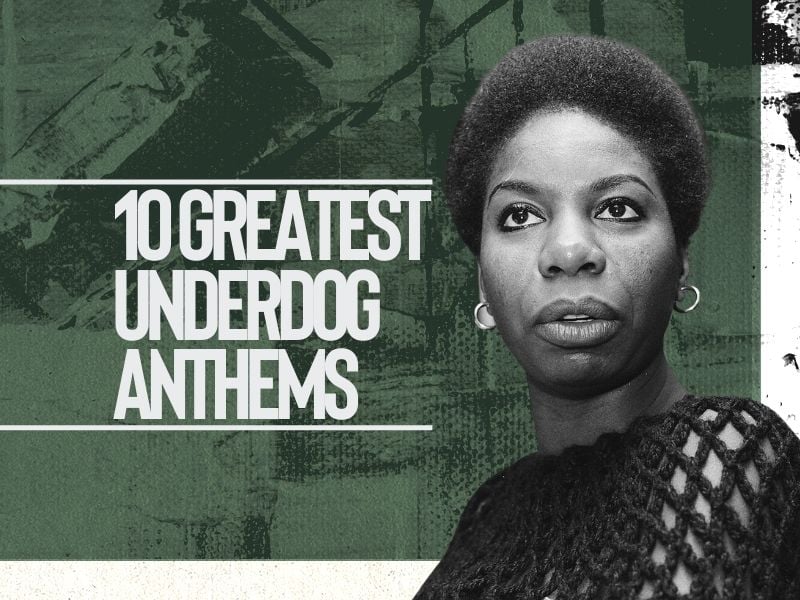
From Radiohead to Nina Simone: The 10 greatest underdog anthems

As somebody who has worked themselves up from a weedy, bookish and athletically-challenged adolescent to a weedy, bookish and athletically- challenged adult with a rented flat and £9,000 of student debt, this writer knows a thing or two about being an underdog. And while it’s not exactly a glamorous character type to fall into, it does have its benefits, the chief of which is probably the number of songs that have been written with you in mind.
Yep, music loves an underdog. Perhaps that’s because so many musicians grew up as outcasts. Although, the fact that Robert Smith was at one time a winger for the Wasps puts a bit of a dent in that particular theory. Either way, there’s no shortage of songs that stick up for the fall guy.
So what makes an underdog, and, more importantly, what makes a great underdog anthem? Let’s start with the first question. Generally speaking, an underdog is someone who is expected to lose by the majority. The so-called underdog mindset, on the other hand, can motivate individuals to work harder than their rivals, something which often leads to them achieving great things against the odds.
This mindset is one of the most essential aspects of a truly great underdog anthem. From Radiohead to Nina Simone, artists have sought to inspire those without hope, convincing them that, although the outlook might not be great, there is always a reason to carry on fighting the status quo.
The 10 greatest underdog anthems:
‘Loser’ – Beck
Though vast swathes of Beck’s 1994 surprise hit make no sense whatsoever (“With the plastic eyeballs, spray paint the vegetables / Dog food stalls with the beefcake pantyhose”), the overall message of ‘Loser’ is clear: don’t let the fuckers get you down.
On release, the track was quickly adopted as an outsider anthem – and with its confrontational refrain of “I’m a loser baby, so why don’t you kill me,” it’s easy to see why. Although, speaking to The Guardian in 1996, Beck explained that the track was never necessarily meant as an anti-establishment encapsulation of slackerdom: “That sort of slacker idea, or the goofy hip-hop guy, I just think it’s silly, it’s not me. It’s like a cartoon. I’m never going to come up with a synopsis, a shorthand version of myself that somebody can just glance at and say, ‘That’s it.'”
‘Teenage Dirtbag’ – Wheatus
On the surface, Teenage Dirtbag’ seems like an obvious example of the ‘horny teenager’ underdog anthem. In this category, the speaker bemoans his inability to get a girlfriend while criticising women for chasing after butch, sporty men. According to Brenden B. Brown, however, ‘Teenage Dirtbag’ actually deals with much darker subject matter. In a 2012 interview with Tonedeaf, the singer explained that the song was inspired by a “Satanic, drug-induced ritual teen homicide that went down; and the kid who did it was called Ricky Kasso, and he was arrested wearing an AC/DC T-shirt,”
Brown continued: “That made all the papers, and the television, obviously; and here I was, 10 years old, walking around with a case full of AC/DC and Iron Maiden and Metallica – and all the parents and the teachers and the cops thought I was some kind of Satan worshipper. So that’s the backdrop for that song. So when I sing: ‘I’m just a teenage dirtbag’, I’m effectively saying: ‘Yeah, f–k you if you don’t like it. Just because I like AC/DC doesn’t mean I’m a devil worshipper, and you’re an idiot. That’s where it comes from.”
‘Underdog’ – Sly & The Family Stone
The first track of Sly and The Family Stones’ debut album, ‘Underdog’ introduced the world to the disco-pioneering outfit with an all-horns-flaring anthem of near-divine perfection.
With saxophonist Jerry Martini’s airy Frère Jacques introduction, SATFS intentionally lure the listener into a false sense of security before unleashing a wave of breakbeat drums, strident horns and lyrics which tell of young Black Americans having to work “twice as good” to gain the same recognition as their white peers.
‘Barracuda’ – Heart
Written as a scathing criticism of the way the music industry treats its female artists, ‘Barracuda’ saw Heart rise up against the soulless corporations at the centre of the business. The 1977 single was written at a time when the band were in a dispute with their label Mushroom Records, which decided to place an ad in a trade publication that implied Ann and Nancy Wilson were lesbians.
According to Anne, ‘Barracuda’ was intended to evoke her rage at being approached by a promoter who urged her to reveal who her “lover” was. Although she initially believed he was talking about her then-boyfriend Michael Fisher, the promoter clarified that he was talking about her sister Nancy. Infuriated by the sleaziness of it all, Anne went up to her hotel room to pen this suitably defiant hit.
‘Common People’ – Pulp
Few Britpop anthems tackled contemporary social issues with the same deftness as Pulp’s ‘Common People’. Released in 1995, the track offers artful criticism of what some have since labelled ‘poverty porn’. Discussing the making of the track in a conversation with Uncut in 2010, Jarvis Cocker explained that ‘common people began life as a three-chord wonder which the frontman wrote on his new Casio keyboard.
When he bought it into the band’s next rehearsal: “Steve (Mackey, bass) started laughing and said, ‘It sounds like (Emerson, Lake & Palmer’s version of) ‘Fanfare For The Common Man.’ I always thought the word ‘common’ was an interesting thing,” Cocker continued.
“It would be used in ‘Fanfare For The Common Man’ as this idea of the noble savage, whereas it was a real insult in Sheffield to call someone ‘common.’ That set off memories of this girl that I met at college. She wanted to go and live in Hackney and be with the common people. She was from a well-to-do background, and there was me explaining that that would never work. I hated all that cobblers you got in films and magazines in which posh people would ‘slum it’ for a while. Once I got that narrative in my head it was very easy to write, lyrically.”
‘Aint Got No, I Got Life’ – Nina Simone
Surely one of the most joyous songs on this list ‘Nina Simone’s 1968 single ‘I Aint Got No/ I Got Life’ has been described both as a Black anthem and a universally-relatable protest against alienation and disenfranchisement.
The track’s brilliance lies in its two-part structure. Featured on ‘Nuff Said, the song is a medley composed of two separate songs, ‘Ain’t Got No and ‘I Got Life’, both from the hit musical Hair. Simone rewrote the two tracks to suit her purpose, using the first half to evoke a sense of despondency and the second to create a feeling of strident, unstoppable optimism.
‘Today’ – Smashing Pumpkins
Since its release on 1993’s Siamese Dream, ‘Today’ has become imbued with a hopefulness that songwriter Billy Corgan didn’t necessarily intend. This is in part thanks to the euphoric opening passage, which sees Smashing Pumpkins drench a simple, plucked melody with layers of velvety fuzz just as the beat kicks in.
The song’s opening line “Today is the greatest day I’ve ever known” may also have aided this misinterpretation. According to Corgan, however, the track was actually written during one of his lowest moments: “I was really suicidal,” he once recalled. “I just thought it was funny to write a song that said today is the greatest day of your life because it can’t get any worse.” Still, the repeated refrain of “Today is the greatest day that I’ve ever known” that closes the track implies a desire to resist the overwhelming power of his depression. This is where the track’s strength resides.
‘You’re No Rock n Roll Fun’ – Sleater Kinney
‘You’re No Rock n Roll Fun’ saw Sleater Kinney criticise how “girl bands” were often treated as less valuable than the wet blanket “guy bands” despite their obvious talent. At its core, ‘You’re No Rock ‘N’ Roll Fun’ is a kickback against a male-dominated industry that fails to recognise female talent even when it’s right under its nose. “Your head’s always up in the clouds / writing your songs, won’t you ever come down?” they sing.
Sleater Kinney understood that groups like ‘Limp Bizkit’ were capable of unleashing pent-up male violence in horrific ways. Woodstock ’99, where the band’s frontman had indirectly encouraged the crowd to engage in violence, had just taken place, and there were numerous sexual assaults reported following the event. In ‘You’re No Rock N Roll Fun’ Sleater Kinney argue that it’s time to party with “the lights on” for a change.
‘Creep’ – Radiohead
If there’s one thing that the ’90s did well, it’s songs about self-loathing. Rich in the melancholy of bands like Nirvana, Smashing Pumpkins, and Radiohead, the era saw the release of a host of classic underdog anthems. ‘Creep’ from Radiohead’s debut album Pablo Honey is perhaps the most archetypal. Written as an attack against the ‘beautiful people’, the 1993 offering is easily relatable to anybody who has ever felt like they don’t conform to the world’s ever-fluctuating beauty standards.
Discussing the track shortly after its release, Yorke said: “I have a real problem being a man in the ’90s… Any man with any sensitivity or conscience toward the opposite sex would have a problem. To actually assert yourself in a masculine way without looking like you’re in a hard-rock band is a very difficult thing to do… It comes back to the music we write, which is not effeminate, but it’s not brutal in its arrogance. It is one of the things I’m always trying: To assert a sexual persona and on the other hand trying desperately to negate it.”
‘Born Under A Bad Sign’ – Albert King
The opening lyrics of this blues classic speak for themselves: “Born under a bad sign / Been down since I begin to crawl / If it wasn’t for bad luck
You know I wouldn’t have no luck at all”. Written by Booker T. Jones, this 1967 Albert King hit is one of the few blues songs to refer to astrology. To be “born under a bad sign” is to be doomed from birth.
Recalling how the track came together, Jones told NPR: “At that time, my writing partner was William Bell. He came over to my house the night before the session. William wrote the words and I wrote the music in my den that night. That was one of my greatest moments in the studio as far as being thrilled with a piece of music. The feeling of it, it’s the real blues done by the real people. It was Albert King from East St. Louis, the left-handed guitar player who was just one of a kind and so electric and so intense and so serious about his music. He just lost himself in the music. He’s such a one-of-a-kind character. I was there in the middle of it and it was exhilarating.”
Stream a playlist of all 10 songs, below.
